Translation
Translation turns an mRNA's message into a polypeptide.
Part 1 · Hook
Why this matters
Since 1982, much of the world's insulin for people with diabetes has been made by bacteria carrying a copy of the human insulin gene. A bacterium has never needed insulin, yet its ribosomes read the human instructions and build the human hormone, amino acid for amino acid. That works because bacteria and people read genes with the same code: the same three-letter words stand for the same amino acids in nearly every living thing.
Part 2 · Before you start
What this builds on
Part 3 · Prerequisite check
Quick check before you start
1. A mature eukaryotic mRNA leaving the nucleus carries
- a 5′ cap, the joined exons and a poly-A tail
- its introns, which are removed in the cytoplasm
- both strands of the gene
Show the answer
Processing in the nucleus adds the cap and tail and splices out introns before export.
- Correct: a 5′ cap, the joined exons and a poly-A tail:
- its introns, which are removed in the cytoplasm:
- both strands of the gene:
2. Amino acids in a polypeptide are joined by
- peptide bonds, formed by dehydration synthesis
- hydrogen bonds between R groups
- phosphodiester bonds
Show the answer
A peptide bond links the carboxyl group of one amino acid to the amino group of the next, releasing water.
- Correct: peptide bonds, formed by dehydration synthesis:
- hydrogen bonds between R groups:
- phosphodiester bonds:
3. What does a tRNA do?
- Carries a specific amino acid to the ribosome
- Carries a gene's message from the nucleus
- Forms the nuclear pores
Show the answer
tRNA is a working RNA that brings amino acids; mRNA carries the message.
- Correct: Carries a specific amino acid to the ribosome:
- Carries a gene's message from the nucleus:
- Forms the nuclear pores:
Part 4 · See it
See it first
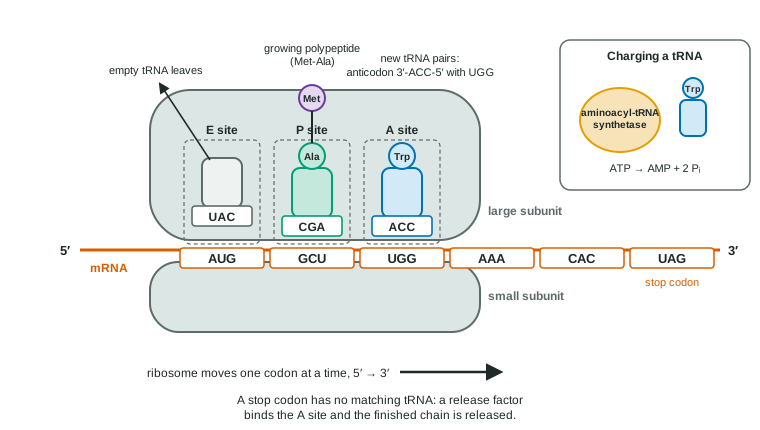
Part 5 · Step by step
How it works, step by step
- Aminoacyl-tRNA synthetases attach each amino acid to the tRNAs that match it, using ATP.Charged tRNAs carry amino acids, each tRNA with an anticodon that fits particular codons.
- The small ribosomal subunit binds the mRNA near its 5′ end and finds the start codon, AUG, with the methionine tRNA.The large subunit joins, with the methionine tRNA in the P site: initiation is complete and the reading frame is set.
- A charged tRNA whose anticodon pairs with the next codon enters the A site.The ribosome forms a peptide bond, moving the growing chain onto that tRNA.
- The ribosome moves one codon toward the mRNA's 3′ end.The chain-carrying tRNA shifts to the P site, the empty tRNA leaves from the E site, and the A site is free: elongation repeats.
- A stop codon (UAA, UAG or UGA) enters the A site, where no tRNA matches it.A release factor binds, the finished polypeptide is released, and the ribosome comes apart: termination.
Part 6 · Key ideas
Key ideas
- Translation builds a polypeptide from an mRNA's codons, three bases each, read 5′ to 3′ in one reading frame from the start codon AUG (methionine) to a stop codon.
- tRNAs link the code to amino acids: each anticodon pairs with a codon, and aminoacyl-tRNA synthetases attach the right amino acid. Ribosomes have A, P and E sites.
- The genetic code (a codon table) has 64 codons for 20 amino acids and stop; it is redundant but not ambiguous, and it is nearly universal, evidence of common ancestry.
- Bacteria translate mRNA while it is still being made (coupled transcription and translation); many ribosomes can read one mRNA (polyribosome). A signal peptide sends a chain into the rough ER.
- Retroviruses such as HIV use reverse transcriptase to copy their RNA into DNA.
Part 7 · Misconception
A common mistake
The wrong idea: tRNA anticodons are written the same way as the codons they read, so the tRNA for UGG has the anticodon UGG.
What actually happens: An anticodon is complementary and antiparallel to its codon: the codon 5′-UGG-3′ pairs with the anticodon 3′-ACC-5′.
Part 8 · Check yourself
Check yourself
Exam-style questions. Anything you miss goes into your review queue.
Model
An mRNA and the genetic code
A bacterial mRNA has the sequence below. Ribosomes start at the first AUG. Spaces are added after every third nucleotide, counting from nucleotide 1 at the 5′ end, to make it easier to read. Use the codon table to answer the questions.
mRNA: 5′-ACG AUG CCU UGG AAG UGC UAG CAU-3′
| Amino acid | Codons |
|---|---|
| Alanine (Ala) | GCU, GCC, GCA, GCG |
| Arginine (Arg) | CGU, CGC, CGA, CGG, AGA, AGG |
| Asparagine (Asn) | AAU, AAC |
| Aspartic acid (Asp) | GAU, GAC |
| Cysteine (Cys) | UGU, UGC |
| Glutamine (Gln) | CAA, CAG |
| Glutamic acid (Glu) | GAA, GAG |
| Glycine (Gly) | GGU, GGC, GGA, GGG |
| Histidine (His) | CAU, CAC |
| Isoleucine (Ile) | AUU, AUC, AUA |
| Leucine (Leu) | UUA, UUG, CUU, CUC, CUA, CUG |
| Lysine (Lys) | AAA, AAG |
| Methionine (Met), also the start signal | AUG |
| Phenylalanine (Phe) | UUU, UUC |
| Proline (Pro) | CCU, CCC, CCA, CCG |
| Serine (Ser) | UCU, UCC, UCA, UCG, AGU, AGC |
| Threonine (Thr) | ACU, ACC, ACA, ACG |
| Tryptophan (Trp) | UGG |
| Tyrosine (Tyr) | UAU, UAC |
| Valine (Val) | GUU, GUC, GUA, GUG |
| Stop (no amino acid) | UAA, UAG, UGA |
1. What polypeptide does this mRNA code for?
- Met-Pro-Trp-Lys-Cys
- Thr-Met-Pro-Trp-Lys-Cys
- Met-Pro-Trp-Lys-Cys-His
- Pro-Trp-Lys-Cys
Show the answer
Start at the first AUG (Met) and read in threes: CCU Pro, UGG Trp, AAG Lys, UGC Cys, then UAG, a stop codon, ends the chain.
- Correct: Met-Pro-Trp-Lys-Cys: Correct: AUG to the codon before UAG.
- Thr-Met-Pro-Trp-Lys-Cys: ACG lies before the start codon, so it is not read.
- Met-Pro-Trp-Lys-Cys-His: UAG is a stop codon; CAU after it is not read.
- Pro-Trp-Lys-Cys: The start codon AUG is read too, and puts methionine first.
2. In a second strain, nucleotide 12 of this mRNA is A instead of G. Predict the polypeptide it codes for.
- Met-Pro, because the third codon read becomes UGA, a stop codon
- Met-Pro-Trp-Lys-Cys, because a single change does not alter the protein
- Met-Pro-Lys-Cys, because the changed codon is skipped by the ribosome
- Met-Pro-Glu-Lys-Cys, because the third codon read now codes for a new amino acid
Show the answer
Nucleotides 10-12 are the third codon read from AUG, UGG (Trp). With A at position 12 it reads UGA, a stop codon, so the chain ends after Met-Pro.
- Correct: Met-Pro, because the third codon read becomes UGA, a stop codon: Correct: UGG → UGA turns tryptophan's codon into a stop.
- Met-Pro-Trp-Lys-Cys, because a single change does not alter the protein: Some single changes leave the amino acid the same, but UGA is a stop codon, so this one shortens the chain.
- Met-Pro-Lys-Cys, because the changed codon is skipped by the ribosome: Ribosomes do not skip codons; a stop codon ends the chain there.
- Met-Pro-Glu-Lys-Cys, because the third codon read now codes for a new amino acid: UGA is not a codon for glutamic acid (GAA or GAG); it is a stop codon.
3. Which tRNA anticodon pairs with the third codon read (UGG)?
- 3′-ACC-5′
- 3′-UGG-5′
- 5′-ACC-3′
- 3′-TCC-5′
Show the answer
The anticodon pairs with the codon antiparallel: codon 5′-UGG-3′ pairs with anticodon 3′-ACC-5′ (U with A, G with C, G with C).
- Correct: 3′-ACC-5′: Correct: complementary and antiparallel.
- 3′-UGG-5′: This repeats the codon; an anticodon is complementary to it.
- 5′-ACC-3′: The bases are complementary, but written this way the anticodon would run parallel to the codon.
- 3′-TCC-5′: tRNA is RNA, so it carries U, not T; and T does not pair with U.
Data table
Protein made from artificial RNAs in a cell-free system
Researchers broke open E. coli cells and removed their DNA and their own mRNA, keeping ribosomes, tRNAs, enzymes, ATP and all twenty amino acids. In each test tube, one amino acid was radioactive. They added an artificial RNA of known sequence, incubated the tubes, and measured the radioactivity built into protein. Values are counts per minute (means of two tubes).
| RNA added | Phenylalanine | Lysine | Proline | Serine | Leucine |
|---|---|---|---|---|---|
| None | 40 | 35 | 50 | 30 | 45 |
| Poly-U (UUUUUU…) | 13,900 | 45 | 60 | 35 | 70 |
| Poly-A (AAAAAA…) | 50 | 9,200 | 55 | 40 | 50 |
| Poly-C (CCCCCC…) | 45 | 40 | 3,100 | 35 | 40 |
| Alternating UC (UCUCUC…) | 60 | 40 | 55 | 4,800 | 4,600 |
4. Alternating UCUCUC… RNA gave a protein containing serine and leucine in strict alternation. How does this support a code read in groups of three?
- Read in threes, the RNA gives UCU and CUC in turn, so two amino acids alternate.
- Read in twos, the RNA gives UC and UC, so it would code for serine and leucine in turn.
- Read in threes, the RNA gives one codon repeated, which is why just two amino acids appear.
- Read in ones, each U and C codes for its own amino acid, so two amino acids alternate.
Show the answer
UCUCUC… read in non-overlapping triplets is UCU-CUC-UCU-CUC…, two different codons in turn, matching the alternating serine and leucine. A two-letter code would read UC-UC-UC…, one codon repeated, giving one amino acid.
- Correct: Read in threes, the RNA gives UCU and CUC in turn, so two amino acids alternate.: Correct: an odd-length codon makes the two codons alternate.
- Read in twos, the RNA gives UC and UC, so it would code for serine and leucine in turn.: Read in twos, every codon would be UC, giving one amino acid repeated, not two alternating.
- Read in threes, the RNA gives one codon repeated, which is why just two amino acids appear.: Triplets from UCUC… alternate between UCU and CUC; they are not one repeated codon.
- Read in ones, each U and C codes for its own amino acid, so two amino acids alternate.: Four bases read singly could code for only four amino acids, and the poly-U, poly-A and poly-C results each give one amino acid, not a mixture.
Experimental setup
Making a secreted protein with and without ER membranes
The mRNA for a protein that pancreas cells secrete was translated in a cell-free system. In some tubes, small sealed vesicles made from rough ER membrane were present. Afterward, a protease (a protein-cutting enzyme) was added: a protein inside a sealed vesicle is protected from it, and a protein outside is digested. Protein size was measured in kilodaltons (kDa).
| Tube | Conditions | Protein size (kDa) | Protected from the protease? |
|---|---|---|---|
| 1 | No ER vesicles | 24 | No |
| 2 | ER vesicles present during translation | 22 | Yes |
| 3 | ER vesicles added after translation had finished | 24 | No |
| 4 | mRNA missing the 60 nucleotides just after the start codon; ER vesicles present during translation | 22 | No |
5. Why is the protein 2 kDa smaller in tube 2 than in tube 1?
- Its signal peptide was cut off after the chain entered the ER vesicles.
- Fewer amino acids were available, so the ribosome stopped early.
- Inside the vesicles, the protease removed part of the protein.
- ER membranes speed up translation, so the chain had less time to grow.
Show the answer
A secreted protein starts with a signal peptide that directs the ribosome to the ER. Once the chain is threaded into the ER, an enzyme there cuts the signal peptide off, so the finished protein is shorter.
- Correct: Its signal peptide was cut off after the chain entered the ER vesicles.: Correct: the first ~20 amino acids are removed inside the ER.
- Fewer amino acids were available, so the ribosome stopped early.: Every tube had all twenty amino acids; the difference depends on the ER being present.
- Inside the vesicles, the protease removed part of the protein.: The protease could not reach protein inside the sealed vesicles; that is why tube 2's protein was protected.
- ER membranes speed up translation, so the chain had less time to grow.: Speed does not change the length; a ribosome reads the mRNA to its stop codon.
6. In tube 3, ER vesicles were added after translation was finished, and the protein was not taken in. What does this show?
- The protein enters the ER while it is being made, as the ribosome builds it.
- The protein enters the ER after it is finished, but just when the cell is intact.
- The ER vesicles in tube 3 were broken, so they could not take up any protein.
- The finished protein is too small to pass through the ER membrane.
Show the answer
In tube 2 the protein entered the vesicles; in tube 3 the same protein, finished first, did not. So entry happens during translation: the signal peptide emerges first and brings the ribosome to the ER, and the chain is threaded in as it grows.
- Correct: The protein enters the ER while it is being made, as the ribosome builds it.: Correct: targeting happens as the chain is made.
- The protein enters the ER after it is finished, but just when the cell is intact.: Nothing in the data points to a need for an intact cell; the timing of adding the vesicles is the only difference from tube 2.
- The ER vesicles in tube 3 were broken, so they could not take up any protein.: The same kind of vesicles took in the protein in tube 2; nothing suggests tube 3's were damaged.
- The finished protein is too small to pass through the ER membrane.: The protein is the same size as in tube 1, and the same protein entered in tube 2, so size is not the reason.
7. An mRNA reads 5′-GAUGCAUGCCAAAUGG…-3′. Ribosomes normally start at the first AUG. If a ribosome started at the second AUG, four nucleotides later, every amino acid after the first would differ. Why?
- Codons are read in non-overlapping threes, so starting 4 bases later shifts the reading frame.
- The second AUG codes for a different amino acid, and that change is passed down the rest of the chain.
- A ribosome that starts late skips each fourth nucleotide, so each codon it reads is new.
- Each amino acid depends on the one before it, so changing the first changes the rest.
Show the answer
From the first AUG the codons are AUG-CAU-GCC-AAA-UGG…; from the second they are AUG-CCA-AAU-GG…. Four is not a multiple of three, so every codon is grouped differently: a new reading frame.
- Correct: Codons are read in non-overlapping threes, so starting 4 bases later shifts the reading frame.: Correct: the grouping into triplets shifts.
- The second AUG codes for a different amino acid, and that change is passed down the rest of the chain.: AUG always codes for methionine; the change comes from how later bases are grouped.
- A ribosome that starts late skips each fourth nucleotide, so each codon it reads is new.: The ribosome reads every nucleotide in order, three at a time; it does not skip any.
- Each amino acid depends on the one before it, so changing the first changes the rest.: Each codon is read on its own; one amino acid does not determine the next.
Part 9 · Summary
Summary
Translation turns an mRNA's message into a polypeptide. The message is read in codons, three nucleotides each, in one reading frame set by the start codon AUG (methionine) and ended by a stop codon (UAA, UAG or UGA). Aminoacyl-tRNA synthetases load each tRNA with its amino acid; a tRNA's anticodon pairs with the codon in the ribosome. In initiation the ribosome assembles at the start codon; in elongation charged tRNAs enter the A site, peptide bonds form, and the ribosome moves one codon at a time, tRNAs passing from the A to the P to the E site; at termination a release factor frees the chain. The genetic code is nearly universal, evidence of common ancestry. Bacteria couple transcription and translation; polyribosomes make many copies at once. A signal peptide directs a chain into the rough ER. Retroviruses copy RNA into DNA with reverse transcriptase.
Part 10 · Up next
What comes next
Part 11 · Connections