Living things are built from four kinds of large molecules. This page explains what makes a molecule "large", how cells build these molecules from small pieces, and how they take them apart again. One reaction builds; its reverse breaks down. Both involve water.
Monomers, polymers and macromolecules
A macromolecule is a very large molecule, often made of thousands of atoms. Most macromolecules are polymers ("many parts"): long chains of small, similar units called monomers ("one part"), joined one after another by covalent bonds. Think of a polymer as a bead necklace. The beads are monomers, and the string between each pair of beads is a covalent bond.
A polymer can be made of one kind of monomer repeated (like a necklace of identical beads) or of several kinds in a particular order (like a necklace of 20 colors of bead, where the color order spells out a message). Both kinds matter in biology.
The four groups
| Group | Building blocks | Elements | Polymer? | Main roles |
|---|---|---|---|---|
| Carbohydrates | Single sugar units | C, H, O | Yes (the large ones) | Energy storage, structure |
| Proteins | Amino acids (20 kinds) | C, H, O, N, some S | Yes | Speeding up reactions, structure, transport, signaling, movement |
| Nucleic acids | Units named in the Nucleic Acids topic (4 kinds in DNA) | C, H, O, N, P | Yes | Storing and using the information in genes |
| Lipids | Various smaller molecules, not a repeating chain | Mostly C, H, a little O (some P) | No | Long-term energy storage, waterproofing, cell boundaries, signals |
Lipids are the exception. Some are big, and they are built from smaller pieces, but they are not long chains of repeating monomers, so they are not true polymers.
Chemical reactions
A chemical reaction breaks some covalent bonds and forms new ones, turning starting molecules, the reactants, into new molecules, the products. Atoms are rearranged, never created or destroyed, so the products contain exactly the same atoms as the reactants. That bookkeeping rule is the key to everything on this page.
Building a polymer: dehydration synthesis
Look at the top half of Figure 1. To join two monomers:
- One monomer gives up a hydroxyl group (–OH) from one end.
- The other gives up a hydrogen atom (–H) from its end.
- The –OH and –H combine to form a water molecule, H2O, which is released.
- The two monomers are now joined by a new covalent bond where those atoms used to be.
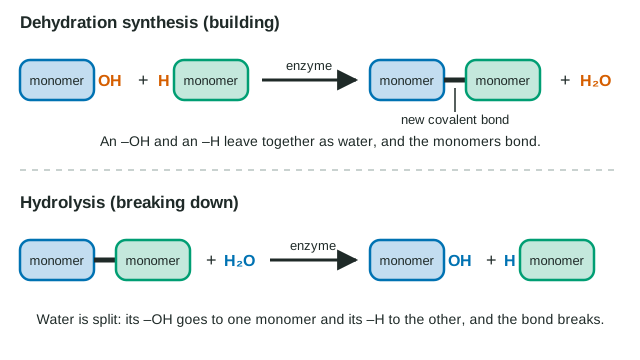
The name says it: "dehydration" (water removed) "synthesis" (building). It is also called a condensation reaction. Repeat it again and again at the end of the chain and you get a polymer.
Worked example: counting water. A cell links 50 identical sugar monomers into one straight chain. How many water molecules are released?
Each bond releases one water. A chain of 50 beads has 49 strings between them, so 49 water molecules. In general, a straight chain of n monomers releases n − 1 water molecules.
Follow-up: if each monomer has a mass of 180 (in daltons, the unit for molecule masses) and water is 18, what is the mass of the chain? 50 × 180 − 49 × 18 = 9,000 − 882 = 8,118 daltons. The chain weighs less than its separate monomers by the water it lost.
Breaking a polymer: hydrolysis
Hydrolysis ("splitting with water") is dehydration synthesis in reverse (bottom half of Figure 1). A water molecule is split across the bond between two monomers: its –H attaches to one monomer and its –OH to the other, and the bond breaks. Digestion is mostly hydrolysis: the large molecules in food are cut into monomers small enough to be absorbed into the blood.
Worked example: does mass go up or down? A 9.0 g sample of a sugar polymer is completely hydrolyzed. Is the total mass of the monomers produced more than, less than or equal to 9.0 g?
Hydrolysis adds the atoms of one water molecule for every bond broken, and those atoms stay in the monomers. So the monomers weigh more than 9.0 g, about 10 g for a long sugar chain, where each 162 units of polymer mass become 180 units of monomer.
Enzymes make it fast
On its own, hydrolysis of a polymer in water can take years. Cells speed it up with enzymes: proteins that speed up chemical reactions such as hydrolysis and dehydration synthesis. A different enzyme handles each kind of polymer: the enzyme in your saliva that cuts sugar chains does nothing to proteins. You will learn how enzymes work in Unit 3.
Structure determines function
The order and way in which monomers are linked decide the overall shape of a macromolecule, and its shape decides what it can do. Two polymers built from the very same sugar monomer can be a soft, digestible energy store or a tough fiber that most animals cannot digest, just because the monomers are linked at slightly different angles (you will see exactly how in the Carbohydrates topic). This idea, structure determines function, runs through the whole course.