Nucleic acids store and use the instructions that build and run every living thing. DNA keeps the instructions; RNA carries out several jobs in using them. This page shows how they are built, why DNA's two strands fit together the way they do, and how a sequence of chemical letters can hold information.
Nucleotides: the monomers
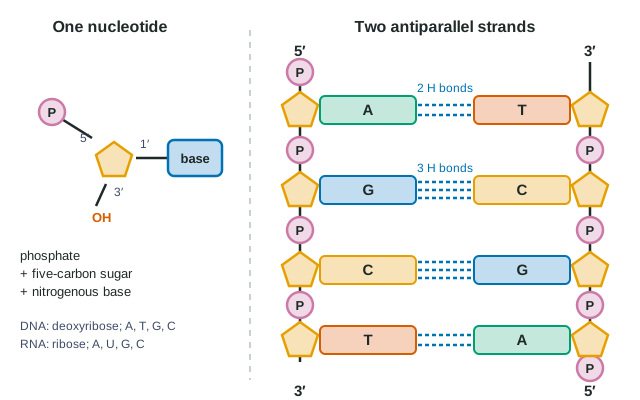
Nucleic acids are polymers. Their monomers, nucleotides, each have three parts (Figure 1):
- A phosphate group, which is negatively charged.
- A five-carbon sugar (a pentose). Its carbons are numbered 1′ to 5′ ("one prime" to "five prime"). In DNA the sugar is deoxyribose; in RNA it is ribose, which has one extra –OH group, on carbon 2′. "Deoxy-" means "missing an oxygen".
- A nitrogenous base, a ring-shaped molecule containing nitrogen, attached to carbon 1′. DNA uses four: adenine (A), thymine (T), guanine (G) and cytosine (C). RNA uses A, G and C too, but uracil (U) in place of thymine.
Building a strand: the sugar-phosphate backbone
Nucleotides join by dehydration synthesis. The phosphate on the 5′ carbon of the incoming nucleotide bonds to the –OH on the 3′ carbon of the last sugar in the chain, releasing water. The covalent link, sugar–phosphate–sugar, is a phosphodiester bond. Repeat it and you get a long strand with a sugar-phosphate backbone, sugar and phosphate alternating, and the bases sticking out to one side.
The two ends of a strand are different, so a strand has a direction:
- The 5′ end has a free phosphate on a 5′ carbon.
- The 3′ end has a free –OH on a 3′ carbon. New nucleotides are always added here, so strands grow 5′ to 3′.
By convention a sequence is written from its 5′ end to its 3′ end: 5′-ATGC-3′ means A is at the 5′ end.
Two strands: complementary base pairing
DNA usually has two strands. They are held together by hydrogen bonds between bases on opposite strands, and the bases fit together only in specific pairs:
- A pairs with T, joined by two hydrogen bonds.
- G pairs with C, joined by three hydrogen bonds.
Each pair matches one of the larger, two-ring bases (A, G) with one of the smaller, one-ring bases (T, C), so every rung of the ladder is the same width. Because of this rule, the sequence of one strand fixes the sequence of the other: the strands are complementary. That is why, in any double-stranded DNA, the amount of A equals the amount of T and the amount of G equals the amount of C.
Worked example: base percentages. A sample of double-stranded DNA is 18% cytosine. What are the percentages of the other bases?
C pairs with G, so G = 18%. Together G + C = 36%, leaving 100 − 36 = 64% for A + T, and A = T, so A = 32% and T = 32%. (This works only for double-stranded DNA; in a single strand nothing forces A to equal T.)
Antiparallel strands and the double helix
The bases line up properly only when the two strands run in opposite directions: one strand 5′ to 3′, its partner 3′ to 5′. The strands are antiparallel. The two strands then twist around each other into a double helix, like a ladder twisted along its length: the sugar-phosphate backbones are the rails, outside, and the base pairs are the rungs, inside.
Worked example: writing the partner strand. One strand reads 5′-GATTACA-3′. Write the complementary strand from its 5′ end.
Step 1, pair each base: G→C, A→T, T→A, T→A, A→T, C→G, A→T, giving 3′-CTAATGT-5′ (it runs the opposite way). Step 2, write it from its 5′ end by reversing it: 5′-TGTAATC-3′.
The hydrogen bonds between strands are weak, so heating DNA to about 90 to 95 °C separates the two strands, while each strand's covalent backbone stays intact. DNA rich in G–C pairs takes a higher temperature to separate than DNA rich in A–T pairs.
DNA and RNA compared
| DNA | RNA | |
|---|---|---|
| Sugar | Deoxyribose (no –OH on 2′) | Ribose (–OH on 2′) |
| Bases | A, T, G, C | A, U, G, C |
| Strands | Usually double-stranded, a double helix | Usually single-stranded (it can fold back on itself) |
| Base pairs | A–T, G–C | A–U, G–C (where it pairs) |
| Main job | Long-term storage of genetic information | Several jobs in using that information |
Sequence is information
Every DNA molecule has the same backbone, so the backbone cannot carry a message. The order of the bases can. Four letters can spell an enormous number of sequences: a stretch just 10 bases long can be arranged in 410, over a million, different ways. This base sequence is the genetic information. A gene is a particular stretch of DNA whose sequence the cell uses, often as the instructions for building one protein. Two DNA samples can contain exactly the same percentages of A, T, G and C and still carry completely different information, just as "listen" and "silent" use the same letters.
Complementary pairing also explains how the information is copied: separate the strands, and each can guide the building of a new partner, base by base. You will see how in Unit 4 and Unit 6.