Evolution is a change in the inherited traits of a population over generations. This page explains the main mechanism that drives it, natural selection: what it needs, how it works step by step, and how biologists measure who "wins" (fitness). It is the foundation for the whole of Unit 7.
Populations evolve, individuals do not
A population is a group of individuals of the same species that live in the same place at the same time and can breed with one another: the mice on one stretch of dunes, the oak trees in one valley. An individual's alleles are fixed when it is conceived. It can grow, learn and get stronger, but it cannot change the alleles it passes on. What can change is the population: which alleles are common, and so which traits are common, from one generation to the next. That is what "evolution" means in biology.
Darwin, Wallace and descent with modification
In the 1830s and 1840s, Charles Darwin gathered evidence on the voyage of HMS Beagle and at home, from island birds to pigeons bred by hobbyists. Alfred Russel Wallace, collecting animals in what is now Malaysia and Indonesia, reached the same idea independently and wrote to Darwin about it in 1858. Their papers were read together in London that year, and Darwin's book On the Origin of Species came out in 1859. Darwin described evolution as descent with modification: the species alive today descend from earlier species and have changed, generation by generation, along the way. Natural selection was their explanation for how.
Four observations, one conclusion
The argument rests on facts anyone can check:
- Individuals vary. No two mice, beetles or sunflowers are exactly alike.
- Much of the variation is heritable. Offspring tend to resemble their parents, because the differences come partly from different alleles. This is heritable variation. (Mutation makes alleles that did not exist before; meiosis and fertilization shuffle them into new combinations.)
- Populations overproduce. A cod releases millions of eggs, an oak drops thousands of acorns, yet each population stays roughly the same size. This overproduction of offspring means most die before reproducing.
- Resources are limited. Food, water, space, nest sites and mates run short, so individuals compete for limited resources, and predators, disease and weather remove many more.
Conclusion: who survives and reproduces is not random with respect to traits. Individuals whose heritable traits suit the current environment leave more surviving offspring, which is differential reproductive success, and their alleles become more common. Over many generations, the population changes.
The logic step by step
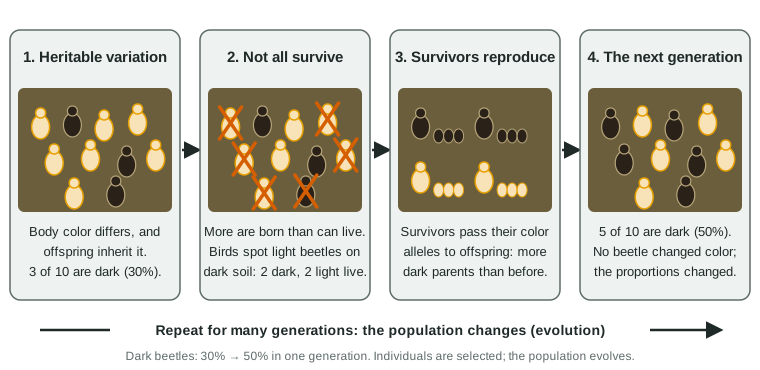
Follow the beetles in Figure 1. Body color is inherited, and the population has both dark and light beetles. More beetles hatch than the soil can feed, and birds hunting by sight find light beetles on dark soil more easily. The survivors are mostly dark, so the next generation is too. The birds are the selective pressure: the feature of the environment that makes one heritable trait leave more offspring than another. Drought, cold, disease, competitors and predators are all selective pressures.
Notice three things. First, the variation existed before the birds arrived: selection sorts variation, it does not create it. Second, no beetle "tried" to be dark; the change is in the proportions. Third, the result depends on the environment. On pale sand, the same birds would favor light beetles.
Fitness: counted in offspring
In everyday speech, "fit" means strong or healthy. In biology, fitness is reproductive success: the number of an individual's offspring that survive to reproduce themselves. A huge, long-lived stag that fathers two surviving fawns has lower fitness than a small stag that fathers seven. Strength, speed and long life matter only through their effect on offspring.
Biologists compare types with relative fitness: divide each type's average number of surviving offspring by that of the most successful type, which then has relative fitness 1.
Worked example: relative fitness. In a meadow plant, purple-flowered plants leave on average 8.0 offspring that survive to flower, white-flowered plants 6.0 and pink-flowered plants 5.0.
Step 1. Find the most successful type: purple, 8.0. Step 2. Divide each type by it: purple 8.0 ÷ 8.0 = 1.00; white 6.0 ÷ 8.0 = 0.75; pink 5.0 ÷ 8.0 = 0.63 (to two decimal places). Step 3. Interpret: for every 100 surviving offspring a purple plant leaves, a pink plant leaves about 63. If flower color is heritable, purple will become more common.
Notice that the plant with the most seeds is not automatically the fittest. What counts is offspring that survive to reproduce.
What natural selection is not
| Mistaken idea | What actually happens |
|---|---|
| Organisms get the traits they need | Mutations arise at random; selection favors whatever helpful variation already exists. If none exists, the population may decline instead. |
| Traits gained during life are inherited | A giraffe that stretches, or a person who lifts weights, does not change the DNA in its gametes, so the change is not passed on. |
| "Survival of the fittest" means the strongest win | Fitness is surviving offspring. Survival matters only because dead individuals do not reproduce. |
| Individuals evolve | Individuals are selected; the population's makeup changes across generations. |
| Selection aims at a perfect design | Selection has no goal. It favors whatever works better in the present environment, and that changes when the environment does. |