Introduction to Natural Selection
Natural selection is a main mechanism of evolution, proposed independently by Charles Darwin and Alfred Russel Wallace.
Part 1 · Hook
Why this matters
On the white sand dunes of Florida's Gulf coast, beach mice have pale coats. A few miles inland, mice of the same species living on dark soil are brown. No mouse ever chose its color or changed it. Owls hunting at night catch mice that stand out from the ground more often, and over many generations that difference in who survives, and who has pups, has made each population match its ground. This is natural selection, the idea Charles Darwin and Alfred Russel Wallace worked out in the 1850s.
Part 2 · Before you start
What this builds on
Part 3 · Prerequisite check
Quick check before you start
1. Where do alleles that never existed before come from?
- Random mutations in DNA
- The environment directing which genes change
- Meiosis creating new genes in each gamete
Show the answer
A mutation is a random change in the base sequence; it is how alleles that never existed before arise. Meiosis reshuffles existing alleles but does not invent new ones.
- Correct: Random mutations in DNA:
- The environment directing which genes change:
- Meiosis creating new genes in each gamete:
2. How does meiosis make offspring of the same parents differ from one another?
- Crossing over and independent assortment give each gamete a new combination of alleles
- Each gamete receives a complete copy of both parents' chromosomes
- Mitosis after fertilization shuffles the alleles
Show the answer
Crossing over swaps segments between homologs, and each homologous pair lines up independently, so every gamete carries a different mix.
- Correct: Crossing over and independent assortment give each gamete a new combination of alleles:
- Each gamete receives a complete copy of both parents' chromosomes:
- Mitosis after fertilization shuffles the alleles:
3. An organism's phenotype is
- its observable traits, produced by its genotype and its environment
- the set of alleles it carries
- the traits it will pass on, whatever its genes
Show the answer
The genotype is the alleles; the phenotype is what those alleles, together with the environment, produce.
- Correct: its observable traits, produced by its genotype and its environment:
- the set of alleles it carries:
- the traits it will pass on, whatever its genes:
Part 4 · See it
See it first
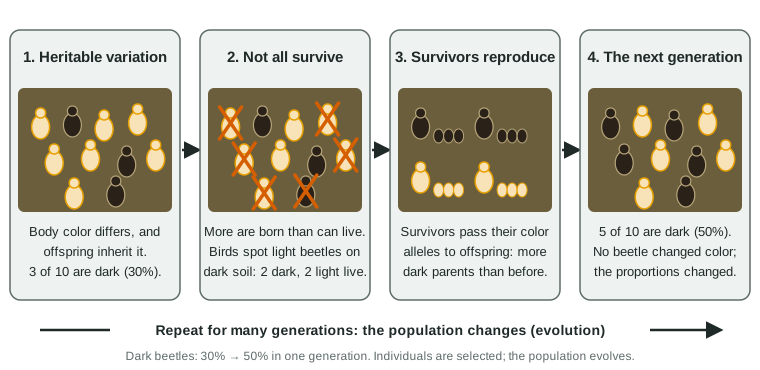
Part 5 · Step by step
How it works, step by step
- Mutations and the shuffling of alleles in meiosis make individuals in a population differ, and some of those differences are inherited.The population carries heritable variation: offspring tend to resemble their parents in these traits.
- Populations produce more offspring than food, space and other resources can support.Individuals compete for limited resources and face predators, disease and harsh weather, so many die before they reproduce.
- Some heritable traits make survival or reproduction more likely in the current environment, such as a coat that matches the ground where owls hunt.Individuals with those traits leave more surviving offspring than others: differential reproductive success.
- Parents pass their alleles to their offspring.The next generation has a higher proportion of individuals with the helpful trait than the last one.
- The same pressure acts generation after generation.The population's makeup changes over time: evolution by natural selection. Individuals do not change their inherited traits; the proportions in the population do.
Part 6 · Key ideas
Key ideas
- Natural selection needs three things: heritable variation in a trait, more offspring than can survive, and differences in survival or reproduction linked to that trait.
- Charles Darwin and Alfred Russel Wallace proposed it independently (1858); Darwin called evolution descent with modification.
- Fitness is reproductive success: the number of offspring that survive to reproduce, not strength or lifespan. Relative fitness = a type's offspring ÷ the best type's offspring.
- A selective pressure is a feature of the environment, such as a predator, drought or disease, that makes some heritable traits leave more offspring than others.
- Selection acts on individuals, but a population is what evolves, and it can only act on variation that already exists.
Part 7 · Misconception
A common mistake
The wrong idea: Animals develop the traits they need, and those changes are passed to their offspring, so a population of mice on light sand turns pale because pale coats help them hide.
What actually happens: No mouse changes its inherited coat because it would help. Pale and dark alleles already exist in the population, owls catch more of the mice that stand out, and the survivors' alleles fill the next generation. Changes an individual makes during its life do not alter the DNA in its gametes.
Part 8 · Check yourself
Check yourself
Exam-style questions. Anything you miss goes into your review queue.
Experimental setup
Coat color and survival in outdoor enclosures
In a species of mouse, coat color is either light or dark. Researchers built eight identical outdoor enclosures, four with light sandy soil and four with dark soil. Into each enclosure they released 10 light-coated and 10 dark-coated adult mice of the same age and size. In six enclosures, owls that hunt at night could fly in; two enclosures (one of each soil) were covered with netting that kept owls out. After four weeks the researchers trapped every surviving mouse. Results for the enclosures of each kind were combined.
| Soil | Owls | Coat | Released | Alive after 4 weeks |
|---|---|---|---|---|
| Light sand | Present | Light | 30 | 23 |
| Light sand | Present | Dark | 30 | 10 |
| Dark soil | Present | Light | 30 | 9 |
| Dark soil | Present | Dark | 30 | 21 |
| Light sand | Kept out | Light | 10 | 9 |
| Light sand | Kept out | Dark | 10 | 9 |
| Dark soil | Kept out | Light | 10 | 9 |
| Dark soil | Kept out | Dark | 10 | 8 |
1. Which statement best describes the results?
- With owls, mice matching the soil survived at about twice the rate of mismatched mice; without owls, both coats survived well.
- Light-coated mice survived better than dark-coated mice on both soils, whether or not the owls could reach them to hunt.
- With owls present, survival was similar for both coats, but it differed between coats once the owls were kept out.
- Dark soil lowered the survival of both coat colors compared with light sand, with or without owls.
Show the answer
On light sand with owls, 23 of 30 light mice (77%) survived against 10 of 30 dark mice (33%); on dark soil the pattern reversed, 21 of 30 dark (70%) against 9 of 30 light (30%). Without owls, 8 or 9 of 10 survived in every group.
- Correct: With owls, mice matching the soil survived at about twice the rate of mismatched mice; without owls, both coats survived well.: Correct: matched mice survived at roughly twice the rate of mismatched mice when owls could hunt, and the difference disappeared without owls.
- Light-coated mice survived better than dark-coated mice on both soils, whether or not the owls could reach them to hunt.: On dark soil the dark mice survived better (21 of 30 against 9 of 30), so light coats were not better on both soils.
- With owls present, survival was similar for both coats, but it differed between coats once the owls were kept out.: This reverses the data: the large difference between coats appears with owls, and survival is similar without them.
- Dark soil lowered the survival of both coat colors compared with light sand, with or without owls.: Dark-coated mice survived well on dark soil; survival depended on the match between coat and soil, not on the soil alone.
2. Why did the researchers include enclosures covered with netting?
- To test whether owls cause the survival differences, with everything else kept the same
- To find out which coat color owls prefer to eat when they are offered both colors at once
- To let the mice breed undisturbed so that the coat colors of their offspring could be counted
- To measure how much the coats of the protected mice changed color during the four weeks
Show the answer
The netted enclosures are a control: same soils, same mice, same time, but no owls. Survival there was high and similar for both coats, so the differences in the open enclosures can be attributed to owls.
- Correct: To test whether owls cause the survival differences, with everything else kept the same: Correct: removing only the owls tests whether they are the cause of the difference.
- To find out which coat color owls prefer to eat when they are offered both colors at once: No owls could reach the netted enclosures, so they cannot show what owls choose.
- To let the mice breed undisturbed so that the coat colors of their offspring could be counted: The study lasted four weeks and counted adults that survived; it did not count offspring.
- To measure how much the coats of the protected mice changed color during the four weeks: Coat color in adult mice is inherited and does not change to match the soil; the netting was not there to measure color change.
3. Coat color in this species is inherited. A wild population of these mice on light sand starts with 50% dark-coated mice, and owls keep killing mice at the rates in the table. Which prediction is best supported?
- Over generations the percentage of dark mice falls, because dark mice leave fewer surviving offspring.
- Dark mice gradually grow lighter coats as they spend more of their lives on light sand.
- The percentage of dark mice stays at 50%, because coat color is set by alleles, not by owls.
- Dark mice vanish from the population in a single generation, because 67% of them die.
Show the answer
Dark mice survive at less than half the rate of light mice on light sand, so fewer dark parents breed, and the dark allele makes up a smaller share of each new generation.
- Correct: Over generations the percentage of dark mice falls, because dark mice leave fewer surviving offspring.: Correct: differential survival, repeated each generation, shifts the proportions.
- Dark mice gradually grow lighter coats as they spend more of their lives on light sand.: Adult mice do not change their inherited coat color in response to the soil.
- The percentage of dark mice stays at 50%, because coat color is set by alleles, not by owls.: Owls do not change any mouse's alleles, but they change which mice survive to pass their alleles on, so the proportions change.
- Dark mice vanish from the population in a single generation, because 67% of them die.: A third of dark mice survive and breed, so dark mice decline over several generations rather than disappearing at once.
4. Put the steps of natural selection in a population of beetles on dark soil in order.
- Beetles differ in color, and color is inherited.
- More beetles hatch than the soil can feed, and birds hunt them.
- Birds catch more light beetles, which stand out on dark soil.
- Dark survivors leave more offspring than light survivors.
- The next generation has a higher proportion of dark beetles.
Show the answer
Heritable variation comes first; overproduction and a selective pressure mean not all survive; the trait affects who survives; survivors reproduce; the population's makeup shifts.
- Correct order: 1. Beetles differ in color, and color is inherited. 2. More beetles hatch than the soil can feed, and birds hunt them. 3. Birds catch more light beetles, which stand out on dark soil. 4. Dark survivors leave more offspring than light survivors. 5. The next generation has a higher proportion of dark beetles.
5. An old explanation for giraffes' long necks says that each giraffe stretched its neck to reach high leaves, its neck grew a little longer, and its offspring inherited the longer neck. What is the main flaw in this explanation?
- Changes made to the body during life do not alter the DNA in gametes, so they are not inherited.
- Giraffes could not have stretched their necks, because the length of a neck is fixed at birth.
- It leaves out mutation, which on its own would lengthen the necks of a whole herd within one generation.
- Acquired traits can be inherited, but neck length is too complex a trait to be passed to offspring.
Show the answer
Inheritance runs through the alleles in gametes. Stretching does not change those alleles, so a stretched neck is not passed on. Selection explains long necks through inherited differences in neck length that already existed.
- Correct: Changes made to the body during life do not alter the DNA in gametes, so they are not inherited.: Correct: traits acquired during life are not inherited.
- Giraffes could not have stretched their necks, because the length of a neck is fixed at birth.: Necks grow after birth; the flaw is not about stretching but about inheritance.
- It leaves out mutation, which on its own would lengthen the necks of a whole herd within one generation.: A mutation changes one individual's alleles at random; it does not lengthen necks across a population in one generation.
- Acquired traits can be inherited, but neck length is too complex a trait to be passed to offspring.: Neck length is heritable; what is not inherited is a change acquired by stretching.
6. Which deer has the highest fitness?
- A small male that lives 4 years and fathers 7 fawns that survive to breed
- A large male that lives 15 years and fathers 3 fawns that survive to breed
- A female that lives 12 years and gives birth to 10 fawns, 2 of which survive to breed
- A male that wins the most fights in the herd and fathers 1 fawn that survives to breed
Show the answer
Fitness is the number of offspring that survive to reproduce. The small male leaves 7, more than any other deer listed, whatever its size or lifespan.
- Correct: A small male that lives 4 years and fathers 7 fawns that survive to breed: Correct: 7 offspring that breed is the highest reproductive success here.
- A large male that lives 15 years and fathers 3 fawns that survive to breed: Size and a long life matter only through offspring; 3 breeding fawns is fewer than 7.
- A female that lives 12 years and gives birth to 10 fawns, 2 of which survive to breed: Ten fawns born, but only 2 reach breeding age, so this female's fitness is 2.
- A male that wins the most fights in the herd and fathers 1 fawn that survives to breed: Winning fights is not fitness unless it leads to offspring; this male leaves 1.
7. After a hurricane swept over a small island, the lizards that survived had larger toe pads, on average, than lizards measured on the island just before the storm. Which additional finding would best support the claim that the population evolved?
- The survivors' offspring, raised in the same conditions as earlier lizards' offspring, also have larger toe pads.
- The survivors' toe pads grew larger in the months after the storm, as they climbed in damaged trees.
- Lizards with large toe pads were seen clinging to branches during the storm while others were blown away.
- The survivors were older, and so had larger bodies and feet, on average, than the lizards measured before the storm.
Show the answer
Evolution is a change in the inherited makeup of a population across generations. If the survivors' offspring, raised in the same conditions, also have larger toe pads, the difference is heritable and the next generation has shifted.
- Correct: The survivors' offspring, raised in the same conditions as earlier lizards' offspring, also have larger toe pads.: Correct: it shows the change is inherited and appears in the next generation.
- The survivors' toe pads grew larger in the months after the storm, as they climbed in damaged trees.: Growth during an individual's life is not inherited, so this would weaken the claim.
- Lizards with large toe pads were seen clinging to branches during the storm while others were blown away.: This shows how survivors were selected within one generation, but not that the trait is inherited by the next.
- The survivors were older, and so had larger bodies and feet, on average, than the lizards measured before the storm.: Age differences would offer another explanation for larger pads, weakening the claim rather than supporting it.
8. Which statement about natural selection is correct?
- It acts on individuals, but its effect is a change in the population's traits over generations.
- It changes the inherited traits of individuals so that each one fits its environment better.
- It acts on whole populations by making the individuals more similar within a single generation.
- It works toward a goal: the best possible version of each trait for the environment a population lives in.
Show the answer
Individuals survive and reproduce or do not; that is where selection acts. The result, a shift in which traits are common, appears in the population across generations.
- Correct: It acts on individuals, but its effect is a change in the population's traits over generations.: Correct: individuals are selected, populations evolve.
- It changes the inherited traits of individuals so that each one fits its environment better.: An individual's inherited traits do not change; which individuals reproduce changes.
- It acts on whole populations by making the individuals more similar within a single generation.: Selection's effect accumulates over generations; it does not reshape a population's individuals within one.
- It works toward a goal: the best possible version of each trait for the environment a population lives in.: Selection has no goal; it favors whatever works better now, and that changes when the environment changes.
Part 9 · Summary
Summary
Natural selection is a main mechanism of evolution, proposed independently by Charles Darwin and Alfred Russel Wallace. Individuals in a population differ, and some of the differences are heritable. Populations produce more offspring than resources can support, so individuals compete and many die before reproducing. Those whose heritable traits suit the current environment survive and reproduce more, so their alleles become more common in the next generation; repeated over many generations, the population changes. Fitness is measured by reproductive success, the number of offspring that survive to reproduce, and relative fitness compares types with the most successful one. A selective pressure is the feature of the environment that causes these differences. Selection acts on individuals and on variation that already exists; populations, not individuals, evolve.
Part 10 · Up next
What comes next
Part 11 · Connections