Mitosis copies a cell exactly: two daughter cells, each with the same chromosomes as the parent. That is perfect for growth and repair, but it cannot make sperm or eggs. If a sperm and an egg each carried a full set of 46 chromosomes, the child would have 92. Meiosis is the division that solves this. It makes cells with exactly half the chromosomes, one of each kind, so that two of them can join and rebuild the full number. This page covers how meiosis works and how it differs from mitosis; topic 5.2 covers why the cells it makes are all different.
Two sets of chromosomes: diploid and haploid
Look at the chromosomes of one of your body cells and you find them in matching pairs. You have 23 pairs, 46 chromosomes. One chromosome of each pair came from your mother's egg and the other from your father's sperm. The two members of a pair are homologous chromosomes (homologs): the same length, the centromere in the same place, and the same genes in the same order.
The same genes does not mean the same DNA. A gene can come in different versions, called alleles. Your mother's chromosome 9 and your father's chromosome 9 carry the same genes, but at any one gene they may carry different alleles. (Topic 5.3 shows how alleles affect traits.)
A cell with two sets of chromosomes, one from each parent, is diploid, written 2n. A cell with one set, one chromosome of each kind, is haploid, written n. The chromosome number of a species is given as both: humans have 2n = 46 and n = 23; dogs have 2n = 78; corn has 2n = 20. Body cells are diploid. Gametes, the sperm and egg cells, are haploid.
Do not confuse homologs and sister chromatids.
Sister chromatids: two identical copies of one chromosome, made in S phase and joined at the centromere. Same parent, same DNA.
Homologous chromosomes: two different chromosomes of a pair, one from each parent. Same genes, possibly different alleles.
After S phase, a diploid human cell has 46 chromosomes, 92 chromatids and 23 homologous pairs.
Sex chromosomes and the karyotype
Of your 23 pairs, 22 are autosomes, matched pairs in both sexes. The 23rd pair is the sex chromosomes. Females usually have two X chromosomes (XX). Males usually have one X and one smaller Y (XY); the X and Y share only a short matching region. So every egg carries an X, while about half of a man's sperm carry an X and half a Y.
A karyotype is a picture of one cell's chromosomes, photographed while they are condensed during division and arranged in homologous pairs from largest to smallest, with the sex chromosomes last. It shows at a glance how many chromosomes a cell has and whether it came from a male or a female.
Meiosis step by step
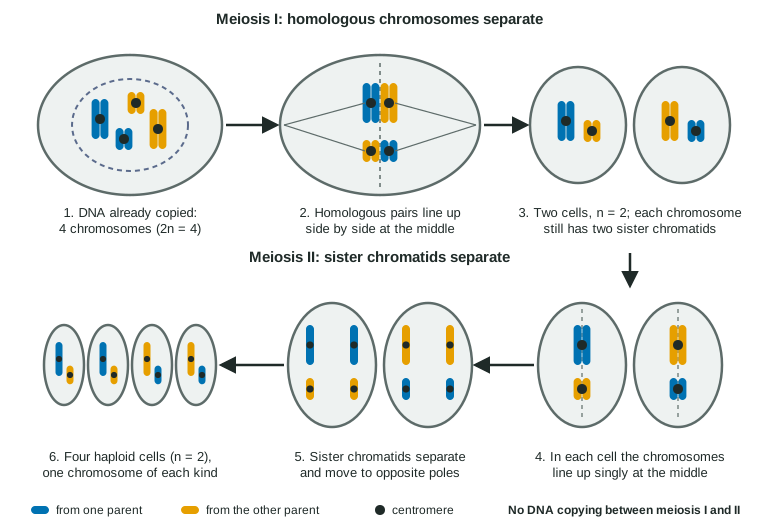
Meiosis starts in a diploid cell that has copied its DNA in S phase, just as a cell does before mitosis. Then it divides twice (Figure 1).
Meiosis I: the homologs separate.
- Prophase I. The chromosomes condense, and each finds its homolog and pairs with it along its whole length. This pairing is synapsis; each pair, four chromatids thick, is called a tetrad. The spindle forms and the nuclear envelope breaks down.
- Metaphase I. The tetrads line up across the middle of the cell, side by side. Spindle fibers from one pole attach to one homolog of each pair, and fibers from the other pole to the other homolog.
- Anaphase I. The homologs of each pair are pulled to opposite poles. Their sister chromatids stay joined at the centromere.
- Telophase I and cytokinesis. The cell splits in two. Each new cell has one chromosome of each kind: it is haploid, even though each chromosome still has two chromatids.
Meiosis II: the sister chromatids separate. There is no S phase before it. In each of the two cells, the chromosomes line up singly across the middle (metaphase II), their sister chromatids separate to opposite poles (anaphase II), and the cells divide (telophase II and cytokinesis). The result is four haploid cells, each with one copy of each kind of chromosome. Meiosis II works like mitosis, but in a haploid cell.
Counting through meiosis
Worked example: a cell with 2n = 8, and 10 units of DNA in G1.
G1: 8 chromosomes, 8 chromatids (one each), DNA 10 units.
After S (prophase I, metaphase I): still 8 chromosomes, now 16 chromatids, 4 tetrads. DNA 20 units.
Each cell after meiosis I: 4 chromosomes (one of each kind), 8 chromatids. DNA 10 units: the same as G1, but the chromosome number has halved.
Each cell after meiosis II: 4 chromosomes, 4 chromatids. DNA 5 units: half of G1.
Trap: the halving of the chromosome number happens in meiosis I. Meiosis II halves the DNA again but not the number of chromosomes.
A graph of DNA per cell through meiosis therefore has one step up (S phase) and two steps down (the end of meiosis I and the end of meiosis II), ending at half the G1 level.
Meiosis I and meiosis II compared
| Meiosis I | Meiosis II | |
|---|---|---|
| DNA copied just before? | Yes (S phase) | No |
| Homologs pair? | Yes, in prophase I (synapsis) | No; there are no homologs left in the cell |
| How chromosomes line up | In pairs, side by side | Singly |
| What separates | Homologous chromosomes | Sister chromatids |
| Cells at the end | Two haploid cells; chromosomes still have two chromatids | Four haploid cells; chromosomes have one chromatid |
| Chromosome number (human) | 46 → 23 | 23 → 23 |
Mitosis and meiosis compared
| Mitosis | Meiosis | |
|---|---|---|
| Divisions | One | Two |
| Rounds of DNA copying | One | One |
| Homologs pair? | No | Yes, in meiosis I |
| Cells made | Two diploid cells (from a diploid parent) | Four haploid cells |
| Are the cells identical? | Yes, to each other and to the parent | No; they differ from each other and from the parent (topic 5.2) |
| Used for | Growth, tissue repair, asexual reproduction | Making gametes (or, in plants and fungi, spores) |
| Where in a human | Body (somatic) cells | Cells in the ovaries and testes |
Fertilization closes the cycle
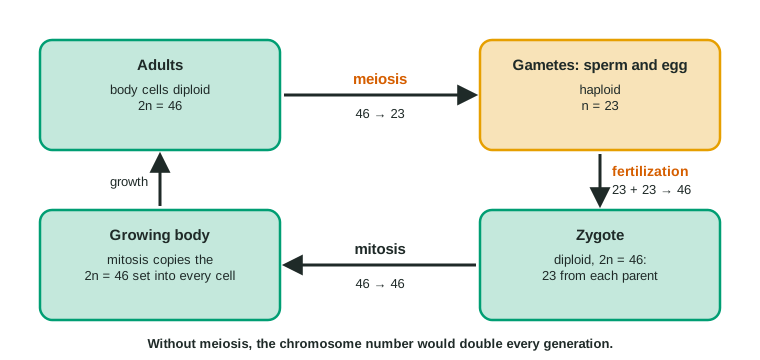
In fertilization, a haploid sperm (n = 23) and a haploid egg (n = 23) join into a diploid zygote (2n = 46), with one set of chromosomes from each parent. The zygote then divides by mitosis, again and again, copying its 46 chromosomes into every cell of the new body (Figure 2). This alternation, meiosis then fertilization in every generation, is sexual reproduction. It keeps the chromosome number constant: halved in the gametes, restored in the zygote.
Meiosis also explains a familiar fact. Every egg carries an X; a sperm carries an X or a Y. An egg fertilized by an X-bearing sperm gives an XX zygote, and one fertilized by a Y-bearing sperm gives XY. So in humans the father's sperm determines the child's sex, with roughly even odds.
Common mistakes
- "Meiosis I separates sister chromatids." It separates homologous chromosomes; sister chromatids separate in meiosis II.
- "Haploid means one chromatid per chromosome." Haploid means one chromosome of each kind. A cell just after meiosis I is haploid with two chromatids per chromosome.
- "DNA is copied again before meiosis II." It is not, which is why the four cells end with half the DNA of a G1 cell.
- "Homologs are identical." Sister chromatids are identical. Homologs carry the same genes but may carry different alleles.
- "Meiosis happens in all cells." In animals it happens only in cells of the ovaries and testes; body cells divide by mitosis.
How the exam tests this
- Identify meiosis I, meiosis II or mitosis from a drawing or description (pairs side by side, single chromosomes, one or two of each kind).
- Count chromosomes, chromatids, tetrads and DNA content at each stage, often from a graph of DNA per cell.
- Compare mitosis and meiosis: number of divisions, cells made, haploid or diploid, identical or not.
- Explain why gametes must be haploid, and predict what would happen to the chromosome number if they were not.