Topics 5.3 and 5.4 treated a phenotype as if it followed from the genotype alone: Pp means purple, ii means type O blood. For many traits that is close enough. But genes work through proteins, and proteins work inside conditions set by the surroundings: temperature, pH, the chemicals available, the food eaten. Change those conditions and the same genotype can give a different phenotype. This page covers how, with the standard examples.
One genotype, many possible phenotypes
Phenotypic plasticity is the ability of one genotype to produce different phenotypes in different environments. To see it, you need individuals with the same genotype: clones (cuttings of one plant), identical twins, or eggs from the same parents split between treatments. Grow them in different conditions, and any difference between them comes from the environment.
Plot a phenotype against an environmental variable for one genotype and you get its norm of reaction: the range of phenotypes that genotype can produce across environments. Different genotypes have different norms of reaction, and their lines can even cross, so that genotype 1 does best in one environment and genotype 2 in another.
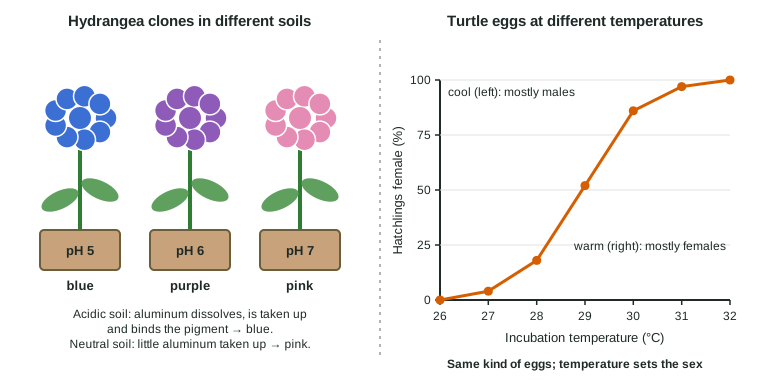
Hydrangea flower color and soil pH
Many garden hydrangeas bloom blue in acidic soil and pink in neutral or alkaline soil, even when the plants are clones (Figure 1, left). The chain of causes:
- In acidic soil (low soil pH), aluminum compounds in the soil dissolve.
- The roots take up the dissolved aluminum, and it is carried to the flowers.
- In the flowers, aluminum binds the red-purple pigment and shifts its color to blue.
- In neutral soil, aluminum stays locked up, little reaches the flowers, and the same pigment looks pink. In between, flowers are purple or mixed.
Gardeners use this: they add lime (which raises pH) for pink flowers, or acidifying compounds with aluminum for blue. The plant's alleles do not change. Seeds of a plant that was made pink by liming carry the same alleles as before, and seedlings grown in acidic soil bloom blue. White-flowered varieties, which make no pigment, stay white whatever the soil: the environment acts on what the genotype provides.
Temperature and phenotype
Temperature-dependent sex determination. In many turtles, and in crocodiles and some lizards, there are no sex chromosomes deciding sex. Instead, the temperature of the egg during a sensitive window of incubation switches the embryo onto a male or a female pathway. In many turtle species, cool nests give mostly males and warm nests mostly females, with a steep switch over a couple of degrees (Figure 1, right). A 2 °C warming of a beach can turn a mostly male hatch into a mostly female one, which is why conservation biologists monitor nest temperatures.
Temperature-sensitive fur color. Himalayan rabbits and Siamese cats carry an allele for an enzyme in the pathway that makes dark pigment. Their version of the enzyme holds its working shape only below normal body-core temperature; in warm skin it loses its shape (topic 3.3) and stops working. So dark fur grows only where the skin is cooler: ears, nose, paws and tail. Shave a patch on the warm back of a Himalayan rabbit and keep it cold while the fur regrows, and the new fur comes in dark. Siamese kittens are born almost white, because the womb is warm all over, and darken at the extremities as they grow.
Worked example: is it the genes or the environment? Yarrow plants on the coast are tall; yarrow plants high in the mountains are short.
Hypothesis 1, environment: the mountains are colder and the growing season is shorter, so any yarrow grows short there.
Hypothesis 2, genes: the two populations carry different alleles affecting height.
Test: take cuttings from both and grow them side by side in one garden (a common-garden experiment), and also grow cuttings of each at the coast and in the mountains.
Read the results: if the two kinds become the same height in the common garden, the difference was environmental. If they still differ, genes contribute. In real experiments of this kind, both are usually true: each kind changes height with the site, and the two kinds still differ at the same site.
Diet and phenotype in humans
Nutrition and height. Height is polygenic (topic 5.4), but how tall a person grows within their genetic range depends heavily on childhood nutrition and health. Average adult height rose by several centimeters, in some countries by more than 10 cm, over the past century, far too fast for the alleles in the population to have changed: the environment changed.
Phenylketonuria (PKU) is an autosomal recessive condition (topic 5.3). People with genotype pp lack a working enzyme that breaks down the amino acid phenylalanine, found in most proteins. On a normal diet phenylalanine builds up and harms the developing brain. Newborns are screened with a drop of blood, and a child with PKU who eats a carefully controlled low-phenylalanine diet from birth develops normally. Her genotype is still pp, and she will pass a p allele to each child; only the phenotype changed. This is why foods with the sweetener aspartame, which contains phenylalanine, carry a warning for people with PKU.
Most traits are multifactorial
A multifactorial trait is shaped by several genes and by the environment together: height, body mass, many heart conditions, type 2 diabetes. A useful way to think about it: the genotype sets a range of possible phenotypes, and the environment decides where in that range an individual ends up. The two cannot be separated into "this much genes, this much environment" for one person, because their effects depend on each other.
| Example | Environmental factor | Phenotype affected | How it works |
|---|---|---|---|
| Hydrangea | Soil pH | Flower color (blue or pink) | Acidic soil frees aluminum, which binds the flower pigment |
| Many turtles | Egg temperature | Sex | Temperature during a sensitive window sets the male or female pathway |
| Himalayan rabbit, Siamese cat | Skin temperature | Fur color pattern | Pigment enzyme works only in cooler skin |
| Humans | Childhood nutrition | Adult height | Growth within a polygenic genetic range |
| Humans with PKU | Dietary phenylalanine | Brain development | Low-phenylalanine diet prevents build-up when the enzyme is missing |
| Arrowhead plant | Water or air around the leaf | Leaf shape | Submerged leaves grow ribbon-like, aerial leaves arrow-shaped |
| Water fleas | Chemicals released by predators | Spine and helmet length | Chemical cues trigger growth of protective structures |
Common mistakes
- "If the environment affects a trait, the trait is not genetic." Most traits are both; plasticity is the genotype's response to the environment.
- "An environmentally caused change is passed to the offspring." A pink hydrangea's seeds or a PKU patient's children inherit the alleles, not the effects of soil or diet.
- "Differences between identical twins must be genetic." Identical twins share their genotype, so their differences show the effect of environment (and of chance).
- "Temperature changes the rabbit's genes." It changes how the enzyme works, not the DNA.
How the exam tests this
- Explain a named example (hydrangea, temperature-dependent sex, fur color, height, PKU) as a chain from environment to protein to phenotype.
- Read a graph or table of one genotype's phenotype across conditions (a norm of reaction), and describe or calculate from it.
- Design or evaluate an experiment that separates genetic and environmental effects: clones or split clutches, common gardens, controlled variables.
- Predict what changes and what does not (genotype, phenotype, offspring's alleles) when the environment changes.