Environmental Effects on Phenotype
A phenotype comes from the genotype acting in an environment.
Part 1 · Hook
Why this matters
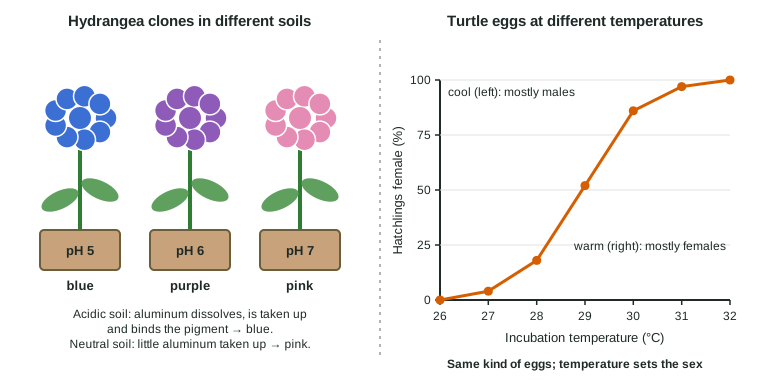
Buy two hydrangea bushes cut from the same parent plant and plant one by the sea in sandy, slightly alkaline soil and the other in acidic woodland soil. A summer later one blooms pink and the other bright blue. Their DNA is identical. Turtle eggs from the same nest can hatch as all males or all females depending on how warm the sand is. Genes do not fix a phenotype on their own: the same genotype can produce different results in different surroundings.
Part 2 · Before you start
What this builds on
Part 3 · Prerequisite check
Quick check before you start
1. An organism's phenotype is
- its observable traits, such as color or height
- the pair of alleles it carries for a gene
- the number of chromosomes in its cells
Show the answer
Phenotype is what you can see or measure; genotype is the alleles.
- Correct: its observable traits, such as color or height:
- the pair of alleles it carries for a gene:
- the number of chromosomes in its cells:
2. Raising the temperature well above an enzyme's optimum usually
- denatures it, changing the active site so the rate falls
- speeds it up without limit
- has no effect on its shape
Show the answer
Heat breaks the weak bonds that hold the enzyme's shape, so the active site changes and activity falls.
- Correct: denatures it, changing the active site so the rate falls:
- speeds it up without limit:
- has no effect on its shape:
3. A trait controlled by many genes, such as human height, usually shows
- continuous variation, a smooth range of values
- a 3:1 ratio of tall to short
- two clear classes with nothing in between
Show the answer
Many genes each adding a small effect give a smooth, bell-shaped range: polygenic inheritance.
- Correct: continuous variation, a smooth range of values:
- a 3:1 ratio of tall to short:
- two clear classes with nothing in between:
Part 4 · See it
See it first
Part 5 · Step by step
How it works, step by step
- A genotype carries the information for proteins, but each protein works inside conditions set by the environment: temperature, pH, available chemicals, food.The same genotype can give a different phenotype when those conditions change (phenotypic plasticity).
- In acidic soil, aluminum dissolves and a hydrangea's roots take it up.Aluminum binds the flower pigment and turns it blue; in neutral soil, with little aluminum taken up, the same plant blooms pink.
- In Himalayan rabbits and Siamese cats, the pigment-making enzyme loses its shape and stops working at normal body temperature.Dark fur grows only where the skin is cooler: ears, nose, paws and tail.
- In many turtles, the temperature of the eggs during a sensitive window switches on a male or a female pathway.Warm nests give mostly females and cool nests mostly males, with no sex chromosomes involved.
- A child with PKU cannot break down phenylalanine, but a low-phenylalanine diet keeps it from building up.With the diet from birth, the brain develops normally: the genotype is unchanged, but the phenotype is not the one the genotype alone predicts.
Part 6 · Key ideas
Key ideas
- Phenotypic plasticity: one genotype can produce different phenotypes in different environments. The range it produces across environments is its norm of reaction.
- Examples: hydrangea flower color set by soil pH (via aluminum), temperature-dependent sex determination in turtles, temperature-sensitive fur color in Himalayan rabbits and Siamese cats.
- In humans, nutrition affects height, and diet controls the effects of phenylketonuria (PKU).
- Most traits are multifactorial: many genes plus environment. The genotype sets the possible range; the environment decides where in it an individual lands.
- Environmentally caused changes are not passed on through the genes: a blue hydrangea's seeds carry the same alleles as a pink one's.
Part 7 · Misconception
A common mistake
The wrong idea: If a trait changes with the environment, it is not genetic.
What actually happens: Genes and environment act together. A Himalayan rabbit's dark ears need both its allele for a temperature-sensitive enzyme and cold skin: a rabbit without that allele stays white in the cold, and one with it has a light body where it is warm.
Part 8 · Check yourself
Check yourself
Exam-style questions. Anything you miss goes into your review queue.
Data table
Hydrangea clones in soils of different pH
A grower took 48 cuttings from one hydrangea plant and rooted them in pots. Groups of 8 were grown in the same potting mix adjusted to six different pH values, with the same light, water and temperature. When the plants flowered, she recorded each plant's flower color and measured aluminum in the colored flower parts (4 plants per group).
| Soil pH | Plants with blue flowers | Plants with purple flowers | Plants with pink flowers | Aluminum in flowers (µg/g) |
|---|---|---|---|---|
| 4.5 | 8 | 0 | 0 | 210 ± 20 |
| 5.0 | 8 | 0 | 0 | 180 ± 18 |
| 5.5 | 5 | 3 | 0 | 120 ± 15 |
| 6.0 | 1 | 4 | 3 | 60 ± 12 |
| 6.5 | 0 | 1 | 7 | 25 ± 8 |
| 7.0 | 0 | 0 | 8 | 15 ± 6 |
1. Which statement best describes the relationship in the table?
- As soil pH rises, flowers shift from blue to pink and aluminum in the flowers falls.
- As soil pH rises, flowers shift from pink to blue and aluminum in the flowers rises.
- Flower color changes with pH, but aluminum in the flowers stays about the same.
- Aluminum in the flowers falls as pH rises, but flower color does not change.
Show the answer
From pH 4.5 to 7.0, blue plants go from 8 to 0 and pink plants from 0 to 8, while aluminum falls from 210 to 15 µg/g.
- Correct: As soil pH rises, flowers shift from blue to pink and aluminum in the flowers falls.: Blue at low pH, pink at high pH, and aluminum drops as pH rises.
- As soil pH rises, flowers shift from pink to blue and aluminum in the flowers rises.: This reverses the trend: blue flowers are at the acidic, low-pH end, where aluminum is highest.
- Flower color changes with pH, but aluminum in the flowers stays about the same.: Aluminum falls more than tenfold across the range, so it does not stay the same.
- Aluminum in the flowers falls as pH rises, but flower color does not change.: Color changes clearly, from 8 blue plants at pH 4.5 to 8 pink plants at pH 7.0.
2. Why did the grower use cuttings from one plant instead of seedlings?
- Cuttings share one genotype, so group differences come from the soil, not genes.
- Cuttings grow faster than seedlings, so the plants flower within a single season.
- Seedlings rarely flower in pots, so cuttings were the one way to see a flower color.
- Cuttings take up more aluminum from soil than seedlings, making the color change larger.
Show the answer
Cuttings are clones: genetically identical. Seedlings come from sexual reproduction and differ in their alleles, so a color difference between seedling groups could be genetic. Holding genotype constant isolates the environmental variable, soil pH.
- Correct: Cuttings share one genotype, so group differences come from the soil, not genes.: Identical genotypes mean any difference between groups comes from the environment.
- Cuttings grow faster than seedlings, so the plants flower within a single season.: Speed may be convenient, but it is not the reason that matters for the conclusion.
- Seedlings rarely flower in pots, so cuttings were the one way to see a flower color.: Hydrangea seedlings can flower; the issue is that each seedling has a different genotype.
- Cuttings take up more aluminum from soil than seedlings, making the color change larger.: Nothing suggests cuttings and seedlings differ in aluminum uptake; the key point is a shared genotype.
3. A student claims that aluminum, not acidity itself, turns the flowers blue. Which additional experiment would best test the claim?
- At pH 5.0, grow cuttings in soil with aluminum removed or bound and in soil with it, all else equal.
- Grow more cuttings at each of the six pH values and measure aluminum in their leaves and roots as well as their flowers.
- Grow seedlings instead of cuttings at pH 4.5 and at pH 7.0, then compare the flower colors of the two groups.
- Measure the soil pH again at the end of the experiment to check that it stayed steady during the season.
Show the answer
In the table, pH and aluminum change together, so either could cause the color. Holding pH constant and changing only aluminum separates them: if the low-aluminum plants turn pink in acidic soil, aluminum is the cause.
- Correct: At pH 5.0, grow cuttings in soil with aluminum removed or bound and in soil with it, all else equal.: This changes aluminum while holding pH fixed, so it separates the two possible causes.
- Grow more cuttings at each of the six pH values and measure aluminum in their leaves and roots as well as their flowers.: More measurements across the same pH values would still have aluminum and pH changing together.
- Grow seedlings instead of cuttings at pH 4.5 and at pH 7.0, then compare the flower colors of the two groups.: Seedlings add genetic differences and still change pH and aluminum together.
- Measure the soil pH again at the end of the experiment to check that it stayed steady during the season.: Checking pH improves the existing data but does not separate aluminum from acidity.
Graph
Turtle hatchling sex and incubation temperature
Eggs from 10 nests of one turtle species were collected, and the eggs of each nest were divided among seven incubators held at 26 to 32 °C, so every incubator received eggs from every nest. After hatching, each turtle's sex was identified. Each point is the mean percentage of female hatchlings across the 10 nests, with error bars of ± 2 SE.
Data table
| Incubation temperature (°C) | Female hatchlings (mean ± 2 SE) (± error) |
|---|---|
| 26 | 0 |
| 27 | 4 ± 3 |
| 28 | 18 ± 6 |
| 29 | 52 ± 8 |
| 30 | 86 ± 6 |
| 31 | 97 ± 3 |
| 32 | 100 |
4. On one beach, nests have been incubating at about 28 °C. If warmer summers raise nest temperatures to about 30 °C, predict the effect on the hatchlings.
- The share of females rises from about 18% to about 86%.
- The share of females falls from about 86% to about 18%.
- The sex ratio stays the same, because sex is set by the hatchlings' genes.
- Each hatchling becomes female, because warming above 28 °C gives females.
Show the answer
Reading the graph: 18% female at 28 °C, 86% at 30 °C. A 2 °C rise near the pivotal temperature shifts the sex ratio strongly toward females.
- Correct: The share of females rises from about 18% to about 86%.: 28 °C gives about 18% females and 30 °C about 86%: a large shift toward females.
- The share of females falls from about 86% to about 18%.: This reverses the direction: warmer eggs give more females in this species.
- The sex ratio stays the same, because sex is set by the hatchlings' genes.: In this species sex is set by temperature, so the ratio changes with warming.
- Each hatchling becomes female, because warming above 28 °C gives females.: At 30 °C the mean is 86% female, not 100%; some males still hatch.
5. A patch of white fur is shaved from the warm back of a Himalayan rabbit, and an ice pack is kept on the patch while the fur grows back. Predict the color of the new fur and the reason.
- Dark, because the pigment enzyme works in the cooled skin.
- White, because the rabbit's genotype for that patch codes for white fur.
- White, because shaving damages the hair follicles in that patch.
- Dark, because the cold changes the rabbit's alleles in that patch.
Show the answer
The rabbit's enzyme for dark pigment is active only at cooler temperatures. Cooled skin lets it work, so the regrowing hair is dark, as on the ears and paws.
- Correct: Dark, because the pigment enzyme works in the cooled skin.: Cold lets the temperature-sensitive enzyme work, so dark pigment is made.
- White, because the rabbit's genotype for that patch codes for white fur.: Every cell has the same genotype; the back is white only because it is warm.
- White, because shaving damages the hair follicles in that patch.: The fur regrows; its color depends on the skin temperature while it grows.
- Dark, because the cold changes the rabbit's alleles in that patch.: Temperature changes how the enzyme works, not the alleles in the DNA.
6. A child with PKU (genotype pp) eats a low-phenylalanine diet from birth and develops normally. Which statement is correct?
- Her genotype is still pp, but the diet changed her phenotype by keeping phenylalanine low.
- The diet changed her genotype from pp to Pp, which is why she developed normally.
- She does not really have PKU, because PKU by definition causes harm to the brain.
- Her children will not inherit PKU alleles from her, because the diet has treated the condition.
Show the answer
Diet cannot change alleles. It changes the environment her enzyme-less cells work in: little phenylalanine, so none builds up to harm the brain. Same genotype, different phenotype.
- Correct: Her genotype is still pp, but the diet changed her phenotype by keeping phenylalanine low.: Genotype pp is unchanged; the environment (diet) changes the outcome.
- The diet changed her genotype from pp to Pp, which is why she developed normally.: Food does not change DNA; she is still pp.
- She does not really have PKU, because PKU by definition causes harm to the brain.: She has the genotype for PKU; the diet prevents its effects.
- Her children will not inherit PKU alleles from her, because the diet has treated the condition.: She will pass a p allele to every child, as she carries no P.
7. Select the examples of phenotypic plasticity.
- An arrowhead plant grows ribbon-like leaves under water and arrow-shaped leaves in air.
- Water fleas grow longer spines when they detect chemicals released by predatory insects.
- Two pink snapdragons produce red, pink and white offspring in a 1:2:1 ratio.
- A four o'clock plant's seedlings have the leaf color of the branch that gave the eggs.
- A testcross of a double heterozygote gives four classes of offspring in equal numbers.
Show the answer
Plasticity is one genotype giving different phenotypes in different environments: the same arrowhead plant makes two leaf shapes, and the same water flea grows spines when predators are around.
- Correct: An arrowhead plant grows ribbon-like leaves under water and arrow-shaped leaves in air.: The same plant, so the same genotype, makes different leaves under water and in air.
- Correct: Water fleas grow longer spines when they detect chemicals released by predatory insects.: The same genotype grows different spines depending on a chemical cue in its environment.
- Two pink snapdragons produce red, pink and white offspring in a 1:2:1 ratio.: This shows how alleles are inherited (incomplete dominance), not the environment changing a genotype's phenotype.
- A four o'clock plant's seedlings have the leaf color of the branch that gave the eggs.: This is inheritance of chloroplasts through the egg, not an environmental effect.
- A testcross of a double heterozygote gives four classes of offspring in equal numbers.: This shows independent assortment of alleles, not an environmental effect.
Part 9 · Summary
Summary
A phenotype comes from the genotype acting in an environment. Phenotypic plasticity is the ability of one genotype to give different phenotypes in different conditions; its norm of reaction is the range across environments. Hydrangeas bloom blue in acidic soil, where aluminum is taken up and binds the pigment, and pink in neutral soil. Many turtles' sex depends on incubation temperature. Himalayan rabbits and Siamese cats grow dark fur only on cool body parts, because their pigment enzyme works only when cool. Nutrition affects height, and a low-phenylalanine diet prevents the effects of PKU. Most traits are multifactorial. Such environmental changes alter the phenotype, not the alleles passed to offspring.
Part 10 · Up next
What comes next
Part 11 · Connections