Your body temperature stays within about a degree of 37 °C whether you are in a snowstorm or a sauna. Your blood glucose stays near the same level whether you just ate cake or skipped lunch. Holding conditions steady is homeostasis (topic 2.5), and this page explains the machinery behind it: feedback loops built from the signals of topics 4.1 to 4.3. It also covers the opposite kind of loop, which drives a change faster and faster until it is finished.
The parts of a feedback loop
Every feedback loop has the same parts. Learn them once and you can read any loop on the exam:
- Stimulus: a change in a variable, such as blood glucose rising after a meal.
- Sensor: cells that detect the change, such as temperature-sensing nerve endings in the skin.
- Control center: compares the variable with its set point, the value it is held near, and sends signals (nerve signals or hormones). The set point is really a normal range: fasting blood glucose of about 70-100 mg/dL, body temperature of about 36.5-37.5 °C.
- Effectors: muscles, glands or organs that carry out the response and change the variable.
Sometimes one cell does several jobs: a beta cell in the pancreas senses glucose and releases insulin itself, so it is both sensor and control center.
Negative feedback: push back toward the set point
In negative feedback, the response opposes the stimulus. If the variable rises, the response lowers it; if it falls, the response raises it. As the variable returns to its set point, the stimulus disappears and the response switches off. The loop is self-limiting, which makes it ideal for keeping things stable. Most homeostasis is negative feedback.
You have already seen a molecular version: in feedback inhibition (topic 3.4), the end product of a pathway slows the pathway's first enzyme, so its own production falls when it builds up.
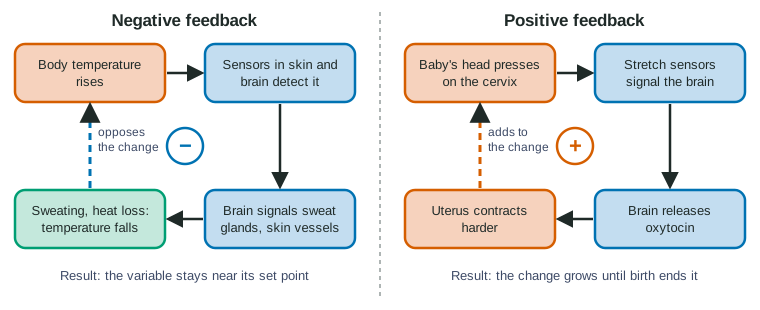
Thermoregulation is the classic body example (Figure 1, left). Temperature sensors in the skin and brain report to a control center in the brain. If you are too warm, sweat glands release sweat, which cools you as it evaporates, and blood vessels in the skin widen so more heat is lost from the surface. If you are too cold, the vessels narrow to keep heat in the core and muscles shiver, releasing heat from cellular respiration. Either way, the response cancels the change.
Blood glucose: two opposing hormones
Blood glucose is held in range by two negative feedback loops that pull in opposite directions (Figure 2).
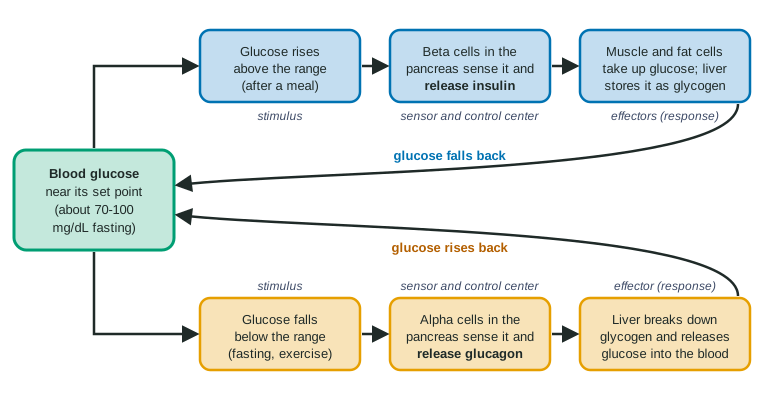
- Glucose too high (after a meal): beta cells in the pancreas release insulin. Insulin binds receptors on muscle and fat cells, which move more glucose transporters into their membranes and take glucose in; the liver stores glucose as glycogen. Glucose falls, and insulin release falls with it.
- Glucose too low (between meals, during exercise): alpha cells in the pancreas release glucagon. Glucagon acts on liver cells, which break down glycogen and release glucose into the blood. Glucose rises, and glucagon release falls.
Notice the timing in real data: insulin rises within minutes of glucose rising, peaks close to the glucose peak, and falls as glucose falls. That lag-and-follow pattern is the signature of a negative feedback loop.
Worked example: reading a meal. A person's fasting glucose is 85 mg/dL. An hour after lunch it is 140 mg/dL, and insulin has risen from 9 to 62 µU/mL. Three hours after lunch glucose is back to 90 and insulin to 15.
Size of the change: (140 − 85) ÷ 85 × 100 ≈ 65% rise in glucose.
Identify the loop: stimulus = glucose rise; sensor and control center = beta cells; signal = insulin; effectors = muscle, fat and liver cells; response = glucose taken out of the blood.
Why negative: the response (glucose removal) opposes the stimulus (glucose rise), and once glucose is back near 85-90, insulin falls back too.
When the loop breaks: diabetes
In diabetes, blood glucose stays high because the insulin loop fails.
- Type 1: the immune system destroys the beta cells, so little or no insulin is made. Glucose rises after every meal and does not come back down. Insulin injections replace the missing signal.
- Type 2: insulin is made, but target cells respond weakly to it (insulin resistance). Glucose stays high, so the beta cells keep releasing more and more insulin; over years they may wear out. Exercise, diet changes and drugs that boost the cells' response help.
Both show the same principle: if any part of the loop fails (sensor, signal, receptor or effector), the variable moves away from its set point and stays there.
Positive feedback: push further, then stop
In positive feedback, the response adds to the stimulus, so the change grows faster and faster. That would be a disaster for keeping things steady, but it is exactly right for a process that should happen quickly and completely. Positive feedback loops end when an outside event removes the stimulus.
- Childbirth (Figure 1, right): the baby's head stretches the cervix; stretch sensors signal the brain to release oxytocin; oxytocin makes the uterus contract harder, which presses the head harder, which releases more oxytocin. The loop ends when the baby is born and the stretching stops.
- Blood clotting: platelets that stick at a damaged vessel release chemicals that make more platelets stick, and each activated clotting protein activates many more. The loop ends when the break is sealed.
- Fruit ripening: in fruits such as apples, bananas and tomatoes, the gas ethylene triggers ripening, and ripening fruit makes more ethylene. One ripe apple speeds the ripening of the whole bag.
| Negative feedback | Positive feedback | |
|---|---|---|
| Response compared with the stimulus | Opposes it | Adds to it |
| Effect on the variable | Returns it toward the set point | Pushes it further from where it started |
| How the loop stops | By itself, once the variable is back in range | An outside event ends it (birth, a sealed wound) |
| Job in the body | Stability: homeostasis | Finishing a process quickly |
| Examples | Insulin and glucagon, thermoregulation, feedback inhibition of enzymes | Oxytocin in childbirth, blood clotting, ethylene in ripening |
Common mistakes
- "Negative means bad." It means the response opposes the change.
- "Insulin breaks down glucose." Insulin is a signal: it makes target cells take up and store glucose.
- "Glucagon is the same as glycogen." Glucagon is a hormone; glycogen is the stored polysaccharide it causes the liver to break down.
- "Positive feedback goes on forever." It ends when an outside event removes the stimulus.
How the exam tests this
- Read a graph of glucose, insulin and glucagon (or temperature and a response) over time, and explain each rise and fall.
- Label the stimulus, sensor, control center and effectors in a described loop, and classify it as negative or positive.
- Predict what happens when one part of a loop fails, as in type 1 and type 2 diabetes.
- Explain why positive feedback suits childbirth or clotting but not glucose control.