Feedback
Feedback loops link a stimulus, a sensor, a control center with a set point, and effectors.
Part 1 · Hook
Why this matters
Before 1922, a child found to have type 1 diabetes usually lived only months, or a year or two. Their blood was full of sugar, yet their cells were starving. In January of that year, a dying 14-year-old in Toronto was given an injection of insulin extracted from animal pancreases, and his blood sugar fell. Insulin restored one half of a control loop the body uses every minute of every day. This topic is about those loops: how your body notices a change and pushes back.
Part 2 · Before you start
What this builds on
Part 3 · Prerequisite check
Quick check before you start
1. Homeostasis is
- keeping internal conditions within a narrow range while outside conditions change
- the growth of an organism by adding more cells
- the movement of water from high to low water potential
Show the answer
Homeostasis means holding the internal environment steady, such as temperature, water and glucose.
- Correct: keeping internal conditions within a narrow range while outside conditions change:
- the growth of an organism by adding more cells:
- the movement of water from high to low water potential:
2. In feedback inhibition of a metabolic pathway, what does the end product do?
- It binds the first enzyme of the pathway and slows it, so less end product is made
- It speeds up the last enzyme of the pathway so it is used up faster
- It is converted back into the starting molecule
Show the answer
The end product binds an allosteric site on an early enzyme, switching the pathway down when product builds up.
- Correct: It binds the first enzyme of the pathway and slows it, so less end product is made:
- It speeds up the last enzyme of the pathway so it is used up faster:
- It is converted back into the starting molecule:
3. Why do only some cells respond to insulin in the blood?
- Only cells with insulin receptors bind it
- Insulin can reach only the cells next to the pancreas
- Insulin is broken down before it reaches most cells
Show the answer
A hormone acts only on target cells, those with a receptor that binds it.
- Correct: Only cells with insulin receptors bind it:
- Insulin can reach only the cells next to the pancreas:
- Insulin is broken down before it reaches most cells:
Part 4 · See it
See it first
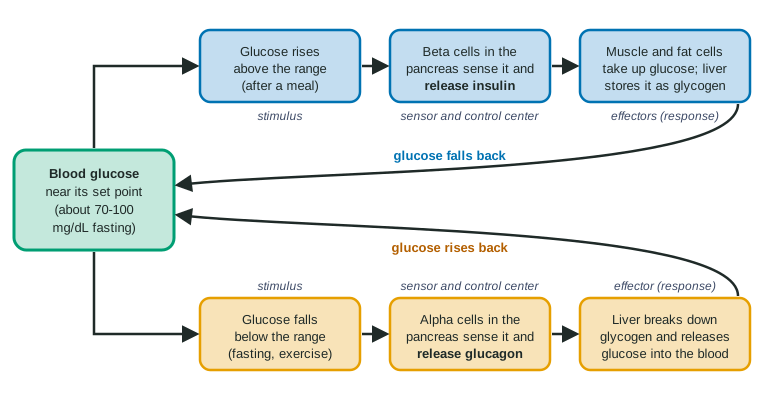
Part 5 · Step by step
How it works, step by step
- After a meal, glucose from digested food is absorbed into the blood.Blood glucose rises above its normal range: this is the stimulus.
- Beta cells in the pancreas detect the higher glucose (they are both sensor and control center).They release more insulin into the blood.
- Insulin binds receptors on muscle and fat cells, and on liver cells.Muscle and fat cells take up more glucose; the liver stores glucose as glycogen (the effectors respond).
- Glucose leaves the blood faster than it enters.Blood glucose falls back toward the set point, and the stimulus for insulin release fades.
- If glucose falls below the range during fasting or exercise, alpha cells in the pancreas release glucagon.The liver breaks down glycogen and releases glucose, so glucose rises back: the response always opposes the change.
Part 6 · Key ideas
Key ideas
- A feedback loop has a stimulus (a change), a sensor, a control center that compares with a set point, and effectors that respond.
- Negative feedback opposes the change and returns the variable to its set point, then switches itself off. It keeps conditions stable: blood glucose, body temperature.
- Positive feedback amplifies the change until an outside event ends it: oxytocin in childbirth, blood clotting, ethylene ripening fruit such as apples and bananas.
- Blood glucose is held by two opposing hormones: insulin lowers it, glucagon raises it.
- When a loop fails, homeostasis fails. In diabetes, too little insulin (type 1) or a weak response to it (type 2) leaves blood glucose high.
Part 7 · Misconception
A common mistake
The wrong idea: Negative feedback is harmful and positive feedback is helpful, as their names suggest.
What actually happens: "Negative" means the response opposes the change; "positive" means it adds to the change. Both are normal. Negative feedback keeps conditions steady; positive feedback finishes a process quickly, such as giving birth or sealing a wound.
Part 8 · Check yourself
Check yourself
Exam-style questions. Anything you miss goes into your review queue.
Graph
Blood glucose, insulin and glucagon over a day
A healthy 17-year-old wore a sensor that recorded blood glucose, and blood samples were taken to measure insulin and glucagon. Meals rich in carbohydrate were eaten at 7:00, 12:00 and 18:00, and the volunteer ran from 15:00 to 16:00. Each hormone is plotted in its own unit, given in the key.
Glucose (mg/dL)Insulin (µU/mL)Glucagon (pg/mL)
Data table
| Time of day (hours) | Glucose (mg/dL) | Insulin (µU/mL) | Glucagon (pg/mL) |
|---|---|---|---|
| 6 | 85 | 8 | 90 |
| 7 | 86 | 8 | 90 |
| 7.5 | 128 | 42 | 78 |
| 8 | 138 | 58 | 70 |
| 9 | 112 | 40 | 76 |
| 10 | 92 | 18 | 85 |
| 11 | 86 | 10 | 90 |
| 12 | 85 | 9 | 90 |
| 12.5 | 132 | 45 | 78 |
| 13 | 140 | 62 | 70 |
| 14 | 110 | 42 | 74 |
| 15 | 90 | 15 | 88 |
| 15.5 | 78 | 8 | 105 |
| 16 | 72 | 6 | 118 |
| 17 | 84 | 9 | 96 |
| 18 | 86 | 9 | 90 |
| 18.5 | 135 | 46 | 78 |
| 19 | 142 | 64 | 70 |
| 20 | 112 | 44 | 75 |
| 21 | 95 | 20 | 84 |
| 22 | 88 | 11 | 89 |
1. Which statement best describes the hormones after each meal?
- Insulin rises and falls with glucose, while glucagon falls and then recovers.
- Insulin and glucagon both rise with glucose and both fall as glucose falls back.
- Glucagon rises with glucose, while insulin stays near its fasting level through the day.
- Insulin rises an hour before glucose rises, in step with the time of each meal.
Show the answer
After lunch, glucose goes 85 → 140 and insulin 9 → 62, both returning by 15:00; glucagon dips from 90 to 70 and comes back.
- Correct: Insulin rises and falls with glucose, while glucagon falls and then recovers.: Insulin tracks glucose, and glucagon moves the opposite way, as the meal peaks show.
- Insulin and glucagon both rise with glucose and both fall as glucose falls back.: Glucagon falls after meals; only insulin rises.
- Glucagon rises with glucose, while insulin stays near its fasting level through the day.: This reverses the two hormones.
- Insulin rises an hour before glucose rises, in step with the time of each meal.: Insulin rises with glucose after each meal; at 7:00, 12:00 and 18:00 it is still at its fasting level.
2. Which explanation best accounts for the changes between 15:00 and 17:00?
- Running muscles took up glucose; the fall triggered glucagon release and less insulin, so the liver released glucose.
- Running used up the insulin in the blood, so glucose fell; glucagon then rose to take the place of the missing insulin.
- The run raised insulin, which lowered glucose; glucagon rose afterward because glucose had become too high.
- Glucagon rose first and caused glucose to fall, and glucose recovered at 17:00 because the next meal began.
Show the answer
Glucose falls from 90 to 72 during the run; glucagon rises to 118 and insulin falls to 6; by 17:00 glucose is back to 84, before dinner at 18:00.
- Correct: Running muscles took up glucose; the fall triggered glucagon release and less insulin, so the liver released glucose.: Glucose use lowers glucose; the low level is the stimulus for glucagon, whose response restores it.
- Running used up the insulin in the blood, so glucose fell; glucagon then rose to take the place of the missing insulin.: Insulin falls during the run because glucose falls; glucagon is the opposing hormone, not a replacement.
- The run raised insulin, which lowered glucose; glucagon rose afterward because glucose had become too high.: Insulin falls during the run (15 → 6), it does not rise; and glucose was low, not high, when glucagon rose.
- Glucagon rose first and caused glucose to fall, and glucose recovered at 17:00 because the next meal began.: Glucagon raises glucose; and the recovery at 17:00 comes before the 18:00 meal.
3. Which feature of the data is the best evidence that blood glucose is controlled by negative feedback?
- After each rise or fall, glucose returns to about 85-90 mg/dL as the opposing hormone acts.
- Glucose reaches about the same peak, 138-142 mg/dL, after each of the three meals of the day.
- Insulin is higher at 19:00 than at any earlier time of day.
- Glucagon is about 90 pg/mL at 6:00 and about 89 pg/mL at 22:00.
Show the answer
Negative feedback means the response opposes the change and brings the variable back: glucose returns to its set point after meals (insulin up) and after the run (glucagon up).
- Correct: After each rise or fall, glucose returns to about 85-90 mg/dL as the opposing hormone acts.: A return to the set point, driven by a hormone that opposes the change, is what defines negative feedback.
- Glucose reaches about the same peak, 138-142 mg/dL, after each of the three meals of the day.: Similar peaks show similar meals; they do not show what brings glucose back down.
- Insulin is higher at 19:00 than at any earlier time of day.: A single high value does not show a response opposing a change.
- Glucagon is about 90 pg/mL at 6:00 and about 89 pg/mL at 22:00.: Two matching values at the start and end do not show how glucose was corrected during the day.
Data table
A glucose tolerance test
Three adults fasted overnight, then drank a solution containing 75 g of glucose at time 0. Blood glucose and insulin were measured over the next two hours. One person is healthy, one has type 1 diabetes and has not taken insulin that morning, and one has type 2 diabetes.
| Person | Measurement | 0 min | 30 min | 60 min | 120 min |
|---|---|---|---|---|---|
| A | Glucose | 85 | 140 | 125 | 100 |
| A | Insulin | 6 | 50 | 45 | 20 |
| B | Glucose | 160 | 260 | 320 | 310 |
| B | Insulin | 2 | 3 | 3 | 2 |
| C | Glucose | 135 | 220 | 260 | 230 |
| C | Insulin | 20 | 75 | 110 | 120 |
4. Persons B and C are each given the same dose of insulin by injection after the test. Predict the effect on their glucose.
- B's glucose falls a lot, and C's falls less, because C's cells respond weakly to insulin.
- C's glucose falls a lot, and B's falls less, because B's cells have lost their insulin receptors.
- Neither glucose level falls, because diabetes damages the liver rather than the hormone system.
- Both fall by the same amount, because injected insulin works the same way in each person.
Show the answer
B's problem is the missing signal, so supplying it works well. C already has plenty of insulin; the problem is the response, so extra insulin helps less.
- Correct: B's glucose falls a lot, and C's falls less, because C's cells respond weakly to insulin.: B lacks insulin but responds to it; C has insulin resistance.
- C's glucose falls a lot, and B's falls less, because B's cells have lost their insulin receptors.: B's beta cells are destroyed, not the receptors on target cells.
- Neither glucose level falls, because diabetes damages the liver rather than the hormone system.: Both types are failures of the insulin loop: a missing signal or a weak response.
- Both fall by the same amount, because injected insulin works the same way in each person.: C's high insulin with high glucose shows C's cells respond weakly, so the same dose does less.
Graph
Ethylene from ripening bananas
Green bananas from one harvest were divided into three groups of 12 and kept in ventilated boxes at 20 °C. Group 1 was left alone. Group 2 shared its box with two fully ripe bananas for the whole experiment. Group 3 was first treated with 1-MCP, a gas that binds ethylene receptors without activating them. Ethylene given off by the green bananas was measured each day.
Group 1: aloneGroup 2: with ripe bananasGroup 3: 1-MCP treated
Data table
| Day | Group 1: alone | Group 2: with ripe bananas | Group 3: 1-MCP treated |
|---|---|---|---|
| 0 | 0.2 | 0.2 | 0.2 |
| 1 | 0.3 | 1.5 | 0.2 |
| 2 | 0.4 | 7 | 0.2 |
| 3 | 0.6 | 15 | 0.3 |
| 4 | 1.5 | 12 | 0.3 |
| 5 | 6 | 8 | 0.3 |
| 6 | 14 | 5 | 0.4 |
| 7 | 12 | 4 | 0.4 |
| 8 | 8 | 3 | 0.5 |
5. Which explanation best accounts for the shape of the group 1 curve between days 3 and 6?
- Ethylene binding the fruit's receptors makes the fruit produce more ethylene, so production speeds itself up.
- The bananas lose water as they age, so the ethylene in them becomes more concentrated each day.
- Ethylene production is set by the day of harvest, so each banana starts producing heavily on day 4.
- Ethylene breaks down cell walls, and the broken walls release ethylene that had been stored in them.
Show the answer
A slow start followed by an accelerating rise is the shape of positive feedback: the product (ethylene) triggers more of its own production, until ripening is complete and production falls.
- Correct: Ethylene binding the fruit's receptors makes the fruit produce more ethylene, so production speeds itself up.: Each increase in ethylene causes a bigger increase: positive feedback.
- The bananas lose water as they age, so the ethylene in them becomes more concentrated each day.: Ethylene is measured as gas given off per hour, not as a concentration in the fruit, and water loss could not explain a 20-fold rise in three days.
- Ethylene production is set by the day of harvest, so each banana starts producing heavily on day 4.: Group 2 bananas, from the same harvest, start on day 1, so timing is not fixed by harvest date.
- Ethylene breaks down cell walls, and the broken walls release ethylene that had been stored in them.: Ethylene is made as the fruit ripens, not stored in the walls; and 1-MCP, which acts on receptors, stops the rise.
6. During an infection, chemicals from immune cells raise the brain's temperature set point from 37 °C to 39 °C. Predict what a person feels and does while their temperature is still 37 °C.
- They feel cold and shiver, because the control center now reads 37 °C as below the set point.
- They feel hot and sweat, because the infection itself is producing heat inside the body.
- They feel nothing, because their temperature has not changed from its normal value.
- They feel hot and sweat, because a higher set point makes the sensors more sensitive to heat.
Show the answer
The loop compares temperature with the set point. At 37 °C the body is 2 °C below the new set point, so it responds as if cold: shivering and narrowed skin vessels raise temperature.
- Correct: They feel cold and shiver, because the control center now reads 37 °C as below the set point.: Below the new set point, the loop triggers heat-gaining responses.
- They feel hot and sweat, because the infection itself is producing heat inside the body.: Sweating is a response to being above the set point, which happens when the fever breaks.
- They feel nothing, because their temperature has not changed from its normal value.: The variable has not changed, but the set point has, so the gap triggers a response.
- They feel hot and sweat, because a higher set point makes the sensors more sensitive to heat.: Raising the set point changes the target, not the sensitivity of the sensors; being below target triggers warming, not cooling.
7. Select the two examples of negative feedback.
- Insulin release rises after a meal, and glucose falls back to its normal range.
- Sweating increases as body temperature rises above 37 °C, cooling the body.
- Oxytocin release rises as contractions stretch the cervix, making contractions stronger.
- Ripening apples make ethylene, which makes nearby apples ripen and make more.
- Platelets at a wound release chemicals that make more platelets stick there.
Show the answer
In both, the response opposes the change: glucose comes back down, temperature comes back down.
- Correct: Insulin release rises after a meal, and glucose falls back to its normal range.: The response removes the stimulus (high glucose).
- Correct: Sweating increases as body temperature rises above 37 °C, cooling the body.: The response cancels the stimulus (high temperature).
- Oxytocin release rises as contractions stretch the cervix, making contractions stronger.: Stronger contractions stretch the cervix more, adding to the change: positive feedback.
- Ripening apples make ethylene, which makes nearby apples ripen and make more.: More ethylene causes more ripening and still more ethylene: positive feedback.
- Platelets at a wound release chemicals that make more platelets stick there.: More platelets attract still more: positive feedback.
Part 9 · Summary
Summary
Feedback loops link a stimulus, a sensor, a control center with a set point, and effectors. Negative feedback opposes a change and returns the variable to its set point: insulin from beta cells lowers blood glucose after a meal, glucagon from alpha cells raises it when it falls, and sweating or shivering hold body temperature near 37 °C. Positive feedback amplifies a change until an outside event ends it: oxytocin and contractions in childbirth, platelets in blood clotting, ethylene in ripening fruit. When a loop fails, as in type 1 diabetes (little insulin) or type 2 (a weak response to insulin), blood glucose is no longer held in range.
Part 10 · Up next
What comes next
Part 11 · Connections