The last topic showed which substances can cross a membrane. This one asks a different question: which way do they go, and who pays? Some movement happens on its own, some costs the cell energy, and some uses whole vesicles of membrane. Sorting a process into the right kind usually comes down to two checks: is the substance moving down or against its concentration gradient, and is it a single molecule or a large package?
Passive transport: going downhill
In passive transport, a substance moves across a membrane from where it is more concentrated to where it is less concentrated, down its concentration gradient. The cell spends no ATP. The energy comes from the particles themselves: they are always moving (they have kinetic energy), and random motion spreads them from crowded to sparse.
Passive transport includes simple diffusion straight through the bilayer, as oxygen and carbon dioxide do, and diffusion through transport proteins, as water does through aquaporins. Either way, the direction is set by the gradient, not by the cell.
What happens when the concentrations become equal? The molecules do not stop. They keep moving and keep crossing, but now as many cross one way as the other, so the concentrations stay level. This balanced state is a dynamic equilibrium: "dynamic" because movement continues, "equilibrium" because nothing changes overall.
Worked example: the dialysis bag. A bag of dialysis tubing, which passes glucose, water and iodine but not starch, holds glucose and starch. It sits in water with iodine, which turns blue-black with starch.
Iodine is concentrated outside and absent inside, so it diffuses in and the bag turns blue-black.
Glucose is concentrated inside, so it diffuses out; after 30 minutes the beaker tests positive for glucose.
Starch is too large for the pores, so it stays in the bag, and the beaker stays amber.
After a day, glucose reaches about the same concentration inside and out, a dynamic equilibrium. Every move here was passive: each substance went down its own gradient.
Active transport: going uphill
Active transport moves a substance against its concentration gradient, from where it is less concentrated to where it is more concentrated. That is like pushing a ball uphill: it does not happen on its own. It needs a transport protein and an energy source, usually ATP.
The clearest sign of active transport is a cell holding a substance at a higher concentration than its surroundings. Root cells hold potassium at about 100 times the concentration in soil water; diffusion alone could never do that, because diffusion only evens things out.
An experiment shows the difference neatly. Yeast cells growing on a fuel they can use only through their mitochondria, are put in a medium with a labeled amino acid, and the concentration inside the cells is compared with the concentration outside. Untreated cells keep taking it in until the inside is nearly ten times the outside. Cells treated with cyanide, which stops mitochondria from making ATP, take it in only until inside equals outside, then stop.
Worked example: reading uptake data with error bars. The ratio "inside ÷ outside" tells you the direction of the gradient. A ratio of 1.0 means equal concentrations; above 1.0 means the substance has been piled up inside.
Step 1. Untreated cells reach 9.6 at 60 minutes: the amino acid was moved against its gradient, so it needed energy.
Step 2. Cyanide-treated cells stop at 1.0: without ATP, only passive movement happens, and it stops making a difference at equal concentrations.
Step 3. At 10 minutes the means are 2.1 ± 0.3 and 0.6 ± 0.1 (±2 SE). The ranges, 1.8 to 2.4 and 0.5 to 0.7, do not overlap, so the difference is likely real, not sampling noise. (If bars overlap, the data simply do not show a difference; they do not prove there is none.)
Step 4. If the outside concentration is 0.50 mM, the inside of the untreated cells at 60 minutes is 9.6 × 0.50 = 4.8 mM.
(How the proteins that do active transport work, and how one gradient can drive another, is covered in topics 2.6 and 2.8.)
Bulk transport: moving packages
Some things are far too big for any transport protein: a bacterium, a droplet of fluid, a load of hormone molecules. Cells move these in vesicles, which is called bulk transport. It costs energy, because the cell must reshape its membrane and move vesicles along the cytoskeleton.
Endocytosis brings material in. The plasma membrane folds inward around the material and pinches off as a vesicle inside the cell (Figure 1). There are three kinds:
- Phagocytosis ("cell eating"): the cell wraps around a large particle, such as a bacterium. White blood cells do this, and the vesicle then fuses with lysosomes, which digest its contents.
- Pinocytosis ("cell drinking"): the cell takes in small droplets of the surrounding fluid, along with whatever is dissolved in it, without choosing particular molecules.
- Receptor-mediated endocytosis: particular molecules first bind receptors on the surface, and the patch of membrane carrying them folds in. This lets a cell collect a rare substance efficiently. Cells take up LDL, the particles that carry cholesterol in the blood, this way; people whose cells lack working LDL receptors cannot clear LDL from their blood and have very high blood cholesterol.
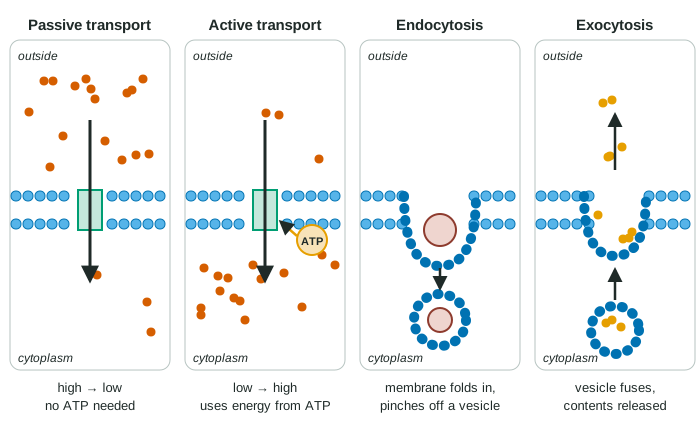
Exocytosis sends material out. A vesicle, often from the Golgi complex, moves to the plasma membrane and fuses with it, emptying its contents outside. This is the last step of the secretory pathway from topic 2.1: pancreas cells release insulin and digestive enzymes this way, and nerve cells release chemical signals. Each fused vesicle adds its membrane to the cell surface, so a cell that secretes a lot must take membrane back in by endocytosis to keep its size steady.
| Passive transport | Active transport | Bulk transport | |
|---|---|---|---|
| Direction | Down the gradient (high to low) | Against the gradient (low to high) | In (endocytosis) or out (exocytosis) |
| Energy from the cell | None | Yes, usually ATP | Yes |
| What moves | Single molecules and ions | Single molecules and ions | Large particles, fluid, many molecules at once |
| Through | The bilayer or a transport protein | A transport protein | Vesicles |
| Example | O₂ entering a red blood cell | Root cells taking up potassium | A white blood cell engulfing a bacterium |
Why it matters: an internal environment
A cell's insides are very different from its surroundings. An animal cell holds far more potassium and far less sodium than the fluid around it, and much more protein. Two things work together to keep it that way. Selective permeability slows the leaks: ions cross the bilayer only very slowly. Active transport repairs them: proteins powered by ATP keep moving ions back. The result is a stable internal environment.
Keeping internal conditions within a working range is called homeostasis. If a poison stops ATP production, active transport stops, the leaks continue, and the cell's ion differences slowly run down toward equal concentrations, a state in which the cell cannot survive.