A eukaryotic cell is not a bag of soup. It is divided by membranes into many separate spaces, the organelles, each with its own contents. This page explains why that arrangement matters: what it lets a cell do that one open space could not, how folded membranes add working area, and how prokaryotes, which have no membrane-bound organelles, still keep their insides organized.
Membranes make rooms
You have seen that a membrane blocks ions and most polar molecules, and that its transport proteins decide what crosses. Put a membrane around a small space and that space can hold a different mix of molecules from its surroundings. Dividing a cell into membrane-bound spaces is called compartmentalization, and each space is a compartment.
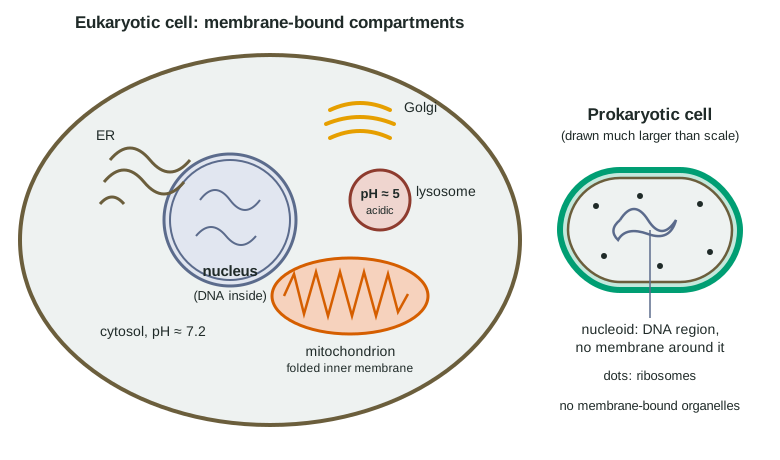
In an animal cell (Figure 1), the nucleus keeps the DNA behind its double membrane; the endoplasmic reticulum and Golgi form a network of sacs for building and packaging proteins and lipids; mitochondria and lysosomes are each sealed off. Each is a room with its own job.
Payoff 1: different conditions side by side
Lysosomes are full of enzymes that break down proteins, fats, sugars and nucleic acids. Proton pumps in the lysosome membrane spend ATP to push H⁺ inside, keeping it at about pH 5. The cytosol around it stays near pH 7.2. Two pH units is a hundredfold difference in H⁺ concentration, held across a membrane only a few nanometers thick.
Lysosomal enzymes work best in acid. At the cytosol's pH they work at only a small fraction of their top rate. That gives the cell two layers of protection: the membrane keeps the enzymes in, and if a few escape, the neutral cytosol all but switches them off.
Worked example: how much protection does pH give? A lysosomal enzyme works at 100% of its top rate at pH 5 and at 12% at pH 7. The drop is 100 ÷ 12 ≈ 8.3 times. An escaped enzyme in the cytosol does roughly an eighth of the damage it could do in its own compartment, and the cell has time to deal with it.
One cell holds several conditions at once. The mitochondrial matrix is slightly basic (about pH 7.8), the cytosol about 7.2, lysosomes about 5. Without membranes, these would mix into one average.
Payoff 2: keeping opposing processes apart
Some processes undo each other. Liver cells build fatty acids in the cytosol and break them down inside mitochondria. If both ran in the same space, newly built fatty acids could be taken straight apart again, a pointless cycle that burns energy. Separate compartments let the cell switch each process on or off without the other interfering.
Payoff 3: concentrating what reacts
A reaction runs faster when its starting molecules and enzymes are crowded together. A large cell has a lot of volume, and molecules spread through all of it would be dilute. Transport proteins can gather the molecules a process needs into a small compartment, where they stay concentrated. This is one reason eukaryotic cells, often 10 to 100 times wider than prokaryotic cells, can still work: compartments recreate small, concentrated spaces inside a large cell.
Folded membranes add area
Many jobs happen on membranes, carried out by proteins embedded in them. More membrane means room for more of those proteins. Some organelles pack extra membrane into a small space by folding it:
- Mitochondria: the inner membrane folds into ridges called cristae. It holds the proteins that make most of the cell's ATP. In a liver cell the inner mitochondrial membrane has about four to five times the area of the outer one.
- Chloroplasts: the light-absorbing proteins sit in thylakoids, flattened membrane sacs piled into stacks.
- The endoplasmic reticulum: a maze of folded sheets and tubes that can make up a third or more of all the membrane in a cell.
This is the same surface-area idea from topic 2.2, applied inside the cell: folding increases area without increasing volume.
| Advantage | How membranes provide it | Example |
|---|---|---|
| Separate conditions | Pumps set different ion levels or pH on each side | Lysosome at pH 5 in cytosol at pH 7.2 |
| Separate processes | Opposing sets of enzymes sit in different rooms | Fatty acids built in cytosol, broken down in mitochondria |
| Concentrated reactants | Transport proteins gather molecules into a small space | Enzymes and their target molecules packed into one organelle |
| More working surface | Folded or stacked membranes | Cristae, thylakoids, ER |
| Protection | Harmful contents kept behind a membrane | Digestive enzymes inside lysosomes |
Prokaryotes: organized without organelles
Prokaryotes (bacteria and archaea) have no membrane-bound organelles. They are small, so molecules reach every part of the cell quickly by diffusion. But "no organelles" does not mean "no organization":
- Their DNA gathers in one region, the nucleoid. Unlike a nucleus, it has no membrane around it.
- Some photosynthetic bacteria have sheets of internal membrane, folded in from the plasma membrane, that hold their light-capturing proteins: more membrane area, the same idea as thylakoids.
- Some bacteria build small compartments walled with protein instead of membrane, which hold particular enzymes together.
Ribosomes are found in every cell, prokaryotic and eukaryotic, so ribosomes alone never tell you which kind of cell you are looking at. A nucleus and other membrane-bound organelles do.
Common mistakes
- "Folding the membrane makes the organelle bigger." Folding adds area while the organelle stays about the same size.
- "Prokaryotes have a nucleus too, just a small one." They have a nucleoid, a region with no membrane around it.
- "Compartments make molecules move faster." They keep molecules concentrated and separated; movement between compartments actually needs transport.