By now you have met every way a substance can cross a membrane: simple diffusion through the bilayer, facilitated diffusion through channels and carriers, pumps that spend ATP, and bulk transport in vesicles. This page adds the last piece, cotransport, where a cell uses one gradient to move a second substance uphill, and then puts all the routes together so you can pick the right one for any substance.
Two kinds of active transport
Active transport moves a substance against its concentration gradient, from where it is scarce to where it is crowded. That always costs energy. The question is where the energy comes from.
- Primary active transport: the transport protein spends ATP itself. The sodium-potassium pump (3 Na⁺ out, 2 K⁺ in per ATP) is the main example in animal cells. Plant cells and fungi rely heavily on a proton pump, which spends ATP to push H⁺ out of the cell.
- Secondary active transport, or cotransport: the transport protein spends no ATP. It uses the energy stored in a gradient that a primary pump built, letting one substance flow down its gradient and dragging a second substance up its own.
Think of a water tower. A pump (primary transport) spends electricity lifting water into the tower. Later, water flowing down out of the tower can turn a wheel and do work (cotransport). The wheel uses no electricity, but it would stop if the pump stopped refilling the tower.
The sodium-glucose cotransporter
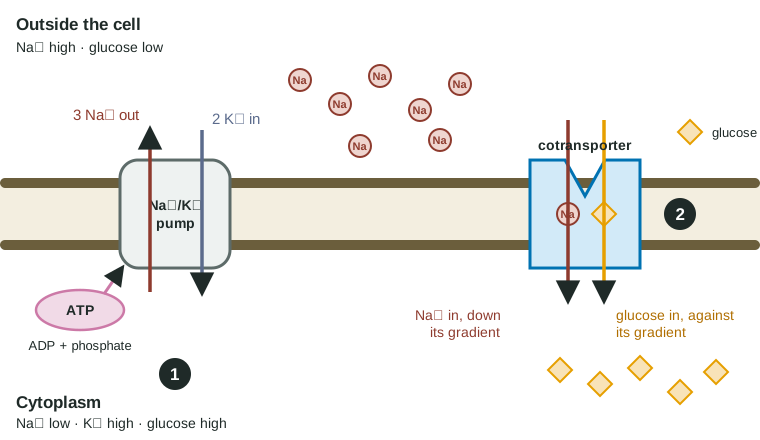
Cells lining your small intestine absorb glucose from digested food. As absorption goes on, the glucose left in the gut can fall below the level inside these cells, yet they keep taking it in. They do it with the sodium-glucose cotransporter (Figure 1):
- The sodium-potassium pump on the cell's blood-facing side spends ATP to keep Na⁺ low inside the cell.
- Na⁺ is crowded in the gut and scarce inside, and the inside is negative, so Na⁺ is strongly pushed inward.
- The cotransporter on the gut-facing side opens a path for Na⁺, but only when it also binds glucose. Two Na⁺ flow in with each glucose molecule.
- The energy released by Na⁺ flowing downhill pays for glucose moving uphill, so glucose can build up inside the cell to several times the gut level.
Worked example: what does one glucose cost? The cotransporter brings in 2 Na⁺ per glucose. The pump removes 3 Na⁺ per ATP. To pump out the 2 Na⁺ that came in with one glucose costs 2 ÷ 3 ≈ 0.67 ATP.
So the cell does pay for glucose uptake, about two-thirds of an ATP each, even though the cotransporter itself never uses ATP. The cost shows up at the pump.
Plant cells use the same trick with H⁺. The proton pump makes the space outside the membrane acidic, about pH 5.5 against pH 7.5 inside. Each pH unit is a tenfold change, so H⁺ is about 100 times more concentrated outside. An H⁺-sucrose cotransporter lets H⁺ back in and carries sucrose with it. This is how cells that load sugar for transport around the plant pack sucrose to high concentrations.
Symport and antiport
Cotransporters come in two arrangements:
- Symport: both substances cross in the same direction. The sodium-glucose cotransporter is a symporter (Na⁺ in, glucose in).
- Antiport: the two substances cross in opposite directions. Heart muscle cells use a Na⁺/Ca²⁺ exchanger, an antiporter that lets 3 Na⁺ in while it pushes 1 Ca²⁺ out. It keeps calcium low between heartbeats.
The sodium-potassium pump also moves two ions in opposite directions, but it spends ATP directly, so it is a pump, not a cotransporter.
What happens when the pump stops
Because cotransport spends a gradient, anything that stops the pump stops cotransport too, but not at once. The gradient already in place keeps the cotransporter working for a while. As Na⁺ keeps flowing in and nothing pumps it out, the gradient runs down, and uphill transport fades. In an experiment you see this as uptake that starts normally and then falls back. Two tests point to cotransport:
- Remove the driving ion (replace outside Na⁺ with another ion at the same concentration, so the solution's total solute stays the same) and uphill transport stops at once.
- Block the pump and uphill transport fails after a delay.
Choosing the route
Any substance's route across a membrane follows from three questions.
| Route | What uses it | Direction | Energy | Protein? |
|---|---|---|---|---|
| Simple diffusion | Small nonpolar molecules (O₂, CO₂, steroids) | Down the gradient | None | No |
| Facilitated diffusion | Ions, water, glucose and other polar molecules | Down the gradient | None | Channel or carrier |
| Primary active transport | Ions such as Na⁺, K⁺, H⁺, Ca²⁺ | Against the gradient | ATP, spent by the pump | Pump |
| Cotransport | Glucose, sucrose, amino acids, some ions | Against the gradient (for the carried substance) | A gradient built by a pump | Symporter or antiporter |
| Bulk transport | Large molecules, fluid, whole cells | In (endocytosis) or out (exocytosis) | ATP | No transport protein; vesicles |
- Is it small and nonpolar? Then it crosses the bilayer by simple diffusion.
- Is it charged or polar, and moving down its gradient? Then it uses a channel or carrier: facilitated diffusion.
- Is it moving against its gradient? Then it needs a pump (if it is an ion the cell pumps directly) or a cotransporter (if it rides on another ion's gradient).
- Is it a large molecule, a droplet of fluid or a whole cell? Then it crosses in vesicles: bulk transport.
Common mistakes
- "Cotransport is passive because it uses no ATP." It moves something uphill, so it is active; the energy was paid by the pump.
- "The pump and the cotransporter are unrelated because they are on different sides of the cell." Both face the same cytoplasm, and the pump sets the Na⁺ level the cotransporter depends on.
- "Antiport means one substance uses ATP and the other does not." Antiport only describes direction: the two substances cross in opposite directions.