Your body has tens of trillions of cells, and they act as one organism because they constantly pass information to each other. A cut finger, a meal, a scare: each sets off signals that change what cells far away are doing. This page is about the first part of that story: how a signal gets from one cell to another. You met receptors in topic 2.3 (a protein that a particular signaling molecule binds) and exocytosis in topic 2.5; both come back here. What happens inside the cell after the signal binds is topic 4.2.
Cells signal over different distances
Cell communication means one cell changing what another cell does. Almost always it works the same way: a signaling cell releases a chemical, the chemical reaches a target cell, and it binds a receptor protein there. What differs is the distance between the two cells, and that distance decides how fast the message arrives and how many cells hear it.
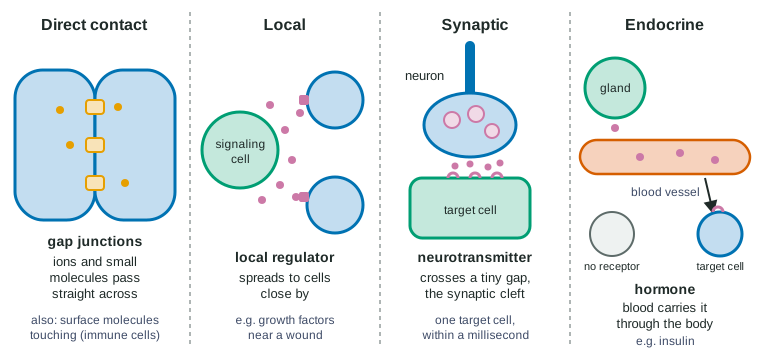
Figure 1 shows the four ranges you need to know. Read it left to right: as the distance grows, the signal reaches more cells but takes longer to get there.
Direct contact: cells that touch
The shortest route is no distance at all. Neighboring animal cells can be joined by gap junctions: clusters of protein channels that line up across both membranes and connect the two cytoplasms. Ions and small molecules (sugars, amino acids, small signaling molecules) pass straight through. Large molecules such as proteins do not fit. In heart muscle, gap junctions let the electrical change that triggers a contraction spread from cell to cell, so the cells contract together as one beat.
Plant cells are wrapped in cell walls, but they have their own version: plasmodesmata, channels that run through the walls and join the cytoplasms of neighboring cells. Sugars and signals move from cell to cell through them.
Cells can also signal by touching surface molecules. The immune system depends on this. An antigen-presenting cell takes in a pathogen (a disease-causing agent such as a bacterium), cuts its proteins into fragments and displays those fragments, called antigens, on its surface. A helper T cell whose receptor fits that antigen is activated only when it touches the presenting cell. Once active, it releases signals that rally other immune cells. Killer T cells also work by contact: they recognize infected cells of the body by the virus antigens they display and destroy them. Because activation needs a physical match, only the T cells that recognize this particular pathogen are switched on.
Local signaling: the cells next door
In local signaling, a cell releases a local regulator into the fluid between cells, and it diffuses to cells nearby (this is also called paracrine signaling). The signal does not travel far, because it is diluted as it spreads and is quickly broken down or taken up. That is the point: the effect stays where it is needed.
Growth factors are a classic example. When you cut your skin, platelets in the clot release a growth factor; nearby skin and connective tissue cells bind it and start to divide, closing the wound. Cells a few centimeters away never notice. Sometimes a cell even responds to the signal it released itself, which is called autocrine signaling.
Synaptic signaling: fast and aimed
A neuron is a nerve cell with a long extension that carries an electrical signal (a change in the membrane potential you met in topic 2.6). When the electrical signal reaches the end of the neuron, vesicles fuse with the membrane and release a neurotransmitter by exocytosis. The neurotransmitter crosses the synaptic cleft, a gap of only a few tens of nanometers, and binds receptors on the target cell: another neuron, a muscle cell or a gland cell. The junction is called a synapse.
Because the gap is tiny and the neurotransmitter is released right next to one cell, synaptic signaling takes about a millisecond and reaches exactly one target. Enzymes in the cleft break the neurotransmitter down quickly, so each signal is brief. The exam groups synaptic signaling with local signaling: both act over short distances.
Endocrine signaling: hormones in the blood
In endocrine signaling, gland cells release a hormone into the blood. Blood circulates through the whole body in about a minute, so a hormone reaches nearly every cell. That does not mean every cell responds. Only target cells, the ones that make a receptor the hormone binds, respond. Insulin, released by beta cells of the pancreas after a meal, binds receptors on muscle, fat and liver cells, which then take glucose out of the blood. Red blood cells and most brain cells use glucose without waiting for insulin.
Hormones act more slowly than neurotransmitters (seconds to minutes to arrive, often hours for the full effect) but they can coordinate tissues all over the body at once. Plants use hormones too, moved through the plant body rather than blood.
| Direct contact | Local (including synaptic) | Long-distance (endocrine) | |
|---|---|---|---|
| How the signal travels | Through gap junctions or plasmodesmata, or by touching surface molecules | Diffuses through tissue fluid; across a synaptic cleft | Carried in the blood (in plants, through the plant body) |
| Typical distance | Zero: the cells touch | Tens of nanometers (synapse) to about a millimeter | Anywhere in the body |
| Speed | Very fast | About a millisecond (synapse) to seconds | Seconds to minutes to arrive; effects can last hours |
| Cells reached | The touching neighbor | One cell (synapse) or a small patch of tissue | Every target cell in the body |
| Examples | Heart muscle gap junctions; plasmodesmata; helper T cell and antigen-presenting cell | Growth factor at a wound; neurotransmitter at a muscle | Insulin; testosterone and estrogen |
Bacteria talk too: quorum sensing
Single-celled organisms signal as well. Many bacteria release a small molecule called an autoinducer at a low rate. One cell alone makes too little to matter: its autoinducer diffuses away. But in a crowded space, every cell is adding autoinducer to the same small volume, so its concentration rises with cell density (the number of cells per volume). When the concentration crosses a threshold, enough receptor proteins in each cell are bound, and every cell switches on the same set of genes at about the same time. In many species those genes include the one for the enzyme that makes the autoinducer, so once the switch flips the cells make even more signal, which holds the switch on. This is quorum sensing: the bacteria act together only when there are enough of them for the action to work.
The glowing squid bacterium, Vibrio fischeri, uses quorum sensing to switch on its light genes. A few cells' light would be wasted; billions packed in the squid's light organ make a visible glow. Other bacteria use quorum sensing to switch on the genes for a sticky protective layer (a biofilm) or for the toxins that cause disease, which are useless in small numbers but overwhelm a host's defenses when released by a large group at once.
Worked example: reading a quorum-sensing graph. A culture's light per cell is 2 units at 2 × 10⁸ cells/mL, 8 units at 3 × 10⁸ and 430 units at 6 × 10⁸.
Step 1, compare the change in density with the change in light. From 3 to 6 × 10⁸ cells/mL, density doubles. Light per cell rises from 8 to 430: 430 ÷ 8 ≈ 54 times.
Step 2, interpret. If each cell simply made a fixed amount of light, light per cell would stay the same as density rose. A 54-fold jump while density merely doubles means the cells have switched something on. That switch is the signature of quorum sensing: little change below a threshold density, then a steep rise.
Step 3, test it. A strain that cannot make autoinducer stays dark at every density, and adding the autoinducer by hand makes it glow even at low density. That shows the autoinducer, not crowding itself, is the signal.
Common mistakes
- "Hormones act on every cell they reach." They reach nearly every cell, but only cells with the matching receptor respond.
- "Local signals are weaker than hormones." Local signals act over a short distance, not with less effect; a growth factor can make cells divide.
- "Quorum sensing means bacteria count each other." No cell counts anything: the concentration of autoinducer simply rises with cell density until it crosses a threshold.
- "Gap junctions let anything through." They pass ions and small molecules, not proteins or other large molecules.
How the exam tests this
- Classify a signal by range (direct contact, local, synaptic, endocrine) from a short description, and explain the trade-off between speed and reach.
- Explain why only some exposed cells respond to a hormone (receptors).
- Read quorum-sensing data: light, toxin or biofilm output against cell density, often with strains that cannot make or detect the autoinducer.
- Evaluate an experiment on contact signaling: what a filter, a blocker or a missing component rules out.