Meiosis
Meiosis makes haploid gametes from a diploid cell.
Part 1 · Hook
Why this matters
Every cell in your body has 46 chromosomes, and so did every cell in each of your parents. You began as one cell, made when a sperm joined an egg. If each of those had carried 46 chromosomes, you would have started with 92, your children with 184, and within a few generations no cell could hold them. That does not happen, because the cells that make sperm and eggs use a special division that cuts the chromosome number exactly in half. This topic shows how that division works and how it differs from mitosis.
Part 2 · Before you start
What this builds on
Part 3 · Prerequisite check
Quick check before you start
1. After S phase, one chromosome consists of
- two identical sister chromatids joined at a centromere
- two different chromosomes, one from each parent
- a single DNA molecule with twice the usual length
Show the answer
S phase copies each DNA molecule; the two identical copies stay joined at the centromere as sister chromatids.
- Correct: two identical sister chromatids joined at a centromere:
- two different chromosomes, one from each parent:
- a single DNA molecule with twice the usual length:
2. A cell with 8 chromosomes in G1 finishes mitosis and cytokinesis. How many chromosomes does each daughter cell have?
- 8
- 4
- 16
Show the answer
Mitosis gives each daughter cell one copy of every chromosome, so the number stays at 8.
- Correct: 8:
- 4:
- 16:
3. A gene is
- a stretch of DNA that carries the information for a product such as a protein
- a whole chromosome
- a protein that copies DNA
Show the answer
A gene is a segment of DNA; one chromosome carries many genes.
- Correct: a stretch of DNA that carries the information for a product such as a protein:
- a whole chromosome:
- a protein that copies DNA:
Part 4 · See it
See it first
Part 5 · Step by step
How it works, step by step
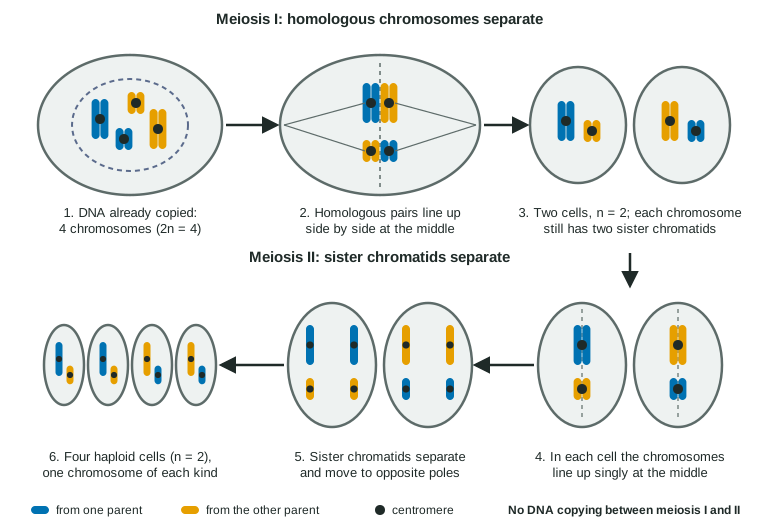
- Before meiosis, the cell copies its DNA in S phase, as before mitosis.Every chromosome is two identical sister chromatids, and the cell is still diploid: each kind of chromosome is present twice, one homolog from each parent.
- Early in meiosis I, each chromosome finds its homolog and pairs with it along its whole length (synapsis).The cell now holds its chromosomes as pairs, each pair four chromatids thick.
- Spindle fibers from opposite poles attach to the two homologs of each pair, and the pairs line up side by side across the middle.One homolog of every pair faces each pole.
- The homologs of each pair are pulled to opposite poles while their sister chromatids stay joined, and the cell divides.Two cells form, each haploid: one chromosome of each kind, each still made of two sister chromatids.
- Without copying DNA again, each cell starts meiosis II: chromosomes line up singly and their sister chromatids separate, as in mitosis.Four haploid cells form from the one diploid cell, each with half the parent's chromosome number.
- At fertilization a haploid sperm and a haploid egg join.The zygote is diploid again, with one set of chromosomes from each parent, so the chromosome number stays the same from one generation to the next.
Part 6 · Key ideas
Key ideas
- Diploid cells (2n) hold two sets of chromosomes, one from each parent; haploid cells (n) hold one set. In humans 2n = 46 and n = 23.
- Homologous chromosomes carry the same genes in the same order but may carry different alleles (versions of a gene). Sister chromatids are identical copies; homologs are not.
- Meiosis is one round of DNA copying followed by two divisions. Meiosis I separates homologs and halves the chromosome number; meiosis II separates sister chromatids.
- Meiosis makes four haploid gametes (or spores) that differ from each other; mitosis makes two diploid cells identical to the parent.
- Fertilization restores the diploid number, so in sexual reproduction meiosis and fertilization alternate every generation.
Part 7 · Misconception
A common mistake
The wrong idea: Meiosis I separates sister chromatids, just like mitosis, and meiosis II then halves the chromosome number.
What actually happens: Meiosis I separates homologous chromosomes, and that is what halves the number: each cell gets one of each pair. Sister chromatids stay together until meiosis II, which works like mitosis in a haploid cell.
Part 8 · Check yourself
Check yourself
Exam-style questions. Anything you miss goes into your review queue.
Graph
DNA content of one cell through meiosis
In a lily flower, cells inside the anther (the part that makes pollen) divide by meiosis. Lily body cells have 2n = 24. Researchers measured the DNA content of one such cell every 2 hours, starting in G1, using a dye whose brightness is proportional to DNA. After each division they followed one of the new cells. DNA content is in relative units, with the cell in G1 set at 2.
Data table
| Time (h) | DNA per cell |
|---|---|
| 0 | 2 |
| 2 | 2 |
| 4 | 2 |
| 6 | 2.6 |
| 8 | 3.4 |
| 10 | 4 |
| 12 | 4 |
| 14 | 4 |
| 16 | 4 |
| 18 | 4 |
| 20 | 4 |
| 22 | 2 |
| 24 | 2 |
| 26 | 2 |
| 28 | 1 |
| 30 | 1 |
| 32 | 1 |
1. During which interval is the cell copying its DNA?
- From 4 to 10 hours
- From 20 to 22 hours
- From 26 to 28 hours
- From 10 to 20 hours
Show the answer
DNA content rises from 2 to 4 between 4 and 10 hours: that is S phase, when each DNA molecule is copied.
- Correct: From 4 to 10 hours: The only rise in the graph is from 2 to 4 units between 4 and 10 hours, which is DNA copying.
- From 20 to 22 hours: DNA content falls here, from 4 to 2: the cell divided at the end of meiosis I.
- From 26 to 28 hours: DNA content falls here, from 2 to 1: the cell divided at the end of meiosis II.
- From 10 to 20 hours: DNA content stays at 4 here: copying is finished and the cell is preparing for and starting meiosis I.
2. A cell at 2 hours and a cell at 24 hours both have a DNA content of 2. How do their chromosomes differ?
- At 24 hours: 12 chromosomes of two chromatids each. At 2 hours: 24 chromosomes of one chromatid each.
- At 24 hours: 24 chromosomes of two chromatids each. At 2 hours: 12 chromosomes of one chromatid each.
- They do not differ: cells with the same DNA content have the same number and kind of chromosomes.
- At 24 hours: 12 chromosomes of one chromatid each. At 2 hours: 24 chromosomes of two chromatids each.
Show the answer
At 2 hours the cell is in G1: 24 chromosomes, each one DNA molecule. At 24 hours meiosis I is over: homologs have separated, so the cell has 12 chromosomes, but each still has two sister chromatids. 12 × 2 = 24 DNA molecules either way, so the DNA content matches.
- Correct: At 24 hours: 12 chromosomes of two chromatids each. At 2 hours: 24 chromosomes of one chromatid each.: Meiosis I halves the number of chromosomes but leaves each one with two chromatids, so the DNA content equals that of a G1 cell.
- At 24 hours: 24 chromosomes of two chromatids each. At 2 hours: 12 chromosomes of one chromatid each.: This has the numbers reversed: the G1 cell is the diploid one, and meiosis I halves the chromosome count.
- They do not differ: cells with the same DNA content have the same number and kind of chromosomes.: DNA content counts DNA molecules, not chromosomes. 24 single-chromatid chromosomes and 12 two-chromatid chromosomes hold the same amount.
- At 24 hours: 12 chromosomes of one chromatid each. At 2 hours: 24 chromosomes of two chromatids each.: Sister chromatids do not separate until meiosis II, so a cell between the two divisions still has two chromatids per chromosome; a G1 cell has one.
3. In a second experiment, a drug that stops spindle fibers from forming was added at 12 hours. The cells stayed alive, did not divide and did not copy their DNA again. Predict the DNA content of a cell at 30 hours.
- 4 units
- 2 units
- 1 unit
- 8 units
Show the answer
The DNA was already copied by 10 hours. Without a spindle, chromosomes are not pulled to the poles, so neither division happens and the cell keeps its doubled DNA content of 4.
- Correct: 4 units: Copying finished before the drug was added, and the blocked cell does not divide, so it keeps 4 units.
- 2 units: Falling to 2 units needs the first division, which needs the spindle to pull homologs apart.
- 1 unit: Falling to 1 unit needs both divisions; the drug blocks the spindle that drives each of them.
- 8 units: Reaching 8 units would need a second round of copying, which the question rules out.
Model
Four dividing cells from one plant
A student looked at stained cells from a plant whose body cells have 2n = 6: two long, two medium and two short chromosomes. She described four cells, W to Z, from different parts of the plant. All four were stopped while their chromosomes were condensed.
| Cell | Chromosomes in the cell | Sister chromatids per chromosome | How the chromosomes are arranged |
|---|---|---|---|
| W | 6 | 2 | Lined up singly in one row across the middle; two of each length |
| X | 6 | 2 | Lined up as three side-by-side pairs across the middle; the two in each pair have the same length |
| Y | 3 | 2 | Lined up singly in one row across the middle; one of each length |
| Z | 3 | 1 | Loose inside a nucleus; one of each length |
4. Which cell is in metaphase of meiosis I?
- Cell X
- Cell W
- Cell Y
- Cell Z
Show the answer
Only in meiosis I do homologous chromosomes line up as side-by-side pairs, as in cell X.
- Correct: Cell X: Paired homologs lined up across the middle are the mark of metaphase I.
- Cell W: Six chromosomes lined up singly, two of each length, is metaphase of mitosis in a diploid cell.
- Cell Y: Three chromosomes lined up singly, one of each length, is metaphase II in a haploid cell.
- Cell Z: Single-chromatid chromosomes inside a nucleus: this cell has finished meiosis.
5. Cells W and Y both have chromosomes lined up singly across the middle. Which observation shows that Y is in meiosis II rather than mitosis?
- Y holds one chromosome of each length, so the homologs have already been separated.
- Each of Y's chromosomes is made of two sister chromatids.
- Y's chromosomes are lined up in one row across the middle of the cell.
- Y has fewer chromosomes because three were broken down during meiosis I.
Show the answer
A diploid cell in mitosis (W) has two of each kind. Y has one of each kind: it is haploid, which a cell becomes only after meiosis I has separated the homologs.
- Correct: Y holds one chromosome of each length, so the homologs have already been separated.: Being haploid, one of each kind, is the evidence that meiosis I has already happened.
- Each of Y's chromosomes is made of two sister chromatids.: W's chromosomes also have two sister chromatids, so this does not tell the two apart.
- Y's chromosomes are lined up in one row across the middle of the cell.: W's chromosomes are lined up the same way, so the arrangement alone does not tell them apart.
- Y has fewer chromosomes because three were broken down during meiosis I.: Chromosomes are not broken down in meiosis I; homologs are shared between the two new cells.
6. Suppose a plant with 2n = 14 made its sperm and egg cells by mitosis instead of meiosis. What would its offspring's chromosome number be, and why?
- 28, because two gametes with 14 chromosomes each would join
- 14, because mitosis keeps the chromosome number the same
- 7, because each gamete would carry half of the 14
- 14, because fertilization would halve the number again
Show the answer
Mitosis would give gametes the full 14 chromosomes. Fertilization adds the egg's and the sperm's chromosomes together: 14 + 14 = 28, double the parent's number.
- Correct: 28, because two gametes with 14 chromosomes each would join: Fertilization adds two gametes' chromosomes, so 14 + 14 = 28.
- 14, because mitosis keeps the chromosome number the same: Mitosis keeps 14 in the gametes, but the offspring gets two gametes' worth.
- 7, because each gamete would carry half of the 14: Halving is what meiosis does; gametes made by mitosis would keep all 14.
- 14, because fertilization would halve the number again: Fertilization combines chromosomes; it never halves them.
7. Compare a sperm cell made by a man's meiosis with one of his skin cells in G1. For the sperm cell, predict whether each value is higher (up), lower (down) or the same (no change).
| Variable | Change |
|---|---|
| Number of chromosomes | — |
| Amount of DNA in the nucleus | — |
| Number of different kinds of autosome (each kind counted once) | — |
| Number of copies of chromosome 1 | — |
Show the answer
Meiosis halves the chromosome number by sending one homolog of each pair to each gamete, so the gamete keeps every kind of chromosome but only one copy of each.
- Number of chromosomes: decreases. Meiosis halves the number: 23 in the sperm cell, 46 in the skin cell.
- Amount of DNA in the nucleus: decreases. Half as many chromosomes, each a single chromatid, means half the DNA of a G1 skin cell.
- Number of different kinds of autosome (each kind counted once): no change. Meiosis gives each gamete one of every pair, so the sperm cell still has all 22 kinds of autosome, just one copy of each.
- Number of copies of chromosome 1: decreases. The skin cell has a homologous pair (two copies); the sperm cell received one of them.
8. Select the statements that are true of both meiosis II and mitosis.
- Sister chromatids separate and move to opposite poles.
- Chromosomes line up singly across the middle of the cell.
- Homologous chromosomes pair before lining up.
- The division begins straight after an S phase.
- The division turns a diploid cell into haploid cells.
Show the answer
Meiosis II works like mitosis: chromosomes line up singly and their sister chromatids separate. What differs is that meiosis II happens in haploid cells with no S phase before it.
- Correct: Sister chromatids separate and move to opposite poles.: Both divisions end by separating sister chromatids.
- Correct: Chromosomes line up singly across the middle of the cell.: In both, chromosomes line up one by one, not in pairs.
- Homologous chromosomes pair before lining up.: Homolog pairing happens in meiosis I, not in meiosis II or mitosis.
- The division begins straight after an S phase.: Mitosis follows an S phase, but meiosis II follows meiosis I with no copying in between.
- The division turns a diploid cell into haploid cells.: Meiosis II starts with haploid cells, and mitosis keeps the number the same; meiosis I is the step that halves it.
Part 9 · Summary
Summary
Meiosis makes haploid gametes from a diploid cell. The DNA is copied once, in S phase, and then the cell divides twice. In meiosis I, homologous chromosomes pair, line up side by side across the middle and separate to opposite poles, so each of the two cells is haploid but its chromosomes still have two sister chromatids. In meiosis II, with no further copying, the chromosomes line up singly and their sister chromatids separate, giving four haploid cells. Fertilization of a haploid egg by a haploid sperm restores the diploid number. Mitosis keeps the chromosome number and makes identical cells; meiosis halves it and makes cells that differ.
Part 10 · Up next
What comes next
Part 11 · Connections