Topic 7.1 laid out the logic of natural selection. This page asks what decides which traits win. The answer is the environment, which keeps changing, acting on variation that starts in molecules and cells. It also sorts selection into patterns: directional, stabilizing, disruptive, sexual and frequency-dependent.
Favorable depends on where you live: the peppered moth
The peppered moth of Britain rests on tree trunks by day, where birds hunt it by sight. Most moths were once pale and speckled, a near-perfect camouflage on lichen-covered bark. A black form, caused by a dominant allele, was first recorded near Manchester in 1848. Coal smoke from factories was killing the lichen and coating trees in soot, and on dark bark the pale moths stood out. By 1895 about 98% of the moths around Manchester were black. This rise of dark forms in sooty regions is called industrial melanism.
After Britain passed clean-air laws (the Clean Air Act of 1956), the soot faded and lichen returned. Within a few decades the black form became rare again in most of the country. Experiments that released and recaptured marked moths, and later studies of birds eating moths resting on real trees, showed that birds take more of the moths that contrast with the bark.
| Environment | Bark | Moth that birds find more easily | Favorable trait |
|---|---|---|---|
| Clean air (before 1850, after about 1970) | Pale, covered with lichen | Black | Pale wings |
| Heavy soot (late 1800s to mid-1900s) | Dark, lichen dead | Pale | Black wings |
The lesson is general: an adaptive trait is adaptive in a particular environment. Whether a trait is a favorable trait is not a fixed property of the trait. Change the environment and a once-helpful trait can become neutral or harmful.
Where phenotypes come from: molecules and cells
Phenotypic variation, the differences we can observe among individuals, comes from molecular variation: alleles that code for slightly different proteins, or that change how much of a protein a cell makes. Selection acts on the phenotype, but the phenotype is built from these molecules.
- Hemoglobin at altitude. Deer mice living high in the Rocky Mountains carry hemoglobin variants, differing by a few amino acids, that bind oxygen more tightly. In thin air their blood loads more oxygen in the lungs, which helps them stay active and warm through cold nights. At low altitude the same variants give no clear advantage, and they are rare there.
- Enzymes and temperature. A small coastal fish, the killifish, has two common alleles for the enzyme lactate dehydrogenase. The enzyme made by the "northern" allele works faster in cold water. That allele is common in cold northern waters and rare in warm southern ones.
- Lactase in adults. In most mammals the gene for lactase, the enzyme that digests milk sugar, switches off after weaning. Mutations in a DNA region that regulates the gene keep it switched on for life. These alleles are common in human populations with a long history of keeping dairy animals, where adults who could digest milk got more food energy, and rare elsewhere.
In each case one change at the molecular level alters how a cell or organ works, which changes survival or reproduction in one environment but not another.
Biotic and abiotic selective pressures
Selective pressures come from two sources. Biotic factors are living: predators, parasites, disease-causing microbes, competitors, food organisms and potential mates. Abiotic factors are nonliving: temperature, rainfall, salinity, sunlight, soil chemistry, soot from factories. Birds eating moths are a biotic pressure; the soot that changed the bark was abiotic. Often both act together.
Three patterns of selection
Many traits, such as beak depth or birth weight, are polygenic and vary smoothly. Plot how many individuals have each value and you get a bell-shaped curve. Selection can change that curve in three ways (Figure 1).
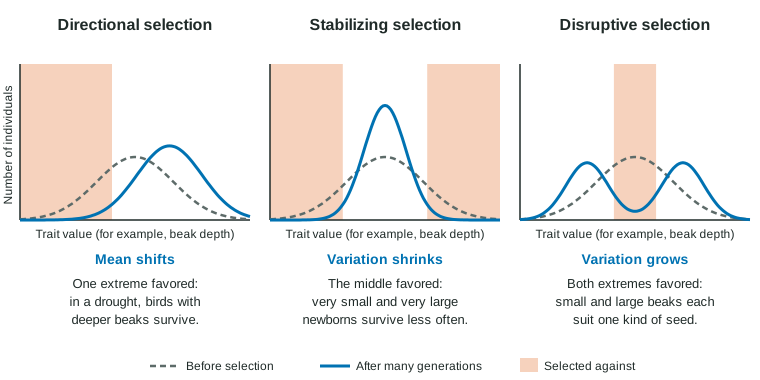
| Pattern | Values favored | Effect on the mean | Effect on variation | Example |
|---|---|---|---|---|
| Directional | One extreme | Shifts toward that extreme | May shrink slowly | In a drought that leaves only large, hard seeds, finches with deeper beaks survive more |
| Stabilizing | Intermediate values | Stays about the same | Shrinks | Human babies of middle birth weight have historically survived best |
| Disruptive (diversifying) | Both extremes | May stay the same | Grows; can give two peaks | An African finch whose small-beaked birds eat soft seeds and large-beaked birds crack hard ones; mid-sized beaks do neither well |
Worked example: naming the pattern from data. Researchers measured the body length of 100 young fish before a flood and counted survivors after it.
Before: 10 small, 30 small-medium, 40 medium, 15 medium-large, 5 large. Survivors: 1, 9, 24, 12, 5.
Step 1. Work out survival in each class: 1 ÷ 10 = 10%, 9 ÷ 30 = 30%, 24 ÷ 40 = 60%, 12 ÷ 15 = 80%, 5 ÷ 5 = 100%. Step 2. Look at the trend: survival rises steadily with size. Step 3. Name it: one extreme (large) is favored, so this is directional selection, and if length is heritable the mean length of the next generation should increase.
Sexual selection
Some traits help an individual mate rather than survive. Sexual selection favors them in two ways. In mate choice, members of one sex, usually females, prefer partners with certain traits: long tails, bright colors, elaborate songs. In competition within a sex, individuals fight or display for access to mates, which favors size, weapons such as antlers, and strength. Because these pressures act mostly on one sex, males and females can come to look very different, a pattern called sexual dimorphism. A peacock's huge tail makes it easier for predators to catch, but if it brings many more matings, alleles for long tails still spread: fitness counts offspring, not survival alone.
Frequency-dependent selection
Sometimes a phenotype's success depends on how common it is. In Lake Tanganyika, a fish that feeds by biting scales off other fish has a mouth twisted either to the right or to the left, and each kind attacks one side of its prey. When right-twisted biters are common, prey watch that side, and the rarer left-twisted biters do better, leave more offspring, and become more common, until the advantage flips. In this frequency-dependent selection, being rare is an advantage, so both forms persist.