Every cell in your body is breaking down food right now to make ATP. Cellular respiration does it in a series of small steps, so that the energy in glucose is released bit by bit and much of it can be caught as ATP instead of escaping as heat all at once. If you have just studied photosynthesis (topic 3.5), you already know the most important machine in this page: an electron transport chain that builds an H⁺ gradient, and ATP synthase that uses it.
The big picture
C₆H₁₂O₆ + 6 O₂ → 6 CO₂ + 6 H₂O + energy (about 30-32 ATP + heat)
This is a redox reaction (topic 3.4). Glucose is oxidized: its carbons leave as CO₂ and its electrons are passed, through carriers, to oxygen. Oxygen is reduced: it accepts the electrons and hydrogen ions and becomes water. Electrons moving toward oxygen release energy, like water running downhill, and the cell captures part of it as ATP.
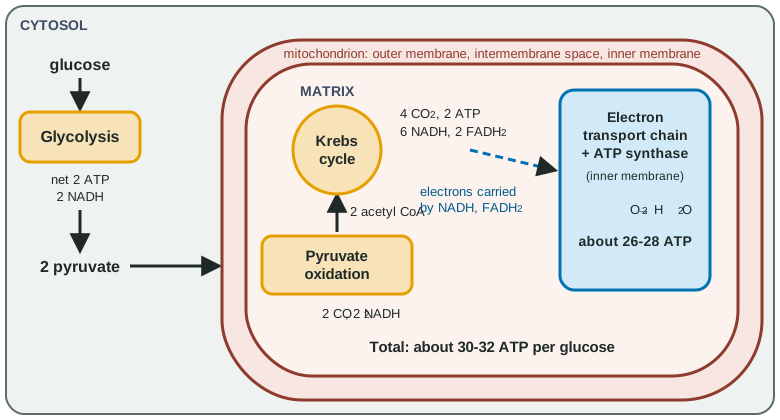
Two electron carriers shuttle the electrons: NAD⁺, which becomes NADH, and FAD, which becomes FADH₂. Think of them as empty and full delivery trucks. The stages and where they happen are in Figure 1.
Stage 1: glycolysis (cytosol)
Glycolysis ("sugar splitting") breaks one glucose (six carbons) into two pyruvate (three carbons each). It spends 2 ATP to get started and makes 4, a net gain of 2 ATP, by moving phosphate groups straight from intermediate molecules onto ADP: substrate-level phosphorylation. It also loads 2 NADH.
Glycolysis needs no oxygen and no organelles, and it runs in nearly every living cell, which suggests it is very ancient. It does need a steady supply of NAD⁺; that detail matters later.
Stage 2: pyruvate oxidation and the Krebs cycle (matrix)
With oxygen present, pyruvate is carried into the mitochondrial matrix. In pyruvate oxidation, each pyruvate loses one carbon as CO₂ and gives electrons to NAD⁺. The two-carbon piece left, attached to a carrier, is acetyl CoA.
The Krebs cycle (also called the citric acid cycle) joins acetyl CoA to a four-carbon molecule and, in a loop of steps, strips it down again, releasing the two carbons as CO₂. Most of the energy goes into NADH and FADH₂; a little makes ATP directly. You do not need the steps, only the inputs and outputs.
| Stage | Where | CO₂ | ATP (direct) | NADH | FADH₂ |
|---|---|---|---|---|---|
| Glycolysis | Cytosol | 0 | 2 (net) | 2 | 0 |
| Pyruvate oxidation | Matrix | 2 | 0 | 2 | 0 |
| Krebs cycle | Matrix | 4 | 2 | 6 | 2 |
| Electron transport + ATP synthase | Inner membrane | 0 | about 26-28 | (used) | (used) |
By the end of the Krebs cycle, all six carbons of glucose have left as CO₂. That is where the carbon dioxide you breathe out comes from.
Stage 3: oxidative phosphorylation (inner membrane)
Now the full trucks unload (Figure 2).
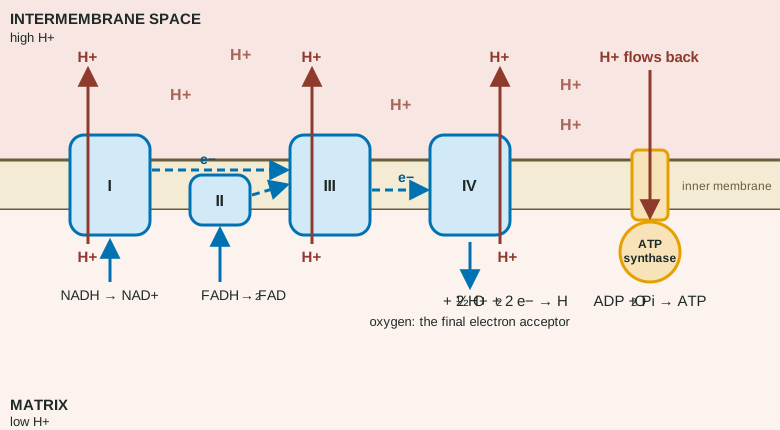
- Electrons enter. NADH gives its electrons to the first protein of the electron transport chain in the inner membrane; FADH₂ gives its electrons a little further along, so it supports less pumping. NAD⁺ and FAD go back to be reloaded.
- H⁺ is pumped. As electrons pass from protein to protein, each step releases energy, and three of the proteins use it to pump H⁺ from the matrix into the intermembrane space. The folded inner membrane (cristae) holds thousands of these chains.
- Oxygen accepts the electrons. At the end, O₂ takes the electrons and combines with H⁺ to form water. Oxygen is the final electron acceptor. Without it, electrons have nowhere to go, the chain backs up, and pumping stops.
- ATP synthase makes ATP. H⁺ flows back into the matrix down its gradient through ATP synthase, which joins ADP and Pi. This is chemiosmosis again; here it is called oxidative phosphorylation because the energy comes from electrons passed to oxygen.
| Chloroplast (3.5) | Mitochondrion (3.6) | |
|---|---|---|
| Source of electrons | Water | NADH and FADH₂ from food |
| Energy that drives the electrons | Light | Moving toward oxygen |
| Final electron acceptor | NADP⁺ | O₂ |
| H⁺ pumped into | Thylakoid space | Intermembrane space |
| ATP made in | Stroma | Matrix |
In all, a cell gets about 30-32 ATP per glucose. Older textbooks say 36-38; the true number varies with how many H⁺ each chain pumps and how NADH from glycolysis enters the mitochondrion, so do not build an argument on the exact figure.
Poisons, uncouplers and experiments
Because the chain and ATP synthase are linked through the gradient, blocking one part affects the others. These predictions are a favorite on the exam.
- Block the end of the chain (cyanide, carbon monoxide): no electrons reach O₂, so O₂ use stops, pumping stops, the gradient fades and ATP synthesis stops.
- Block ATP synthase (the drug oligomycin): H⁺ cannot return, so the gradient builds until the chain can no longer pump against it. O₂ use slows sharply even though the chain itself is untouched.
- Make the membrane leaky to H⁺ (an uncoupler such as DNP): H⁺ returns without passing through ATP synthase. The chain runs at full speed and O₂ use rises, but little ATP is made; the energy is released as heat.
Worked example: reading an oxygen trace. Isolated mitochondria with fuel use O₂ at 4 nmol/mL per minute. ADP and Pi are added: (232 − 152) ÷ 4 min = 20 per minute. Oligomycin is added: 3 per minute. DNP is added: (140 − 20) ÷ 4 min = 30 per minute. Cyanide is added: 0.
Reading it: adding ADP lets ATP synthase run, so H⁺ returns and the chain speeds up. Oligomycin blocks the return, so the chain stalls. DNP opens a new return route, so the chain runs faster than ever, making heat, not ATP. Cyanide blocks the transfer to O₂, so everything stops.
In class, oxygen use is often measured with a respirometer: a sealed vial of germinating seeds with a chemical (KOH) that absorbs CO₂, so the shrinking gas volume shows O₂ taken up. A vial of glass beads corrects for temperature and pressure changes, and dry, dormant seeds show how much less a resting seed respires.
Without oxygen: fermentation
When O₂ runs out, the chain stops, NADH cannot unload, and the cell's small supply of NAD⁺ is soon all used up as NADH. Without NAD⁺, glycolysis stops too, and with it the last source of ATP.
Fermentation solves this by giving NADH's electrons to pyruvate (or a molecule made from it), turning NADH back into NAD⁺. It makes no ATP of its own; it just keeps glycolysis's 2 ATP per glucose coming.
- Lactic acid fermentation (your muscles during hard exercise, some bacteria used to make yogurt): pyruvate becomes lactate. No CO₂.
- Alcohol fermentation (yeast, used in bread and brewing): pyruvate loses CO₂ and becomes ethanol. That CO₂ makes bread rise.
Worked example: yeast with and without oxygen. In one hour, yeast with O₂ used 0.45 mmol glucose and released 2.70 mmol CO₂; without O₂ they used 1.90 mmol glucose and released 3.80 mmol CO₂ and 3.78 mmol ethanol.
With O₂: 2.70 ÷ 0.45 = 6 CO₂ per glucose: complete oxidation. ATP ≈ 0.45 × 30 = 13.5 mmol.
Without O₂: 3.80 ÷ 1.90 = 2 CO₂ per glucose, with 2 ethanol: alcohol fermentation. ATP = 1.90 × 2 = 3.8 mmol, even though four times as much glucose was used.
| Aerobic respiration | Fermentation | |
|---|---|---|
| Needs O₂? | Yes, as final electron acceptor | No |
| Stages | Glycolysis, pyruvate oxidation, Krebs cycle, oxidative phosphorylation | Glycolysis, then pyruvate reduced |
| Where | Cytosol and mitochondria | Cytosol |
| ATP per glucose | About 30-32 | 2 |
| End products | CO₂ and H₂O | Lactate, or ethanol and CO₂ |
| How NAD⁺ is regenerated | Electron transport chain | Electrons passed to pyruvate |
Some prokaryotes carry out anaerobic respiration: they have an electron transport chain but use a different final electron acceptor, such as sulfate. That is not fermentation.
Other fuels and body heat
Cells also burn fats and proteins. Fats are split into glycerol and fatty acids; fatty acids are cut into two-carbon pieces that enter as acetyl CoA. Because fatty acids carry far more hydrogen per carbon than glucose, they load more NADH and FADH₂, so a gram of fat yields more than twice the ATP of a gram of sugar. Amino acids lose their nitrogen and their carbon skeletons enter glycolysis or the Krebs cycle.
Only part of the energy in food ends up in ATP, and every use of ATP releases more as heat (the second law, topic 3.4). This metabolic heat is what endotherms such as birds and mammals use to keep warm (topic 2.2). Some go further: brown fat, found in newborn babies and hibernating animals, has an uncoupling protein (UCP1, also called thermogenin) in its inner mitochondrial membrane. It lets H⁺ leak back into the matrix without making ATP, so the chain runs fast and the gradient's energy is released as heat. Mice that cannot make UCP1 cannot keep warm in the cold.
How the exam tests this
- Say where each stage happens and what goes in and out, especially where CO₂ and water come from.
- Predict the effect of a poison, a blocked ATP synthase or an uncoupler on O₂ use, the H⁺ gradient, ATP and heat.
- Explain why fermentation is needed without O₂ (regenerating NAD⁺), and compare its ATP yield.
- Analyze respirometer or yeast data: rates, corrections with a control, and effects of temperature.