A spoonful of table sugar can sit in a bowl for years without changing, even though breaking it down releases energy. Inside your gut, an enzyme breaks the same sugar apart in a fraction of a second. This page explains how enzymes make that difference: not by adding energy, but by lowering the energy barrier every reaction has to cross.
Every reaction has an energy hill
In a chemical reaction, the bonds of the reactants rearrange to form products. Before new bonds can form, some old bonds have to be stretched and partly broken. That costs energy. So even a reaction that releases energy overall has to climb a hill before it can roll downhill.
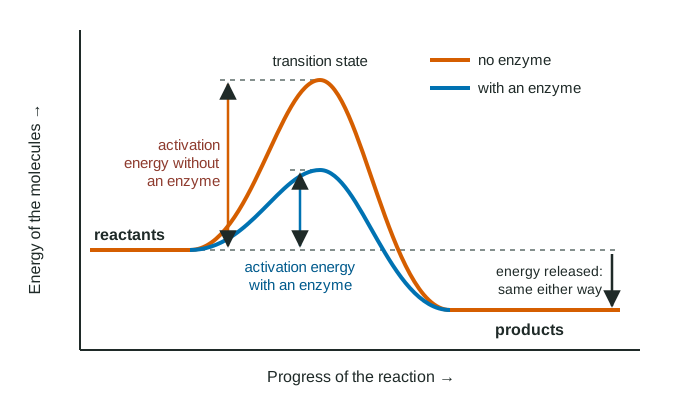
The top of the hill is the transition state: an unstable arrangement where old bonds are partly broken and new ones partly formed. The energy the reactants must absorb to get from their starting level to the transition state is the activation energy.
A graph of this is an energy diagram (Figure 1). The vertical axis is the energy of the molecules; the horizontal axis is how far the reaction has gone. Read it in three parts:
- The left flat level is the energy of the reactants; the right flat level is the energy of the products.
- The height of the hill above the reactants is the activation energy.
- The drop from reactants to products is the energy released (if products are lower) or absorbed (if products are higher).
Why high hills make slow reactions
Molecules are always moving and bumping into each other. At body temperature, only a tiny fraction of them move fast enough, at any moment, to reach the transition state when they meet. If the hill is high, almost none make it, so the reaction is extremely slow. That is the sugar bowl: breaking sucrose releases energy, but its activation energy is so high that at room temperature it barely happens.
There are two ways to speed a reaction up:
| Heating | Adding an enzyme | |
|---|---|---|
| What changes | The molecules: they move faster, so more have enough energy | The path: the hill is lower, so less energy is needed |
| Activation energy | Same | Lower |
| Energy released by the reaction | Same | Same |
| Practical inside a cell? | No: large temperature rises would unfold proteins | Yes: cells make a specific enzyme for each reaction |
How an enzyme lowers the hill
An enzyme binds its substrate in its active site (topic 3.1). The active site does not just hold the substrate; it makes the transition state easier to reach. It can do this in several ways at once:
- Orientation. When two reactants must join, the active site holds them side by side, facing the right way, instead of waiting for them to meet at the right angle by chance.
- Strain. As the active site closes around the substrate (induced fit), it bends the substrate toward the shape of the transition state, stretching the bonds that need to break.
- Helpful side chains. Charged or polar side chains next to the changing bonds can donate or accept a hydrogen ion, or steady a partial charge that forms during the reaction.
With the hill lower, a far larger share of substrate molecules reach the transition state each second. Enzyme-catalyzed reactions commonly run millions of times faster than the same reaction without the enzyme.
What an enzyme does not change
This is where many students lose points. An enzyme:
- does not add energy to the substrate;
- does not change the energy of the reactants or the products, so the energy released or absorbed is the same;
- does not change which products form;
- does not make a reaction possible that would need an energy input. It only speeds up reactions that can already happen. (How cells drive energy-absorbing reactions is the subject of topic 3.4.)
Because the transition state is the same whichever way the reaction runs, an enzyme lowers the barrier for the backward reaction by exactly the same amount as the forward one.
Worked example: reading an energy diagram. Reactants sit at 40 kJ/mol and products at 15 kJ/mol. Without the enzyme the peak is at 115 kJ/mol; with it, 70 kJ/mol.
Activation energy without the enzyme = 115 − 40 = 75 kJ/mol. With the enzyme = 70 − 40 = 30 kJ/mol.
Percent decrease = (75 − 30) ÷ 75 × 100 = 60%.
Energy released = 40 − 15 = 25 kJ/mol, with or without the enzyme.
Backward reaction (products to reactants): 115 − 15 = 100 kJ/mol without the enzyme, 70 − 15 = 55 kJ/mol with it. Both barriers drop by 45 kJ/mol.
Enzymes are not used up
After the products leave the active site, the enzyme has exactly the structure it started with. It binds another substrate and does it again. One molecule of catalase can break down millions of hydrogen peroxide molecules every second. That is why cells need only small amounts of most enzymes, and why a little liver extract can break down a whole flask of hydrogen peroxide.
You can test this directly: when a reaction stops because the substrate has run out, adding more substrate starts it again at close to the original speed. If the enzyme were used up, nothing would happen.
Measuring reaction rate
The reaction rate is how fast product forms or substrate disappears: amount per unit time, such as mL of oxygen per second or µmol of product per minute. When an enzyme is involved, the rate is also called enzyme activity.
On a graph of product against time, the rate is the slope. The curve is usually steepest at the start, when substrate is plentiful, and flattens as substrate runs out. That is why experiments compare the initial rate, measured over the first part of the curve.
Worked example: the catalase experiment. A flask of hydrogen peroxide with liver extract gives 0, 9.0, 16.0 and 21.0 mL of oxygen at 0, 30, 60 and 90 seconds.
Initial rate (first 30 s) = (9.0 − 0.0) mL ÷ 30 s = 0.30 mL/s.
Rate from 60 to 90 s = (21.0 − 16.0) mL ÷ 30 s = 0.17 mL/s. The rate is falling because less hydrogen peroxide is left, not because the enzyme is being used up.
Good experiments include comparisons: a flask with water instead of enzyme shows how fast the reaction goes with no catalyst; a flask with boiled enzyme shows that the effect needs a folded, working protein.
How the exam tests this
- Read activation energy and energy released from an energy diagram, and say which one an enzyme changes.
- Calculate a rate from a table or graph of product against time, and explain why it falls.
- Explain why an enzyme can be reused, and predict what happens when more substrate is added.