Cellular Respiration
Cellular respiration releases the energy in glucose in stages.
Part 1 · Hook
Why this matters
Cyanide kills in minutes, yet it does not touch your lungs, your blood or your heart directly. It jams one protein at the very end of a chain inside your mitochondria. Oxygen keeps arriving, but your cells can no longer hand electrons to it, and ATP production collapses. To see why one jammed protein is fatal, you need to follow glucose all the way to oxygen.
Part 2 · Before you start
What this builds on
Part 3 · Prerequisite check
Quick check before you start
1. In the light reactions, how does the H⁺ gradient across the thylakoid membrane make ATP?
- H⁺ flows down its gradient through ATP synthase, which uses the flow to join ADP and Pi
- H⁺ is pumped up its gradient by ATP synthase, which uses the energy of light to do it
- H⁺ combines with ADP directly in the thylakoid space to form ATP
Show the answer
This is chemiosmosis: an electron transport chain builds the gradient, and H⁺ flowing back through ATP synthase drives ATP synthesis. Mitochondria use the same machinery.
- Correct: H⁺ flows down its gradient through ATP synthase, which uses the flow to join ADP and Pi:
- H⁺ is pumped up its gradient by ATP synthase, which uses the energy of light to do it:
- H⁺ combines with ADP directly in the thylakoid space to form ATP:
2. When glucose is broken down to CO₂ and water, glucose is
- reduced, because it gains electrons from oxygen
- oxidized, because it loses electrons, which end up on oxygen
- neither, because no electrons move in the reaction
Show the answer
Glucose loses hydrogen atoms and their electrons, which end up on oxygen in water. Losing electrons is oxidation.
- reduced, because it gains electrons from oxygen:
- Correct: oxidized, because it loses electrons, which end up on oxygen:
- neither, because no electrons move in the reaction:
3. Where in a mitochondrion are the cristae?
- They are folds of the inner membrane
- They are the fluid inside the inner membrane
- They are pores in the outer membrane
Show the answer
The cristae are folds of the inner membrane, which give it a huge surface for electron transport chains and ATP synthase. The fluid inside is the matrix.
- Correct: They are folds of the inner membrane:
- They are the fluid inside the inner membrane:
- They are pores in the outer membrane:
Part 4 · See it
See it first
Part 5 · Step by step
How it works, step by step
- In the cytosol, glycolysis splits each glucose into two pyruvate.A net 2 ATP are made by substrate-level phosphorylation, and electrons are loaded onto 2 NAD⁺, making 2 NADH.
- With oxygen present, pyruvate enters the mitochondrial matrix and is oxidized.Each pyruvate loses a carbon as CO₂ and gives electrons to NAD⁺; the rest enters the Krebs cycle as acetyl CoA.
- The Krebs cycle oxidizes acetyl CoA completely.Its carbons leave as CO₂, a little ATP is made, and most of the energy is loaded onto NADH and FADH₂.
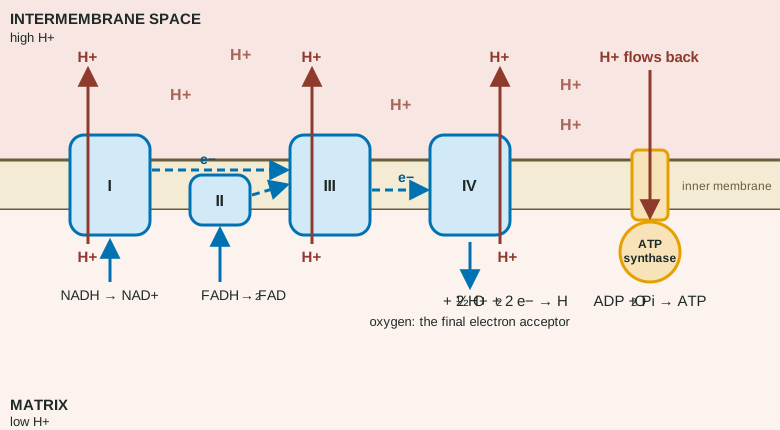
- NADH and FADH₂ hand their electrons to the electron transport chain in the inner membrane, and oxygen accepts them at the end, forming water.As electrons move toward oxygen, the chain pumps H⁺ from the matrix into the intermembrane space, building a proton gradient.
- H⁺ flows back into the matrix through ATP synthase.ATP synthase makes most of the ATP: about 26-28 of the 30-32 ATP per glucose (oxidative phosphorylation).
- Without oxygen, the chain stops and NADH cannot be recycled to NAD⁺.Cells that ferment pass NADH's electrons to pyruvate (making lactate, or ethanol and CO₂), regenerating NAD⁺ so glycolysis can keep making its 2 ATP.
Part 6 · Key ideas
Key ideas
- Overall: C₆H₁₂O₆ + 6 O₂ → 6 CO₂ + 6 H₂O + energy. The CO₂ comes from the carbons of glucose (pyruvate oxidation and Krebs cycle); the water forms when O₂ accepts electrons at the end of the chain.
- Most ATP is made by chemiosmosis, exactly as in chloroplasts, but here the energy comes from electrons moving to oxygen, and H⁺ is pumped into the intermembrane space.
- Fermentation makes no extra ATP. Its only job is to regenerate NAD⁺ so glycolysis can continue without oxygen.
- Energy not captured as ATP is released as heat. Uncoupling proteins in brown fat let H⁺ leak back without making ATP, turning the gradient's energy into heat.
Part 7 · Misconception
A common mistake
The wrong idea: The oxygen we breathe in becomes the carbon dioxide we breathe out.
What actually happens: The oxygen accepts electrons at the end of the electron transport chain and becomes water. The carbon dioxide is made from the carbon atoms of glucose during pyruvate oxidation and the Krebs cycle.
Part 8 · Check yourself
Check yourself
Exam-style questions. Anything you miss goes into your review queue.
Graph
Oxygen use by isolated mitochondria
Mitochondria isolated from liver were placed in a sealed chamber with pyruvate as fuel, and an electrode recorded the O₂ concentration. Additions: at 2 min, ADP and Pi; at 6 min, oligomycin, a drug that blocks the H⁺ channel of ATP synthase; at 10 min, DNP, a chemical that carries H⁺ across membranes; at 14 min, cyanide, which blocks the last protein of the electron transport chain.
Data table
| Time (min) | O₂ concentration |
|---|---|
| 0 | 240 |
| 1 | 236 |
| 2 | 232 |
| 3 | 212 |
| 4 | 192 |
| 5 | 172 |
| 6 | 152 |
| 7 | 149 |
| 8 | 146 |
| 9 | 143 |
| 10 | 140 |
| 11 | 110 |
| 12 | 80 |
| 13 | 50 |
| 14 | 20 |
| 15 | 20 |
| 16 | 20 |
| 17 | 20 |
| 18 | 20 |
1. During which interval did the mitochondria use O₂ fastest?
- 10-14 min
- 2-6 min
- 6-10 min
- 14-18 min
Show the answer
From 10 to 14 min, O₂ fell from 140 to 20 nmol/mL: 30 per minute, the steepest slope.
- Correct: 10-14 min: After DNP, the slope is steepest: 120 nmol/mL in 4 minutes.
- 2-6 min: With ADP, O₂ fell 80 nmol/mL in 4 minutes (20 per minute), fast but not fastest.
- 6-10 min: After oligomycin, O₂ fell only 12 nmol/mL in 4 minutes.
- 14-18 min: After cyanide, O₂ stayed at 20: no use at all.
2. What was the rate of O₂ use between 2 and 6 minutes, in nmol/mL per minute? Give a whole number.
Type a number in nmol/mL per min.
Show the answer
Rate = (232 − 152) ÷ (6 − 2) = 80 ÷ 4 = 20 nmol/mL per minute.
- Answer: 20 nmol/mL per min
3. After oligomycin blocks ATP synthase at 6 minutes, O₂ use falls sharply even though the electron transport chain itself is not blocked. Why?
- H⁺ is no longer able to flow back through ATP synthase, so the gradient grows until the chain stalls.
- Oligomycin also blocks the last protein of the chain, so O₂ is unable to accept electrons from it.
- Without ATP synthase working, the matrix runs out of the O₂ that ATP synthase normally releases.
- The ADP added at 2 minutes has been used up by then, and ADP is the molecule that the chain hands its electrons to.
Show the answer
Pumping and H⁺ return are linked. With the return route blocked, H⁺ piles up in the intermembrane space until pumping becomes too hard, and electron flow to O₂ slows almost to a stop.
- Correct: H⁺ is no longer able to flow back through ATP synthase, so the gradient grows until the chain stalls.: A too-steep gradient holds back the chain: respiration is tied to ATP synthesis.
- Oligomycin also blocks the last protein of the chain, so O₂ is unable to accept electrons from it.: The stem says oligomycin blocks ATP synthase; and adding DNP later restores fast O₂ use, so the chain still works.
- Without ATP synthase working, the matrix runs out of the O₂ that ATP synthase normally releases.: ATP synthase makes ATP; it does not release O₂.
- The ADP added at 2 minutes has been used up by then, and ADP is the molecule that the chain hands its electrons to.: Electrons go to O₂, not to ADP; and the drop happens right when oligomycin is added.
4. DNP, added at 10 minutes, carries H⁺ across membranes. Which statement about the period from 10 to 14 minutes is best supported?
- O₂ use is fast because H⁺ leaks back through DNP, so the chain runs freely, but the energy becomes heat, not ATP.
- O₂ use is fast because DNP unblocks ATP synthase, so the mitochondria are now making more ATP than at any earlier time.
- O₂ use is fast because DNP is itself broken down using O₂, and the mitochondria use it as a fuel.
- O₂ use is fast because DNP is an electron carrier that delivers extra electrons from pyruvate to the chain.
Show the answer
DNP is an uncoupler: it lets H⁺ back into the matrix without ATP synthase. The gradient stays low, so the chain pumps and uses O₂ at full speed, while ATP synthase stays blocked by oligomycin.
- Correct: O₂ use is fast because H⁺ leaks back through DNP, so the chain runs freely, but the energy becomes heat, not ATP.: Uncoupling separates electron flow from ATP synthesis; the energy is released as heat.
- O₂ use is fast because DNP unblocks ATP synthase, so the mitochondria are now making more ATP than at any earlier time.: Oligomycin is still present, so ATP synthase stays blocked; DNP gives H⁺ another way back.
- O₂ use is fast because DNP is itself broken down using O₂, and the mitochondria use it as a fuel.: DNP's effect is to move H⁺, and O₂ use stops at once when cyanide is added, showing the chain, not DNP breakdown, uses the O₂.
- O₂ use is fast because DNP is an electron carrier that delivers extra electrons from pyruvate to the chain.: The stem says DNP carries H⁺, not electrons.
5. Why did O₂ use stop completely after cyanide was added, even though DNP was still present?
- Cyanide stops electrons from reaching O₂, so no O₂ is reduced to water.
- Cyanide blocks the H⁺ leak through DNP, so the gradient rebuilds and stops the pumping.
- Cyanide uses up the O₂ left in the chamber by reacting with it directly.
- Cyanide blocks ATP synthase, which had started making ATP again once DNP was added.
Show the answer
Cyanide blocks the last protein of the chain, the one that hands electrons to O₂. With no electrons reaching O₂, O₂ use stops, whatever happens to the gradient.
- Correct: Cyanide stops electrons from reaching O₂, so no O₂ is reduced to water.: Blocking the final transfer to O₂ stops O₂ use directly.
- Cyanide blocks the H⁺ leak through DNP, so the gradient rebuilds and stops the pumping.: The stem says cyanide blocks the last protein of the chain, not DNP.
- Cyanide uses up the O₂ left in the chamber by reacting with it directly.: O₂ stays flat at 20 nmol/mL after cyanide, so nothing is using it up.
- Cyanide blocks ATP synthase, which had started making ATP again once DNP was added.: ATP synthase was already blocked by oligomycin; cyanide acts on the chain.
6. Cyanide is added to cultured human cells, blocking the last protein of the electron transport chain. Predict the change in each variable over the next few minutes.
| Variable | Change |
|---|---|
| O₂ used by the cells | — |
| H⁺ concentration in the intermembrane space | — |
| ATP made by oxidative phosphorylation | — |
| Lactate made by the cells | — |
| Number of mitochondria in each cell | — |
Show the answer
Blocking the final transfer to O₂ stops the chain, the gradient and most ATP synthesis; cells fall back on glycolysis and fermentation.
- O₂ used by the cells: decreases. Electrons can no longer be passed to O₂, so O₂ is not reduced to water.
- H⁺ concentration in the intermembrane space: decreases. With electrons stuck, the chain stops pumping H⁺, while H⁺ keeps flowing back through ATP synthase, so the gradient runs down.
- ATP made by oxidative phosphorylation: decreases. ATP synthase needs the H⁺ gradient, which is fading.
- Lactate made by the cells: increases. NADH can no longer unload at the chain, so cells turn to fermentation to regenerate NAD⁺ for glycolysis, making lactate.
- Number of mitochondria in each cell: no change. Cyanide blocks a protein; it does not destroy mitochondria or make new ones within minutes.
7. In a cell that cannot ferment, removing O₂ soon stops glycolysis too, although glycolysis itself uses no O₂. Why?
- With the chain stopped, NADH has nowhere to unload and NAD⁺ runs out, so glycolysis stalls.
- Glycolysis needs the ATP made by the chain as its starting energy, and the chain makes no ATP when O₂ is missing.
- Without O₂ the cytosol becomes too acidic for the enzymes of glycolysis, which denature within seconds.
- Pyruvate turns into O₂ when O₂ is absent, and this O₂ blocks the first enzyme of glycolysis by feedback.
Show the answer
Glycolysis needs a steady supply of NAD⁺. Without O₂ to accept electrons, NADH piles up and NAD⁺ is used up; with no fermentation to recycle it, glycolysis stops.
- Correct: With the chain stopped, NADH has nowhere to unload and NAD⁺ runs out, so glycolysis stalls.: The NAD⁺ supply links glycolysis to O₂ indirectly.
- Glycolysis needs the ATP made by the chain as its starting energy, and the chain makes no ATP when O₂ is missing.: Glycolysis does use 2 ATP to start, but it makes 4, so it does not depend on the chain for ATP.
- Without O₂ the cytosol becomes too acidic for the enzymes of glycolysis, which denature within seconds.: Nothing suggests a fast pH crash; the immediate problem is the missing NAD⁺.
- Pyruvate turns into O₂ when O₂ is absent, and this O₂ blocks the first enzyme of glycolysis by feedback.: Pyruvate cannot turn into O₂; this is not a real reaction.
Part 9 · Summary
Summary
Cellular respiration releases the energy in glucose in stages. Glycolysis in the cytosol makes pyruvate, 2 ATP and 2 NADH. In the mitochondrial matrix, pyruvate oxidation and the Krebs cycle release the carbons as CO₂ and load electrons onto NADH and FADH₂. In the inner membrane, the electron transport chain passes those electrons to oxygen, forming water, and pumps H⁺ into the intermembrane space; ATP synthase uses the gradient to make most of the 30-32 ATP. Without oxygen, fermentation regenerates NAD⁺ so glycolysis continues, for only 2 ATP. Energy not captured as ATP is released as heat, which uncoupling proteins increase.
Part 10 · Up next
What comes next
Part 11 · Connections