How do we know that living species descend from earlier ones? Not from one kind of evidence but from several independent kinds that agree: rocks and fossils, the anatomy of living things, their embryos, where they live, and the sequences of their DNA and proteins. This page takes each in turn and shows how to read it, including the traps.
Fossils and the fossil record
A fossil is the preserved remains or trace of a past organism: bones, shells, leaf impressions, footprints, burrows. Most form when an organism is buried quickly in mud or sand, which later hardens into sedimentary rock; minerals may slowly replace its hard parts. Soft-bodied organisms, and those that die where nothing buries them, rarely fossilize, so the fossil record, all the fossils found so far in order of age, is incomplete. Even so, it shows clear patterns:
- Life has changed over time. The oldest rocks hold only single-celled life; fish appear long before four-limbed animals, and those long before mammals.
- Most species that ever lived are now extinct. Extinction is ongoing, and at a few times, called mass extinctions, a large share of species vanished worldwide in a geologically short time. The best known, about 66 million years ago, ended the non-bird dinosaurs.
- Transitional fossils show mixtures of features from an older and a later group, in rocks of in-between age.
Dating rocks and fossils
Relative dating puts layers in order without giving years. Sediment settles on top of what is already there, so in undisturbed layers, or strata, lower layers are older than those above them: the law of superposition. A fossil is older than fossils in the layers above it and younger than those below.
Radiometric dating gives ages in years. Radioactive isotopes decay into other elements at a constant rate, unaffected by heat or pressure. The half-life is the time it takes for half of a sample of the isotope to decay. After one half-life, 50% of the original isotope is left; after two, 25%; after three, 12.5%; and so on. Measuring how much of the original isotope remains, compared with its decay product, gives the time since the clock started.
- Carbon-14 (half-life about 5,730 years) is taken in by living things and stops being replaced at death, so it dates bones, wood and shells up to about 50,000 years old (radiocarbon dating).
- Isotopes with very long half-lives, such as potassium-40 (about 1.25 billion years) and uranium-238 (about 4.5 billion years), date volcanic rock. Their clock starts when the minerals crystallize from molten rock. Fossils usually lie in sedimentary rock, which cannot be dated this way, because its grains formed earlier, so geologists date volcanic ash layers above and below a fossil to bracket its age.
Worked example: half-lives. A bone contains 25% of the carbon-14 that a living animal would contain. How old is it?
Step 1. Count halvings: 100% → 50% → 25% is two half-lives. Step 2. Multiply: 2 × 5,730 = 11,460 years. Check: if 12.5% remained, that would be three half-lives, 17,190 years.
Bracketing. A fossil lies between a volcanic ash layer dated 5.3 million years (above it) and one dated 23 million years (below it). By superposition, the fossil is between 5.3 and 23 million years old.
Transitional fossils: two examples
- From water to land. Fish with lobed fins are found in rocks about 385 million years old, and the first four-limbed animals in rocks about 365 million years old. In 2004, researchers searched rocks of in-between age, about 375 million years, on Ellesmere Island in Arctic Canada, and found Tiktaalik: a fish with scales and gills, but also a flat head, a mobile neck and front fins with bones matching an upper arm, forearm and wrist.
- Whales. Whales are mammals that breathe air and nurse their young. Fossils from about 50 to 40 million years ago show a series of whale relatives with four walking legs and an ear bone found only in whales, then with shorter legs and nostrils farther back, then fully aquatic animals with tiny hind legs. A distinctive ankle bone in the early forms matches that of hippos and their relatives, and DNA agrees that whales and hippos share a recent common ancestor.
Anatomy: homologous, analogous and vestigial
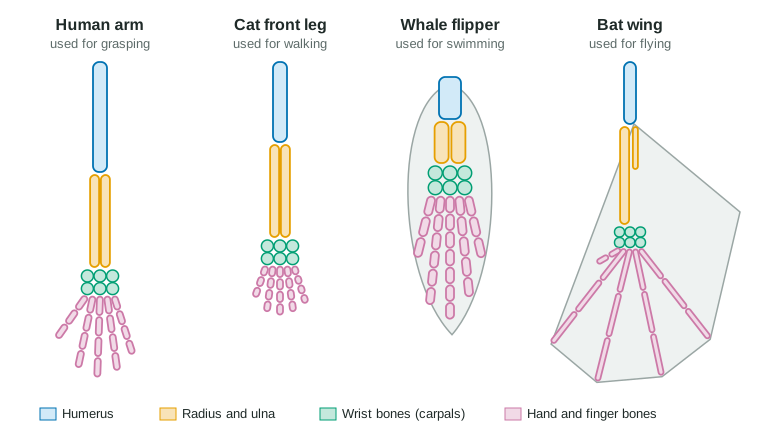
Homologous structures are shared because they were inherited from a common ancestor, even if they now do different jobs. A human arm, a cat's leg, a whale's flipper and a bat's wing all contain one upper-arm bone, two forearm bones, a set of wrist bones and five sets of finger bones (Figure 1). An engineer designing a flipper and a wing from scratch would not use the same parts; inheritance from a four-limbed ancestor explains why they do.
Convergent evolution is the opposite pattern: unrelated groups evolve similar traits because similar environments favored them. The results are analogous structures: similar in function and often in shape, but built differently and not inherited from a shared ancestor that had them. The wings of insects (made of thin sheets of cuticle) and of birds (made of feathered forelimbs) are analogous. Sharks (fish) and dolphins (mammals) both have streamlined bodies and fins. Some structures are both: bird and bat wings are homologous as forelimbs but analogous as wings, because their common ancestor had legs, not wings.
Vestigial structures are reduced remnants of structures that were fully developed and working in ancestors. Whales have small hip bones not attached to the spine; cave fish living in total darkness have small, nonfunctional eyes; humans have a tailbone (fused tail vertebrae) and muscles that once moved the ears. Vestigial does not always mean useless: whale hip bones anchor muscles of the reproductive organs. What matters is that their form makes sense only as a modified leftover.
| Kind | Shared ancestry? | Same function? | Examples | What it tells you |
|---|---|---|---|---|
| Homologous | Yes | Often not | Forelimbs of humans, cats, whales and bats | Descent from a common ancestor, modified for different uses |
| Analogous | No (not for that trait) | Yes | Insect and bird wings; shark and dolphin body shapes | Similar selective pressures (convergent evolution), not close relatedness |
| Vestigial | Yes | Reduced or lost | Whale hip bones, cave fish eyes, human tailbone | Ancestors in which the structure was fully developed |
Embryos and geography
Comparative embryology. Early embryos of fish, frogs, chickens and humans look surprisingly alike. All develop a series of pharyngeal arches, with pharyngeal pouches between them, in the neck region, and a tail. In fish, the arches become gill supports. In mammals the same tissues form parts of the jaw, the bones of the middle ear and structures of the throat. These shared stages are inherited from a common ancestor and modified later in development.
Biogeography. Where species live makes sense only in the light of descent. The animals of the Galápagos Islands resemble those of nearby South America, not those of islands with a similar climate off Africa, whose species resemble Africa's. Islands far from any mainland have many species found nowhere else but few land mammals, which rarely cross the sea. Australia's mammals are mostly marsupials, which carry young in a pouch, filling roles that placental mammals fill elsewhere.
Molecular evidence
All living things store information in DNA, use the same genetic code and build proteins from the same 20 amino acids. Comparing the sequences of a gene, or of the protein it codes for, across species gives molecular homology. Once two lineages separate, mutations build up in each independently, so the longer ago their common ancestor lived, the more differences their sequences have.
| Species | Differences from human |
|---|---|
| Gorilla | 1 |
| Rhesus monkey | 8 |
| Mouse | 27 |
| Chicken | 45 |
| Frog | 67 |
The order matches the fossil record and anatomy: other primates first, then other mammals, then birds, then amphibians. Molecular evidence is especially useful where anatomy misleads, as with convergent traits, and for organisms with few visible features, such as bacteria.