Evidence of Evolution
Several independent kinds of evidence show that living species descend, with modification, from earlier ones.
Part 1 · Hook
Why this matters
In 2004, paleontologists working on an Arctic island found exactly what they had predicted: a 375-million-year-old fish with a neck, flat head and fins containing wrist-like bones. They had chosen rocks of that age because fish fossils appear in older rocks and four-legged animals in younger ones. A good theory makes predictions that could fail. Fossils, anatomy, embryos, the map of where species live and the sequences of DNA and proteins all point to the same history.
Part 2 · Before you start
What this builds on
Part 3 · Prerequisite check
Quick check before you start
1. Isotopes of an element differ in their number of
- neutrons
- protons
- electrons in the outer shell
Show the answer
Isotopes have the same number of protons but different numbers of neutrons; some are radioactive and decay at a steady rate.
- Correct: neutrons:
- protons:
- electrons in the outer shell:
2. A protein's primary structure is
- its sequence of amino acids
- its folded 3-D shape
- the number of polypeptide chains it has
Show the answer
Primary structure is the amino acid sequence, which is set by the gene's base sequence.
- Correct: its sequence of amino acids:
- its folded 3-D shape:
- the number of polypeptide chains it has:
3. Natural selection can change a population only when variation in a trait is
- heritable
- acquired during life
- the same in every individual
Show the answer
Selection acts on inherited differences, so over generations populations descend with modification.
- Correct: heritable:
- acquired during life:
- the same in every individual:
Part 4 · See it
See it first
Part 5 · Step by step
How it works, step by step
- Organisms are buried quickly in sediment, which hardens into rock layer by layer.Fossils form, and lower layers hold older fossils (relative dating); radioactive isotopes in volcanic layers give ages in years (radiometric dating).
- Fossils are arranged by age.The fossil record shows life changing over time: most species that lived are extinct, and transitional fossils link older and later groups.
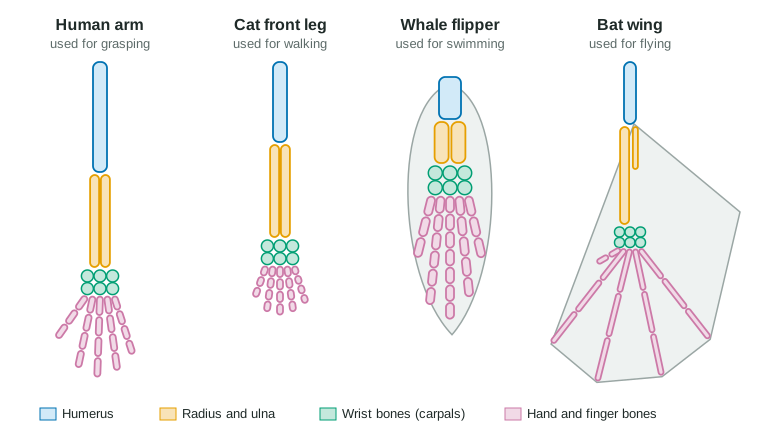
- Descendants inherit structures from a common ancestor and modify them for new uses.Homologous structures (one bone plan in arms, legs, flippers and wings), vestigial structures and shared embryo features appear across related species.
- Unrelated species face similar environments.Convergent evolution produces analogous structures that look alike but are built differently, which is why anatomy must be read with care.
- Once two lineages separate, mutations build up in each independently.The more recent their common ancestor, the more similar their DNA and protein sequences: molecular evidence that matches the fossils and anatomy.
Part 6 · Key ideas
Key ideas
- The fossil record, ordered by relative dating (lower strata are older) and radiometric dating (decay at a known half-life), shows change over time, extinction and transitional fossils.
- Homologous structures share an inherited plan despite different uses. Analogous structures share a function but arose separately, by convergent evolution.
- Vestigial structures, such as whale hip bones, are reduced leftovers of structures that were fully developed in ancestors.
- Comparative embryology: all vertebrate embryos form pharyngeal arches. Biogeography: island species resemble those of the nearest mainland.
- Molecular homology: species with a more recent common ancestor have more similar DNA and amino acid sequences.
Part 7 · Misconception
A common mistake
The wrong idea: Animals that look alike, such as sharks and dolphins, must be closely related.
What actually happens: Similar environments can shape unrelated animals alike (convergent evolution). A dolphin has lungs, mammary glands and the bones of a mammal's forelimb inside its flipper, and its DNA matches other mammals, not sharks. Homologous structures and sequences, not overall shape, show who is related to whom.
Part 8 · Check yourself
Check yourself
Exam-style questions. Anything you miss goes into your review queue.
Data table
Amino acid differences in cytochrome c
Cytochrome c is a protein of the electron transport chain in mitochondria, found in nearly every eukaryote. In humans it is 104 amino acids long. The table gives the number of positions at which each species' cytochrome c differs from the human protein (approximate counts from published sequence comparisons).
| Species | Group | Amino acid differences from human |
|---|---|---|
| Chimpanzee | Mammal (primate) | 0 |
| Rhesus monkey | Mammal (primate) | 1 |
| Rabbit | Mammal | 9 |
| Dog | Mammal | 11 |
| Horse | Mammal | 12 |
| Chicken | Bird | 13 |
| Bullfrog | Amphibian | 18 |
| Tuna | Fish | 21 |
| Baker's yeast | Fungus | 44 |
1. Which conclusion is best supported by the data?
- Humans share a more recent common ancestor with rhesus monkeys than with dogs.
- Humans share a more recent common ancestor with chickens than with horses.
- Tuna are more closely related to yeast than to humans.
- Rabbits and dogs share a more recent common ancestor with each other than either does with humans.
Show the answer
Rhesus monkey cytochrome c differs from human at 1 position, dog at 11. Fewer differences means less time for mutations to build up since the lineages separated.
- Correct: Humans share a more recent common ancestor with rhesus monkeys than with dogs.: Correct: 1 difference against 11.
- Humans share a more recent common ancestor with chickens than with horses.: Chickens differ from humans at 13 positions and horses at 12, so the data do not place chickens closer.
- Tuna are more closely related to yeast than to humans.: The table compares each species only with humans, so it says nothing directly about tuna and yeast; it does show tuna sharing far more of the sequence with humans than yeast do.
- Rabbits and dogs share a more recent common ancestor with each other than either does with humans.: The table gives only differences from human, so it cannot show how rabbits and dogs compare with each other.
2. What percentage of the 104 amino acid positions are identical in human and tuna cytochrome c? Give your answer to one decimal place.
Type a number in %.
Show the answer
Identical positions = 104 − 21 = 83. 83 ÷ 104 × 100 = 79.8%. Humans and tuna last shared an ancestor hundreds of millions of years ago, yet four-fifths of the protein is the same.
- Answer: 79.8 %
3. Why do these data count as evidence of common ancestry?
- Many sequences could do this job, yet species share one, with differences graded by relatedness.
- Each species needs cytochrome c, so its sequence has to be identical across species for respiration to work.
- The differences show that each species made its own version of the protein in response to its environment.
- Species with more amino acid differences are better adapted than species with fewer differences.
Show the answer
If each species had its own origin, there would be no reason for yeast and humans to share most of a protein's sequence, or for the differences to follow the same order as anatomy and fossils. Inheritance from shared ancestors, with mutations added over time, explains both.
- Correct: Many sequences could do this job, yet species share one, with differences graded by relatedness.: Correct: shared sequence plus graded differences match descent with modification.
- Each species needs cytochrome c, so its sequence has to be identical across species for respiration to work.: The sequences are not identical; up to 44 positions differ, and the protein still works.
- The differences show that each species made its own version of the protein in response to its environment.: Mutations arise at random, not in response to the environment, and the differences track relatedness, not habitat.
- Species with more amino acid differences are better adapted than species with fewer differences.: The number of differences measures time since a shared ancestor, not how well adapted a species is.
Experimental setup
Rock layers in a canyon wall
Geologists described six undisturbed layers exposed in a canyon wall, numbered from the top. Three layers are volcanic ash, whose crystals were dated by the decay of a radioactive isotope. The other layers are sedimentary rock containing fossils of horse-like mammals.
| Layer | Rock type | Fossils or date |
|---|---|---|
| 1 (top) | Sandstone | Horse-like mammal with one large toe on each foot, about 1.5 m tall |
| 2 | Volcanic ash | Dated to 5.3 million years ago |
| 3 | Shale | Horse-like mammal with three toes on each foot, the middle one largest, about 1 m tall |
| 4 | Volcanic ash | Dated to 23 million years ago |
| 5 | Mudstone | Dog-sized mammal with four toes on each front foot and three on each hind foot |
| 6 (bottom) | Volcanic ash | Dated to 56 million years ago |
4. Put the horse-like fossils in order from oldest to youngest.
- The dog-sized mammal with four front toes (layer 5)
- The three-toed mammal (layer 3)
- The one-toed mammal (layer 1)
Show the answer
In undisturbed layers, lower layers formed first (superposition): layer 5 is below layer 3, which is below layer 1.
- Correct order: 1. The dog-sized mammal with four front toes (layer 5) 2. The three-toed mammal (layer 3) 3. The one-toed mammal (layer 1)
5. The isotope used to date the ash has a half-life of 14 million years. What percentage of the original isotope should remain in the crystals of layer 6? Give your answer to two decimal places.
Type a number in %.
Show the answer
56 ÷ 14 = 4 half-lives. 100% → 50% → 25% → 12.5% → 6.25%, or 100% × (1/2)⁴ = 6.25%.
- Answer: 6.25 %
6. Which pair of structures is analogous rather than homologous?
- The wing of a butterfly and the wing of a sparrow
- The flipper of a whale and the arm of a human
- The wing of a bat and the front leg of a cat
- The pharyngeal arches of a fish embryo and of a human embryo
Show the answer
Butterfly wings are thin sheets of cuticle on an insect; sparrow wings are feathered forelimbs with bones. They do the same job but were not inherited from a common ancestor with wings: convergent evolution.
- Correct: The wing of a butterfly and the wing of a sparrow: Correct: same function, different origins.
- The flipper of a whale and the arm of a human: Homologous: both contain the same set of forelimb bones inherited from a common ancestor.
- The wing of a bat and the front leg of a cat: Homologous: a bat's wing is a modified mammal forelimb with the same bones as a cat's leg.
- The pharyngeal arches of a fish embryo and of a human embryo: Homologous: all vertebrate embryos inherit pharyngeal arches from a common ancestor.
7. Sharks and dolphins both have streamlined bodies, a dorsal fin and flippers or fins. Which explanation fits all the evidence best?
- Similar selection for fast swimming shaped two unrelated groups alike: convergent evolution.
- Sharks and dolphins inherited their body shapes from a recent common ancestor that was a streamlined fish.
- Dolphins are fish that evolved lungs, so their shape shows their close relationship to sharks.
- The body shapes are homologous, because structures with the same function are inherited.
Show the answer
Dolphins have lungs, hair at birth, mammary glands and mammal forelimb bones inside their flippers, and their DNA matches other mammals. Their shark-like shape evolved separately under similar pressures: an analogous resemblance.
- Correct: Similar selection for fast swimming shaped two unrelated groups alike: convergent evolution.: Correct: unrelated groups shaped alike by similar environments.
- Sharks and dolphins inherited their body shapes from a recent common ancestor that was a streamlined fish.: The last common ancestor of sharks and dolphins lived more than 400 million years ago, long before either streamlined form evolved; dolphins descend from four-legged land mammals.
- Dolphins are fish that evolved lungs, so their shape shows their close relationship to sharks.: Dolphins are mammals; their skeletons, DNA and fossils show descent from land mammals.
- The body shapes are homologous, because structures with the same function are inherited.: Same function does not mean shared ancestry; that is the definition of an analogous structure.
8. Why are transitional fossils, showing features of both an older and a later group, relatively rare?
- Fossils form only under special conditions, such as quick burial, and most remains decay first.
- Transitional forms did not exist, because new groups appear fully formed.
- Transitional forms were too weak to survive for long, so very few individuals lived.
- Fossils of transitional forms are destroyed faster than other fossils, because they are mixtures.
Show the answer
Only a tiny fraction of organisms are buried quickly in sediment, and many fossils are later destroyed or never exposed. The record is incomplete for every group, transitional or not.
- Correct: Fossils form only under special conditions, such as quick burial, and most remains decay first.: Correct: fossilization is rare.
- Transitional forms did not exist, because new groups appear fully formed.: Many transitional fossils have been found, such as early whales with legs and fish with limb-like fins.
- Transitional forms were too weak to survive for long, so very few individuals lived.: Transitional forms were successful populations in their time, not weak ones.
- Fossils of transitional forms are destroyed faster than other fossils, because they are mixtures.: Preservation depends on burial and rock, not on whether a fossil is transitional.
Part 9 · Summary
Summary
Several independent kinds of evidence show that living species descend, with modification, from earlier ones. The fossil record, put in order by relative dating (lower layers are older) and given ages by radiometric dating (isotopes decay with fixed half-lives), shows life changing over time, many extinctions, and transitional fossils. Homologous structures, such as the forelimb bones of humans, cats, whales and bats, reveal a shared plan inherited from a common ancestor; vestigial structures are reduced remnants of ancestral ones; and vertebrate embryos share features such as pharyngeal arches. Analogous structures, produced by convergent evolution, look alike without shared ancestry. Biogeography shows species resembling their nearest neighbors in space. Molecular evidence, the similarity of DNA and protein sequences, matches these patterns: the more recently two species shared an ancestor, the more alike their sequences.
Part 10 · Up next
What comes next
Part 11 · Connections