Natural Selection
Environments change, and whether a trait is favorable depends on the environment of the moment: peppered moths went from mostly pale to mostly dark as soot darkened trees, and back as the air cleaned.
Part 1 · Hook
Why this matters
Before 1850, almost every peppered moth near Manchester, England, was pale and speckled, invisible against the lichen on tree bark. Then coal smoke killed the lichen and blackened the trees. By 1895 about 98% of the moths there were black. After clean-air laws in the 1950s, the bark lightened again, and so did the moths. Nothing about the moths' alleles told them which color would win. The environment changed, and with it, which moths birds could see.
Part 2 · Before you start
What this builds on
Part 3 · Prerequisite check
Quick check before you start
1. Fitness is measured by
- the number of offspring that survive to reproduce
- how long an individual lives
- how strong or large an individual is
Show the answer
Fitness is reproductive success; survival and strength matter only through their effect on offspring.
- Correct: the number of offspring that survive to reproduce:
- how long an individual lives:
- how strong or large an individual is:
2. A trait such as human height shows a smooth range of values because it is
- polygenic: many genes, each with a small effect, plus the environment
- controlled by one gene with two alleles
- inherited only through mitochondria
Show the answer
Many genes adding small effects, plus environmental influence, give a continuous, bell-shaped distribution.
- Correct: polygenic: many genes, each with a small effect, plus the environment:
- controlled by one gene with two alleles:
- inherited only through mitochondria:
3. A mutation changes one amino acid in an enzyme's active site. The most likely effect is
- a change in the enzyme's shape or activity, which can change the phenotype
- no effect, because enzymes are not made from amino acids
- a change in every protein in the cell
Show the answer
A protein's function depends on its shape, which depends on its amino acid sequence.
- Correct: a change in the enzyme's shape or activity, which can change the phenotype:
- no effect, because enzymes are not made from amino acids:
- a change in every protein in the cell:
Part 4 · See it
See it first
Part 5 · Step by step
How it works, step by step
- Different alleles code for proteins that differ slightly, or are made in different amounts, such as more or less of a pigment-making enzyme.Individuals differ in phenotype: dark or pale wings, deeper or shallower beaks, hemoglobin that binds oxygen more or less tightly.
- The environment, through biotic factors (predators, food, mates) and abiotic factors (temperature, water, soot), sets which phenotypes survive and reproduce best.A favorable trait is favorable only in a particular environment: pale moths on lichen, dark moths on soot.
- Individuals with the favorable phenotype leave more surviving offspring.The alleles behind that phenotype become more common in the next generation.
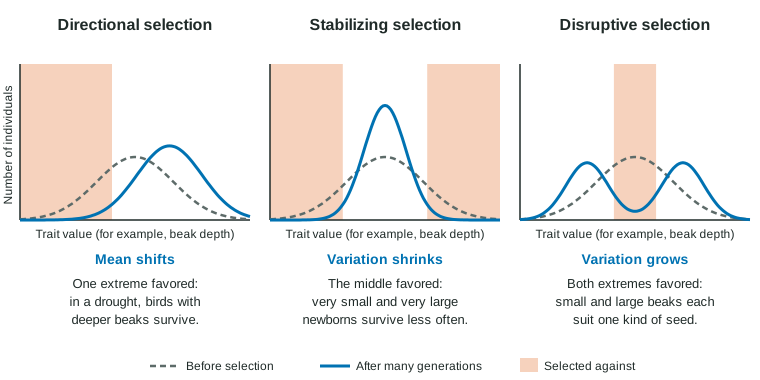
- Selection may favor one extreme, the middle, or both extremes of a trait.The trait's distribution shifts (directional), narrows (stabilizing) or splits (disruptive).
- The environment changes, for example when clean air lets lichen grow back.A different phenotype becomes favorable and selection reverses: the population tracks its changing environment, generation by generation.
Part 6 · Key ideas
Key ideas
- Whether a trait is favorable depends on the environment. An adaptive trait raises fitness in a particular setting; the same trait can be harmful elsewhere.
- Phenotypic variation comes from molecular variation: differences in proteins and how cells work, such as hemoglobin that loads oxygen better in thin mountain air.
- Selective pressures can be biotic (predators, parasites, competitors, mates) or abiotic (temperature, drought, salinity). Camouflage is favored where predators hunt by sight.
- Directional selection shifts the mean; stabilizing selection narrows variation around the middle; disruptive selection favors both extremes.
- Sexual selection favors traits that win mates, even at a cost to survival. In frequency-dependent selection, a phenotype's fitness depends on how common it is.
Part 7 · Misconception
A common mistake
The wrong idea: Natural selection produces organisms that are as well adapted as possible, and once a trait is favored it stays favored.
What actually happens: Selection favors whatever works better in the present environment, among the variants that exist. When the environment changes, the favored trait can change too, as peppered moths went dark and then pale again within about 150 years.
Part 8 · Check yourself
Check yourself
Exam-style questions. Anything you miss goes into your review queue.
Graph
Beak depth of island finches across a drought and a wet year
On a small island, researchers banded and measured nearly every member of a population of seed-eating finches each year. Earlier work there had shown that beak depth is heritable: chicks resemble their parents in beak depth whatever they are fed. In 1977 almost no rain fell. The small, soft seeds were eaten first, the remaining seeds were mostly large and hard, and about 85% of the finches died; no chicks were raised that year. In 1983 heavy rain produced a flood of small, soft seeds that lasted two years. Each point is the mean beak depth of the birds hatched in that year, measured once they were adults, with error bars of ± 2 SE. (Values are simplified for teaching.)
Data table
| Year hatched | Mean beak depth (± 2 SE) (± error) |
|---|---|
| 1976 | 9.4 ± 0.12 |
| 1978 | 9.92 ± 0.14 |
| 1979 | 9.88 ± 0.12 |
| 1980 | 9.85 ± 0.12 |
| 1981 | 9.83 ± 0.12 |
| 1982 | 9.8 ± 0.13 |
| 1984 | 9.58 ± 0.13 |
| 1985 | 9.52 ± 0.12 |
1. Which statement best describes the difference between birds hatched in 1976 and in 1978?
- Mean beak depth rose by about 0.5 mm, and the error bars do not overlap, so the difference is likely real.
- Mean beak depth rose by about 0.5 mm, but the error bars overlap, so the data do not show a real difference.
- Mean beak depth rose by about 5 mm, which is larger than the year-to-year change at any later time.
- Mean beak depth stayed about the same, because the change is smaller than the size of the error bars.
Show the answer
9.92 − 9.40 = 0.52 mm. The 1976 bar runs 9.28-9.52 mm and the 1978 bar 9.78-10.06 mm; they do not overlap, so the increase is unlikely to be chance alone.
- Correct: Mean beak depth rose by about 0.5 mm, and the error bars do not overlap, so the difference is likely real.: Correct: a 0.52 mm rise with non-overlapping ± 2 SE bars.
- Mean beak depth rose by about 0.5 mm, but the error bars overlap, so the data do not show a real difference.: The bars end at 9.52 and start at 9.78 mm, so they do not overlap.
- Mean beak depth rose by about 5 mm, which is larger than the year-to-year change at any later time.: The rise is about 0.5 mm, not 5 mm; the axis is in tenths of a millimeter.
- Mean beak depth stayed about the same, because the change is smaller than the size of the error bars.: The bars are about ± 0.1 mm wide, far smaller than the 0.5 mm change.
2. Which explanation best accounts for the deeper beaks of birds hatched in 1978?
- In the drought, deep-beaked birds cracked the hard seeds left, survived and bred more, and their chicks inherited deep beaks.
- Chicks hatched after the drought grew deeper beaks because their parents passed on the beak growth they gained by cracking hard seeds.
- The drought caused mutations that made beaks deeper in the birds that needed to crack large, hard seeds to survive.
- Birds hatched in 1978 ate harder seeds as chicks than birds hatched in 1976, and the extra work made their beaks grow deeper.
Show the answer
Beak depth is heritable and affected survival during the drought, because only deep beaks could open the remaining seeds. Survivors were mostly deep-beaked, so their offspring had deeper beaks: directional selection.
- Correct: In the drought, deep-beaked birds cracked the hard seeds left, survived and bred more, and their chicks inherited deep beaks.: Correct: differential survival in the drought, then inheritance by the next generation.
- Chicks hatched after the drought grew deeper beaks because their parents passed on the beak growth they gained by cracking hard seeds.: Changes gained during life are not inherited; the parents' alleles, not their experience, set the chicks' beaks.
- The drought caused mutations that made beaks deeper in the birds that needed to crack large, hard seeds to survive.: Mutations arise at random, not because birds need them; the drought sorted birds that already differed.
- Birds hatched in 1978 ate harder seeds as chicks than birds hatched in 1976, and the extra work made their beaks grow deeper.: The stimulus says chicks resemble their parents in beak depth whatever they are fed, which rules out diet as the cause.
3. Mean beak depth fell for birds hatched in 1984 and 1985. What does this, together with the 1977 change, show about natural selection?
- The favorable beak depth depends on the food supply, so selection reversed when the seeds changed.
- Selection in the drought was too weak to last, so beak depth returned to its starting value after a few years.
- Wet years cause mutations for smaller beaks, which undo the mutations for deeper beaks caused by the drought.
- The population has one fixed best beak depth, and the 1984-1985 values show it drifting back toward that value.
Show the answer
In the drought, deep beaks were favored; after the wet year, abundant small, soft seeds favored smaller beaks, which handle them efficiently, and smaller birds need less food. A trait's value depends on the environment.
- Correct: The favorable beak depth depends on the food supply, so selection reversed when the seeds changed.: Correct: changing food changed which beak was favorable, and selection followed.
- Selection in the drought was too weak to last, so beak depth returned to its starting value after a few years.: The 1978-1982 means stayed high for years; they fell only after the food changed in 1983.
- Wet years cause mutations for smaller beaks, which undo the mutations for deeper beaks caused by the drought.: Weather does not cause specific mutations; it changes which existing beak depths survive and breed.
- The population has one fixed best beak depth, and the 1984-1985 values show it drifting back toward that value.: There is no fixed best value; the favored depth changed with the seeds available.
Graph
Tail length and mating success in a grassland bird
In a grassland bird, males have tails about half a meter long, several times longer than the females' tails. Researchers caught 36 males that each held a territory, and assigned 9 at random to each of four groups. Shortened: tail cut to about 15 cm. Cut and reglued: tail cut and the same feathers glued back, so length was unchanged. Unaltered: caught, measured and released. Lengthened: feathers taken from the shortened birds glued on, adding about 25 cm. The researchers then counted the new nests that females built in each male's territory over the next four weeks.
Data table
| Treatment group | New nests per male (± error) |
|---|---|
| Shortened | 0.6 ± 0.4 |
| Cut and reglued | 1.1 ± 0.5 |
| Unaltered | 1.2 ± 0.5 |
| Lengthened | 2.3 ± 0.6 |
4. What is the purpose of the cut-and-reglued group?
- To test whether the handling itself affects mating success, with tail length unchanged
- To provide birds with the longest possible tails for comparison with the lengthened group
- To measure how much a male's tail feathers grow back in the four weeks after being cut
- To give females a choice between males with natural tails and males with glued tails
Show the answer
Shortened and lengthened birds were cut and glued. The cut-and-reglued birds had the same handling with no change in length, so any difference between them and the other treatments can be attributed to tail length.
- Correct: To test whether the handling itself affects mating success, with tail length unchanged: Correct: it controls for the procedure itself.
- To provide birds with the longest possible tails for comparison with the lengthened group: Their tails were the normal length; the lengthened group had the longest tails.
- To measure how much a male's tail feathers grow back in the four weeks after being cut: Regrowth was not measured; the dependent variable is the number of new nests.
- To give females a choice between males with natural tails and males with glued tails: Every group lived on its own territory; the reglued group was not set up as a choice test.
5. A tail half a meter long makes flying harder and may make males easier for predators to catch. Which explanation best accounts for long tails in this species?
- Females prefer long-tailed males, and the extra matings outweigh the survival cost, so long-tail alleles spread.
- Long tails help males escape predators by distracting them, so long-tailed males live longer than other males.
- Females have long tails too, so the trait is favored in both sexes for the same reason.
- Males grow longer tails during the breeding season because they need them to attract a female.
Show the answer
This is sexual selection by mate choice. Fitness is offspring, not survival: a male with a long tail may die sooner but fathers more chicks, so long-tail alleles increase.
- Correct: Females prefer long-tailed males, and the extra matings outweigh the survival cost, so long-tail alleles spread.: Correct: mating success can outweigh a survival cost.
- Long tails help males escape predators by distracting them, so long-tailed males live longer than other males.: The stimulus gives no evidence that tails help escape; the data concern mating success.
- Females have long tails too, so the trait is favored in both sexes for the same reason.: The stimulus says males' tails are several times longer than females': a sexual dimorphism.
- Males grow longer tails during the breeding season because they need them to attract a female.: Need does not produce traits, and individual growth in one season does not explain why the trait evolved.
6. In an African finch, birds with small beaks feed efficiently on soft seeds and birds with large beaks crack hard seeds, but birds with mid-sized beaks handle both kinds poorly. If beak size is heritable, which pattern of selection is acting?
- Disruptive selection, which favors both extremes and increases variation
- Stabilizing selection, which favors the average and narrows variation
- Directional selection, which favors the larger beaks and shifts the mean
- Sexual selection, which favors the beak sizes preferred by mates
Show the answer
Both extremes leave more offspring than the middle, so the distribution of beak size spreads out or splits into two peaks.
- Correct: Disruptive selection, which favors both extremes and increases variation: Correct: the two extremes are favored over intermediates.
- Stabilizing selection, which favors the average and narrows variation: Stabilizing selection favors intermediates; here intermediates do worst.
- Directional selection, which favors the larger beaks and shifts the mean: Small beaks are favored too, so selection is not pushing in one direction.
- Sexual selection, which favors the beak sizes preferred by mates: Nothing in the example concerns mating; seeds are the selective pressure.
7. In an industrial region where most peppered moths were black, laws cut coal smoke, and lichen slowly grew back on the trees. Predict the change in each of these over the following decades.
| Variable | Change |
|---|---|
| Percentage of moths in the region that are black | — |
| How easily birds spot a black moth resting on a tree trunk | — |
| Number of copies of the black allele in the cells of one black moth | — |
| Survival of pale moths compared with black moths | — |
Show the answer
Cleaner air changed the bark, which changed which phenotype was favorable. Selection then reversed, and the black form became rare, as it did in Britain after the 1950s.
- Percentage of moths in the region that are black: decreases. On pale, lichen-covered bark, birds find black moths more easily, so black moths leave fewer offspring.
- How easily birds spot a black moth resting on a tree trunk: increases. Black moths contrast more with pale lichen than with soot-darkened bark.
- Number of copies of the black allele in the cells of one black moth: no change. Selection changes which moths survive and breed, not the alleles inside a living moth.
- Survival of pale moths compared with black moths: increases. Pale moths now blend in with lichen, so birds take fewer of them than black moths.
8. A scale-eating fish in an African lake has a mouth twisted either to the right or to the left; right-twisted fish attack prey from one side, left-twisted fish from the other, and the trait is inherited. Prey fish become watchful on the side from which they are attacked most often. In a year when 70% of the scale-eaters are right-twisted, what is the most likely result?
- Left-twisted fish catch more scales and leave more offspring, so their share rises toward half.
- Right-twisted fish keep the advantage of being common, so their share rises toward 100% over generations.
- The two forms keep their current shares, because prey watch both sides equally.
- Right-twisted fish switch the direction of their mouths so that they can attack from the less-watched side.
Show the answer
With most attacks from one side, prey guard that side, so the rarer form has the advantage. Its share rises until it is no longer rare: frequency-dependent selection keeps both forms near equal.
- Correct: Left-twisted fish catch more scales and leave more offspring, so their share rises toward half.: Correct: the rare form is favored, so the shares swing back toward balance.
- Right-twisted fish keep the advantage of being common, so their share rises toward 100% over generations.: Being common is a disadvantage here, because prey guard against the common form's attacks.
- The two forms keep their current shares, because prey watch both sides equally.: Prey become watchful on the side attacked most often, so they do not guard both sides equally.
- Right-twisted fish switch the direction of their mouths so that they can attack from the less-watched side.: Mouth direction is inherited, not switched; selection changes the proportions of the forms.
Part 9 · Summary
Summary
Environments change, and whether a trait is favorable depends on the environment of the moment: peppered moths went from mostly pale to mostly dark as soot darkened trees, and back as the air cleaned. The phenotypic variation that selection acts on is rooted in molecular and cellular variation, such as proteins that differ by an amino acid or are made in different amounts. Selective pressures can be biotic or abiotic. On traits with many values, selection can be directional (shifting the mean), stabilizing (favoring the middle and reducing variation) or disruptive (favoring both extremes). Sexual selection favors traits that increase mating success, and in frequency-dependent selection a phenotype's success depends on how common it is. Over generations, natural selection changes the makeup of a population.
Part 10 · Up next
What comes next
Part 11 · Connections