The first half of Unit 1 was about describing data you already have. The second half is about getting data worth describing. It starts with a question, because the question decides what to measure, on whom, and what kind of conclusion the data can support.
The investigative question
An investigative question is a question that data can answer. A good one names four things:
- the population: who or what the question is about;
- the variable: what will be measured or recorded on each individual;
- the parameter or summary wanted: a proportion, a typical value, a comparison between groups;
- the kind of conclusion: describing the population, or finding out whether one variable causes a change in another.
Sharpen a question. A student council asks, "Do students like their phones?"
Problems: no population, and "like" cannot be measured clearly.
Better: "What proportion of Lincoln High School students use a phone during lunch on a typical school day?"
Population: Lincoln High students. Variable: phone use at lunch (yes or no). Parameter: a population proportion. Kind of conclusion: describing the school.
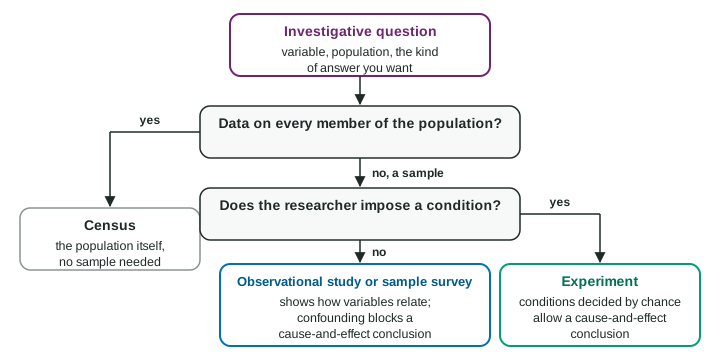
Four ways to collect data
| Method | What happens | What it can tell you |
|---|---|---|
| Census | data from every member of the population | the population’s value exactly, if everyone is reached |
| Sample survey | questions asked of a sample | an estimate for the population, if the sample represents it |
| Observational study | variables recorded as they are, nothing imposed | how variables are related |
| Experiment | the researcher imposes conditions and measures responses | whether a condition causes a change |
A census makes sense for a small, reachable population, like a class of 28 students. For a school of 1,500 or a country of millions, a well chosen sample is far cheaper and can be very accurate. A sample survey is one kind of observational study: it records answers without imposing anything. Observational studies can look back at existing records (retrospective) or follow people forward and record what happens (prospective).
Explanatory and response variables
Many questions are about whether one variable helps explain another. The explanatory variable is the one that might explain or influence; the response variable is the outcome measured. In "Is daily walking related to blood pressure?", walking is explanatory and blood pressure is the response.
Confounding and causation
A health researcher looks at records of 1,200 adults and finds that adults who walk 30 minutes or more a day have lower blood pressure. Does walking lower blood pressure? Perhaps, but the walkers chose to walk. They may be younger, eat differently, or smoke less, and each of those could lower blood pressure on its own.
A variable that is related to both the explanatory and the response variable is a confounding variable. Its effect on the response is mixed up with the explanatory variable’s effect, so the two cannot be separated. Age is a likely confounder here: younger adults tend to walk more and tend to have lower blood pressure.
State what an observational study allows. Breakfast eaters at a school earn higher grades than students who skip breakfast.
Type of study: observational, since no one was told whether to eat breakfast.
A possible confounding variable: family routine. Students with regular morning routines may be more likely to eat breakfast and also more likely to finish homework.
Conclusion in context: "These data show that breakfast and grades are related at this school, but they do not show that eating breakfast causes higher grades, because a confounding variable such as family routine could explain the difference."
To support a cause-and-effect conclusion, the researcher must impose the conditions and let chance decide which individuals get which condition. Then the groups differ, on average, only in the condition, and a difference in the response can be traced to it. That is an experiment, the subject of topic 1.13. Without it, say "is associated with" or "is related to", never "causes".
Matching the question to the plan
- "What proportion of ...?" or "What is the typical ...?": a sample survey or census.
- "Is ... related to ...?": an observational study can answer it.
- "Does ... cause ...?" or "Does ... increase ...?": an experiment.