A simulation estimates a probability by repeating a chance process. When every outcome has the same chance, you can often skip the repetition and find the probability exactly, by careful counting. This page sets up the words you need: sample space, event and complement.
Sample spaces and events
The sample space of a chance process is the list of all its possible outcomes. Flip a coin: heads, tails. Roll one die: 1, 2, 3, 4, 5, 6. Roll a red die and a blue die: 36 ordered pairs, from (1, 1) to (6, 6). An event is a set of outcomes, described in words: "the sum is 8" is the event made of (2, 6), (3, 5), (4, 4), (5, 3) and (6, 2).
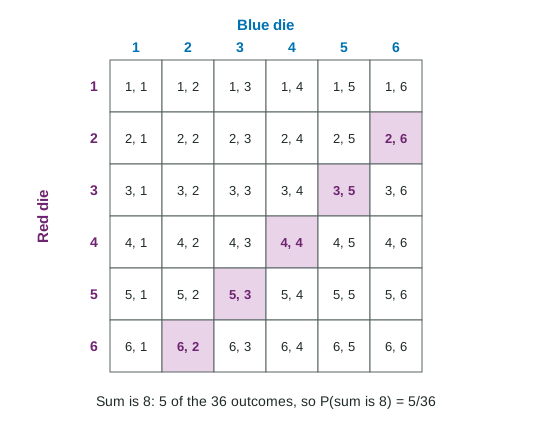
Order matters here. (2, 6) means red 2 and blue 6; (6, 2) means red 6 and blue 2. They are different outcomes, which is why the grid in the figure has 36 cells.
Probability by counting
If the outcomes in the sample space are equally likely, then
Worked example 1. Two fair dice are rolled. Find the probability that the sum is at least 10.
Write the event in words first: "at least 10" means a sum of 10, 11 or 12.
Count its outcomes: (4, 6), (5, 5), (6, 4), (5, 6), (6, 5), (6, 6). That is 6.
Divide:
The rule needs equally likely outcomes. There are 11 possible sums (2 to 12), but they are not equally likely: six pairs give 7 and only one gives 12. Likewise "win, lose or tie" does not make each a one-third chance. When outcomes are not equally likely, probabilities come from long-run shares or from data, such as the counts in a table. Choose one of 40 club members at random, 8 of them juniors, and each member is equally likely, so , even though there are only 4 classes.
Two rules every probability follows
- Every probability is between 0 and 1. A probability of 0 means the event never happens; 1 means it always does. A value like 1.2 or signals a mistake.
- The probabilities of all the outcomes in a sample space add to 1, because one of them is sure to happen.
A probability is a long-run idea. A forecast of 0.3 for rain means that on many days like tomorrow it rains on about 30% of them. It does not promise 3 rainy days in every 10.
The complement rule
The complement of event A, written , is "A does not happen". A and split the sample space between them, so
The complement is often much easier to count. "At least one" questions are the classic case: the complement of "at least one 6" is "no 6 at all".
Worked example 2. Two dice are rolled. Find the probability that at least one die shows a 6.
Complement: neither die shows a 6. The red die has 5 choices and the blue die has 5 choices, so outcomes.
Complement rule:
Check by direct count: 6 outcomes with a red 6 and 6 with a blue 6, but (6, 6) is in both lists, so .
The direct count shows the trap the complement avoids: counting (6, 6) twice gives , which is wrong.
Words to translate carefully
| Words | Means | For a sum of two dice |
|---|---|---|
| at least 10 | 10 or more | 10, 11, 12 |
| more than 10 | above 10 | 11, 12 |
| at most 3 | 3 or less | 2, 3 |
| not doubles | the complement of doubles | 30 of the 36 outcomes |
Write the event in words, list or count its outcomes, and check that your answer is between 0 and 1. If it is bigger than a half, ask whether the event really is more likely than not.