Momentum, p = mv, measured how much motion an object carries in a straight line, and impulse measured how a force changes it. Rotation has its own pair: angular momentum and angular impulse. They behave so much like their straight-line partners that you can often reason by analogy. One new idea needs care: a moving point object can have angular momentum about a point even when nothing is spinning.
Angular momentum of a turning object
For a rigid object turning about a fixed axis, angular momentum is rotational inertia times angular velocity:
L = Iω
The unit is kg·m²/s. Its sign follows ω: positive for counterclockwise, negative for clockwise (with the usual choice). A potter's wheel with I = 0.40 kg·m² spinning at 15 rad/s has L = 6.0 kg·m²/s.
Angular momentum of a point object
Now take a single small object, a puck, sliding in a straight line at constant velocity on a frictionless table. Pick a point P beside its path. The puck has angular momentum about P:
L = rmv sin θ
Here r is the distance from P to the puck and θ is the angle between r and the velocity. The product r sin θ is the perpendicular distance from P to the puck's line of motion, the lever arm of its momentum. So L is the momentum mv times that lever arm.
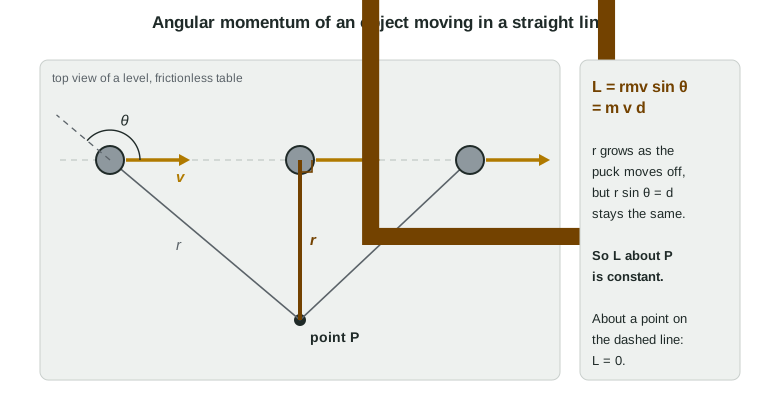
Two consequences surprise most students.
- As the puck slides by, r grows and shrinks, but r sin θ stays equal to the fixed distance d from P to the line. So the puck's angular momentum about P is constant: L = mvd, the same at every position.
- Angular momentum depends on the point you choose. About a point Q on the puck's own path, the lever arm is zero and L = 0.
Worked example 1. A 0.15 kg hockey puck slides at 4.0 m/s along a line that passes 0.25 m from point P. What is its angular momentum about P?
L = mv(r sin θ) = mvd = (0.15 kg)(4.0 m/s)(0.25 m) = 0.15 kg·m²/s.
A puck of the same mass at 2.0 m/s on a line 0.50 m from P has the same L: half the speed, twice the lever arm.
A ball whirled on a string in a circle of radius r at speed v also has L = rmv about the center, since its velocity is perpendicular to r. That matches L = Iω with I = mr² and ω = v/r.
Angular impulse changes angular momentum
A net torque acting for a time Δt delivers an angular impulse, τΔt, and that is exactly the change in angular momentum:
τnetΔt = ΔL
If the torque changes with time, the angular impulse is the area under a graph of torque against time. Rearranged, τnet = ΔL/Δt: the net torque is the slope of a graph of L against time. When I is constant this is the same as τnet = Iα from Unit 5.
Worked example 2. A wheel (I = 0.80 kg·m²) starts at rest. A net torque of +3.0 N·m acts for 4.0 s, then nothing for 1.0 s, then −1.5 N·m for 2.0 s. Find L and ω at the end.
Add the signed areas under τ-t: (3.0)(4.0) + 0 + (−1.5)(2.0) = 12 − 3.0 = 9.0 kg·m²/s.
L = 9.0 kg·m²/s, so ω = L/I = (9.0 kg·m²/s)/(0.80 kg·m²) = 11 rad/s. The L-t graph rises with slope 3.0, stays flat, then falls with slope −1.5.
Side by side
| Linear | Rotational |
|---|---|
| p = mv (kg·m/s) | L = Iω, or L = rmv sin θ for a point object (kg·m²/s) |
| impulse FΔt = Δp | angular impulse τΔt = ΔL |
| Fnet = slope of p-t | τnet = slope of L-t |
| area under F-t | area under τ-t |
Keep τΔt and τΔθ apart. Torque times time changes the angular momentum; torque times angle (the work) changes the kinetic energy.