Until now every vector lay along one line, and a sign was enough to give its direction. A kicked ball, a thrown dart or a plane changing course moves in two directions at once. To handle that, you split each vector into two perpendicular parts, its components, using right-triangle trigonometry. You need only three ratios and one calculator setting.
Right triangles and SOH CAH TOA
A right triangle has one 90° angle. Its longest side, across from the right angle, is the hypotenuse. Pick one of the other angles and call it θ. The leg touching θ is the adjacent side; the leg across from θ is the opposite side. Three ratios connect them:
| Ratio | Definition | Memory aid |
|---|---|---|
| sin θ | opposite / hypotenuse | SOH |
| cos θ | adjacent / hypotenuse | CAH |
| tan θ | opposite / adjacent | TOA |
The Pythagorean theorem links the sides: hypotenuse² = adjacent² + opposite².
Before you press a trig key, check that your calculator is in degree mode. In the other angle mode, cos 30 comes out 0.154 instead of 0.866, and every answer after it is wrong. The equations sheet lists the values for 0°, 30°, 37°, 45°, 53°, 60° and 90°; 37° and 53° belong to the 3-4-5 triangle, so sin 37° = cos 53° ≈ 0.60 and cos 37° = sin 53° ≈ 0.80.
Splitting a vector into components
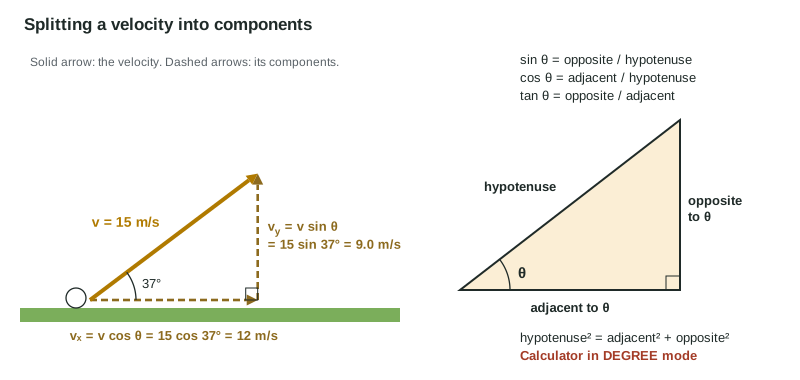
Draw the vector from the origin of your axes and drop a line from its tip to the x-axis. You have made a right triangle: the vector is the hypotenuse, and the legs are its components along x and y. If the angle θ is measured from the x-axis,
Aₓ = A cos θ Ay = A sin θ
Worked example 1. A soccer ball is kicked at 15 m/s, 37° above the horizontal. Find its components.
The horizontal leg is adjacent to 37°: vₓ = (15 m/s) cos 37° = 15 × 0.799 = 12 m/s.
The vertical leg is opposite 37°: vy = (15 m/s) sin 37° = 15 × 0.602 = 9.0 m/s.
Check: √(12² + 9.0²) = √225 = 15 m/s. The components rebuild the original vector.
The rule to remember is not "x is cosine". It is "adjacent is cosine". If an angle is measured from the vertical, the vertical leg is adjacent and gets cosine, and the horizontal leg gets sine. Always look at which axis the angle touches.
From components back to a vector
If you know the components, the Pythagorean theorem gives the magnitude and the tangent gives the direction:
A = √(Aₓ² + Ay²) θ = tan⁻¹(Ay / Aₓ)
Worked example 2. A velocity has components vₓ = 15 m/s and vy = 8.0 m/s. Find its magnitude and direction.
v = √(15² + 8.0²) = √289 = 17 m/s.
θ = tan⁻¹(8.0 / 15) = tan⁻¹(0.533) = 28° above the horizontal.
Adding vectors in two dimensions
To add vectors that are not along one line, draw them tip to tail: start the second vector where the first one ends. The sum (the resultant) runs from the tail of the first to the tip of the last. Walk 6.0 m east, then 8.0 m north, and you end 10. m from the start, not 14 m.
For calculations, add components instead. Split each vector into x and y parts, add all the x parts, add all the y parts, then rebuild the resultant from the two sums. Each direction behaves like the one-line vectors you already know, with its own signs.
Worked example 3. A plane flies 300. km at 30.0° south of west, then 100. km due south. How far south of its start does it end?
Leg 1: the angle is measured from west, so the south part is opposite it: 300. km × sin 30.0° = 150. km south.
Leg 2: 100. km south, all of it.
Total south component = 150. km + 100. km = 250. km. (The west component of leg 1, 300. km × cos 30.0° = 260. km, would go into the west total.)
Checks that catch mistakes
- A component is never longer than the vector.
- A small angle from the x-axis means a big x-component and a small y-component.
- Components rebuild the vector: Aₓ² + Ay² = A².
- Degree mode, every time.