Many exam questions never ask for a number. They ask what happens to one quantity when another changes: "if the speed is tripled, the stopping distance is multiplied by...". This is functional dependence, and it is pure reasoning about an equation. The reader reports say students lose points here more than almost anywhere else, usually because they guess instead of reading the power in the equation.
Directly proportional
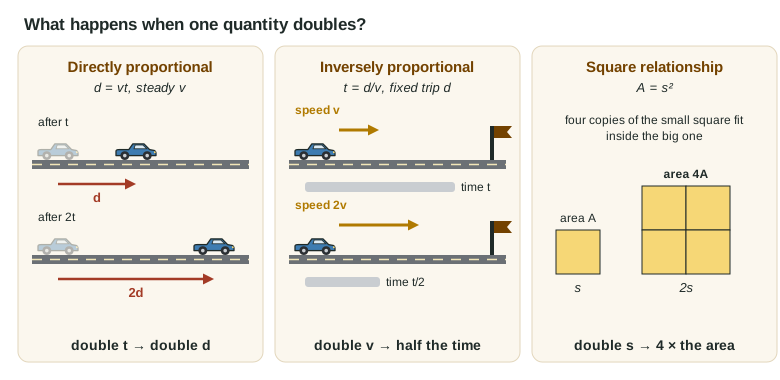
A cyclist at a steady speed v covers distance d = vt. Hold v fixed. Ride twice as long and you go twice as far; ride three times as long and you go three times as far. We say d is directly proportional to t, written d ∝ t. In general y ∝ x means y = kx for some constant k, and multiplying x by a factor multiplies y by the same factor.
Inversely proportional
Now fix the trip length d and change the speed. The time is t = d/v. Drive twice as fast and the trip takes half as long. t is inversely proportional to v: t ∝ 1/v. Multiplying v by a factor divides t by that factor. A neat check: in an inverse relationship the product stays fixed. Here v × t = d, the same trip every time.
Square relationships
A square tile of side s has area A = s². Double the side and four copies of the old tile fit inside: the area is 2² = 4 times as large. Triple the side and the area is 3² = 9 times as large. When y ∝ x², the factor on y is the factor on x squared.
Motion has square relationships too. A car that starts from rest with a steady acceleration covers Δx = ½at². In twice the time it covers 4 times the distance. A car braking with a steady deceleration needs a stopping distance d = v²/(2a), so twice the speed needs 2² = 4 times the distance.
The same idea runs backward. If y ∝ x², then x ∝ √y: to double x you need 4 times y. And an inverse square, y ∝ 1/x², divides y by the factor squared: double x and y becomes ¼ as large.
The method
- Write the equation and solve it for the quantity the question asks about.
- Cross out everything the question holds fixed.
- Read the power of the quantity that changes: 1, −1 (in the denominator), 2, ½.
- Raise the factor to that power. If several quantities change, do this for each and multiply the results.
- Check that the direction makes sense: faster should mean less time, longer should mean farther.
Worked example 1. A cart starts from rest with a steady acceleration and moves 0.30 m in 1.0 s. How far does it move in 4.0 s?
Equation: Δx = ½at². With a fixed, Δx ∝ t².
Factor on t: 4.0 s / 1.0 s = 4. Factor on Δx: 4² = 16.
Δx = 16 × 0.30 m = 4.8 m. No need to find a.
Worked example 2. In y = kx²/z, x is tripled and z is doubled. What happens to y?
Factor from x: 3² = 9 (on top). Factor from z: 2 (on the bottom, so divide).
Total factor: 9/2 = 4.5. y becomes 4.5 times as large.
Reading the pattern from data
Sometimes you get a table instead of an equation. Pick two rows where one quantity changes by a simple factor and see what the other does.
| When x doubles, y... | Relationship |
|---|---|
| doubles | y ∝ x |
| halves | y ∝ 1/x |
| becomes 4 times as large | y ∝ x² |
| becomes ¼ as large | y ∝ 1/x² |
| becomes about 1.41 times as large | y ∝ √x |
On the free response
When a question asks you to check a claim with your derived equation, write the dependence in words and tie it back: "d ∝ v², so doubling the speed makes the stopping distance 4 times as long, which agrees with my claim that it more than doubles." Naming the power and the factor is what earns the point.