Proportional Reasoning and Functional Dependence
Functional dependence says how one quantity responds when another changes.
Part 1 · Hook
Why this matters
Part 2 · Before you start
What this builds on
Part 3 · Prerequisite check
Quick check before you start
1. Solve d = vt for t.
- t = d/v
- t = v/d
- t = dv
- t = d − v
Show the answer
Divide both sides by v.
- Correct: t = d/v:
- t = v/d:
- t = dv:
- t = d − v:
2. What is 3²?
- 9
- 6
- 3
- 1.5
Show the answer
3² = 3 × 3 = 9.
- Correct: 9:
- 6:
- 3:
- 1.5:
Part 4 · See it
See it first
Part 5 · Step by step
How it works, step by step
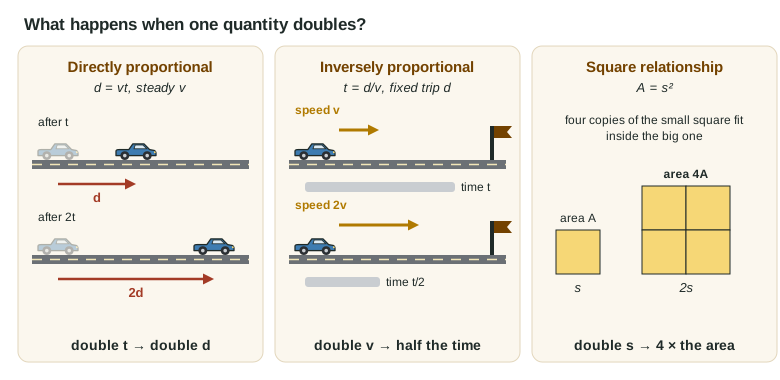
- An equation links two quantities while the others stay fixedthe power of each quantity in the equation sets how the other responds
- y = kx (first power)multiplying x by a factor multiplies y by the same factor
- y = k/x (x in the denominator)multiplying x by a factor divides y by that factor
- y = kx² (x squared)multiplying x by a factor multiplies y by the factor squared
Part 6 · Key ideas
Key ideas
- To find a functional dependence, solve for the quantity asked, hold everything else fixed, and look at the power of the quantity that changes.
- Directly proportional (y ∝ x): factor in, same factor out. Inversely proportional (y ∝ 1/x): factor in, divide by it.
- Square (y ∝ x²): factor in, factor squared out. Triple x → 9y. A square root (y ∝ √x): quadruple x → 2y.
- Several changes at once: write a factor for each and multiply them. In y = kx²/z, doubling x and z gives 2²/2 = 2.
Part 7 · Misconception
A common mistake
The wrong idea: If the speed doubles, the braking distance doubles, because a bigger speed means a proportionally bigger distance.
What actually happens: Read the equation: d = v²/(2a), so d ∝ v². Doubling v multiplies d by 2² = 4.
Part 8 · Check yourself
Check yourself
Exam-style questions. Anything you miss goes into your review queue.
1. A cyclist rides at a steady speed, so the distance covered is d = vt. If she rides for 3 times as long, how does the distance change?
- It is 9 times as large
- It is 3 times as large
- It is one third as large
- It is unchanged
Show the answer
d = vt with v fixed: d ∝ t. Multiply t by 3 and d is multiplied by 3.
- It is 9 times as large: That would be true if d depended on t², but at a steady speed d = vt has t to the first power.
- Correct: It is 3 times as large: Right: d is directly proportional to t, so tripling t triples d.
- It is one third as large: Riding longer at the same speed covers more distance, not less.
- It is unchanged: Distance depends on time here; only the speed is held steady.
2. A bus route has a fixed length d. The time for the trip is t = d/v. If the bus drives 1.5 times as fast, how does the trip time change?
- It becomes about 0.67 times as long
- It becomes about 1.5 times as long
- It becomes about 2.25 times as long
- It becomes about 0.50 times as long
Show the answer
t = d/v: t ∝ 1/v. New t = t/1.5 ≈ 0.67t.
- Correct: It becomes about 0.67 times as long: Right: t is inversely proportional to v, so multiplying v by 1.5 divides t by 1.5.
- It becomes about 1.5 times as long: Faster means less time; v is in the denominator.
- It becomes about 2.25 times as long: v is not squared in t = d/v, and the time should shrink, not grow.
- It becomes about 0.50 times as long: Halving the time would need twice the speed, not 1.5 times.
3. A cart starts from rest with a steady acceleration, so its displacement is Δx = ½at². After 2.0 s it has moved 0.50 m. How far has it moved after 6.0 s?
Type a number in m.
Show the answer
Δx ∝ t². The time is 3 times as long, so Δx is 3² = 9 times as large: 9 × 0.50 m = 4.5 m.
- Answer: 4.5 m
4. For a car braking with the same steady deceleration, the stopping distance is d = v²/(2a). Driving at 3 times the speed multiplies the stopping distance by
- 3
- 6
- 9
- 1/9
Show the answer
d = v²/(2a), a fixed: d ∝ v². Factor = 3² = 9. This is why speed matters so much for braking.
- 3: That treats d as proportional to v, but the speed is squared.
- 6: Squaring 3 gives 9, not 2 × 3. A square multiplies the factor by itself.
- Correct: 9: Right: d ∝ v², so 3 times the speed gives 3² = 9 times the distance.
- 1/9: The speed is on top of the fraction, so a larger speed gives a larger distance.
5. In y = kx²/z, x is doubled and z is doubled at the same time. By what factor does y change?
- 1
- 2
- 4
- 8
Show the answer
Write the factor for each change and multiply: (2)²/(2) = 4/2 = 2.
- 1: The two changes do not cancel: x is squared but z is not.
- Correct: 2: Right: doubling x multiplies y by 2² = 4, and doubling z divides it by 2. 4 ÷ 2 = 2.
- 4: This counts the effect of x but forgets that z also doubled, in the denominator.
- 8: z is in the denominator, so doubling it divides y by 2 rather than multiplying.
6. A table of measurements shows that each time t doubles, a quantity Q becomes 4 times as large. Which relationship fits?
- Q ∝ t
- Q ∝ 1/t
- Q ∝ √t
- Q ∝ t²
Show the answer
Test with a factor: if t × 2 gives Q × 4 = Q × 2², then Q ∝ t².
- Q ∝ t: A direct proportion would only double Q when t doubles.
- Q ∝ 1/t: An inverse relationship would halve Q when t doubles.
- Q ∝ √t: A square root would multiply Q by about 1.41 when t doubles.
- Correct: Q ∝ t²: Right: a factor of 2 in t giving a factor of 4 = 2² in Q is the mark of a square relationship.
Part 9 · Summary
Summary
Part 10 · Up next
What comes next
Part 11 · Connections