Right-Triangle Trigonometry and Vector Components
A vector at an angle is the hypotenuse of a right triangle.
Part 1 · Hook
Why this matters
Part 2 · Before you start
What this builds on
Part 3 · Prerequisite check
Quick check before you start
1. Solve y = A sin θ for A.
- A = y / sin θ
- A = y sin θ
- A = sin θ / y
- A = y − sin θ
Show the answer
Divide both sides by sin θ.
- Correct: A = y / sin θ:
- A = y sin θ:
- A = sin θ / y:
- A = y − sin θ:
2. Displacements of +5.0 m and −2.0 m along a line add to
- +3.0 m
- +7.0 m
- −3.0 m
- −7.0 m
Show the answer
Add the signed values.
- Correct: +3.0 m:
- +7.0 m:
- −3.0 m:
- −7.0 m:
Part 4 · See it
See it first
Part 5 · Step by step
How it works, step by step
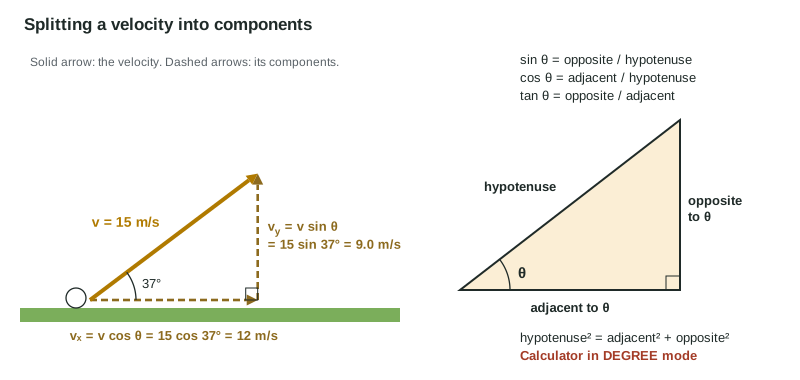
- A vector points at an angle to the axesit forms the hypotenuse of a right triangle whose legs lie along the axes
- You know the magnitude and the anglethe leg adjacent to the angle is A cos θ and the leg opposite it is A sin θ
- You know both componentsthe magnitude is the square root of (x-component² + y-component²), and tan θ = y-component ÷ x-component
- You add vectors that are not along one lineyou add their x-components and their y-components separately
Part 6 · Key ideas
Key ideas
- SOH CAH TOA: sin θ = opposite/hypotenuse, cos θ = adjacent/hypotenuse, tan θ = opposite/adjacent.
- Components: the side adjacent to the given angle is A cos θ; the side opposite it is A sin θ. Check which axis the angle is measured from.
- Back to the vector: magnitude = √(Aₓ² + Ay²); angle = tan⁻¹(Ay/Aₓ).
- Set your calculator to degree mode. The sheet lists 37° and 53° (the 3-4-5 triangle): sin 37° ≈ 0.60, cos 37° ≈ 0.80.
- Add vectors tip to tail, or by adding x-components and y-components separately.
Part 7 · Misconception
A common mistake
The wrong idea: The x-component always uses cosine and the y-component always uses sine.
What actually happens: Cosine goes with the side adjacent to the angle you are given. If the angle is measured from the vertical (or from the ramp), the horizontal component uses sine.
Part 8 · Check yourself
Check yourself
Exam-style questions. Anything you miss goes into your review queue.
1. A ball is kicked at 20. m/s at 30.° above the horizontal. What is the horizontal component of its velocity? (Degree mode.)
Type a number in m/s.
Show the answer
The horizontal side is adjacent to the angle: vₓ = v cos θ = (20. m/s)(cos 30°) = 17 m/s.
- Answer: 17 m/s
2. A hiker's displacement is 400 m at 53° north of east. What is the north component of the displacement? (Degree mode.)
Type a number in m.
Show the answer
North is the side opposite the 53° angle (measured from east): d(north) = d sin θ = 400 m × sin 53° = 320 m (2 significant figures; 3.2 × 10² m).
- Answer: 320 m
3. A velocity has components vₓ = 9.0 m/s and vy = 12 m/s. What is its magnitude?
Type a number in m/s.
Show the answer
The components are the legs of a right triangle and the velocity is the hypotenuse: v = √(9.0² + 12²) = √225 = 15 m/s.
- Answer: 15 m/s
4. A vector of magnitude A makes an angle θ with the vertical (y) axis. Which expression gives its horizontal (x) component?
- A cos θ
- A tan θ
- A sin θ
- A / cos θ
Show the answer
Do not memorize "x uses cosine". Find the side adjacent to the angle you are given: it gets cosine; the opposite side gets sine.
- A cos θ: Cosine gives the side adjacent to θ, which here is the vertical side.
- A tan θ: Tangent is a ratio of the two legs, not a leg divided by the hypotenuse.
- Correct: A sin θ: Right: measured from the vertical, the horizontal side is opposite θ, so it uses sine.
- A / cos θ: A component is shorter than the vector; dividing by cos θ makes it longer.
5. A student computes cos 60 on her calculator and gets −0.952. What went wrong?
- Cosine of 60° is negative
- The calculator is not in degree mode
- She should have used sine
- She should type the angle as 0.60
Show the answer
Physics 1 angles are in degrees. Set the calculator to degree mode before any trig: cos 60° = 0.500.
- Cosine of 60° is negative: Cosine is positive for angles from 0° to 90°.
- Correct: The calculator is not in degree mode: Right: it read 60 in another angle unit and gave −0.952. In degree mode, cos 60° = 0.500.
- She should have used sine: Changing the function does not fix a calculator in the wrong angle mode.
- She should type the angle as 0.60: Angles in degrees are entered as written; the mode is the problem.
6. Two displacements are added tip to tail: 3.0 m east, then 4.0 m north. Which describes the total displacement?
- 7.0 m, north of east
- 1.0 m, north
- 5.0 m, due north
- 5.0 m, north of east
Show the answer
Tip to tail: draw the second vector starting at the tip of the first; the resultant goes from the first tail to the last tip. Here it is a 3-4-5 triangle.
- 7.0 m, north of east: Perpendicular displacements do not add as plain numbers; 7.0 m is the distance walked.
- 1.0 m, north: Subtracting works only for vectors along the same line in opposite directions.
- 5.0 m, due north: The resultant points from the start to the end, which is north of east, not due north.
- Correct: 5.0 m, north of east: Right: the two legs are perpendicular, so the resultant is the hypotenuse √(3.0² + 4.0²) = 5.0 m, pointing between east and north.
Part 9 · Summary
Summary
Part 10 · Up next
What comes next
Part 11 · Connections