Vectors and Motion in Two Dimensions
Two-dimensional motion is two independent one-dimensional motions sharing the same time.
Part 1 · Hook
Why this matters
Part 2 · Before you start
What this builds on
Part 3 · Prerequisite check
Quick check before you start
1. A velocity of 10. m/s at 30.° above the horizontal has a vertical component of
- 5.0 m/s
- 8.7 m/s
- 10. m/s
- 3.0 m/s
Show the answer
vy = v sin θ = 10. × sin 30.° = 5.0 m/s.
- Correct: 5.0 m/s:
- 8.7 m/s:
- 10. m/s:
- 3.0 m/s:
2. A stone dropped from rest falls for 1.0 s. How far does it fall? (g = 9.8 m/s²)
- 4.9 m
- 9.8 m
- 19.6 m
- 2.5 m
Show the answer
Δy = ½gt² = ½(9.8)(1.0)² = 4.9 m.
- Correct: 4.9 m:
- 9.8 m:
- 19.6 m:
- 2.5 m:
3. A walker moves at 1.5 m/s on a walkway moving at 1.0 m/s the same way. Her velocity relative to the floor is
- 2.5 m/s
- 0.5 m/s
- 1.5 m/s
- 1.0 m/s
Show the answer
Add the velocities along the line.
- Correct: 2.5 m/s:
- 0.5 m/s:
- 1.5 m/s:
- 1.0 m/s:
Part 4 · See it
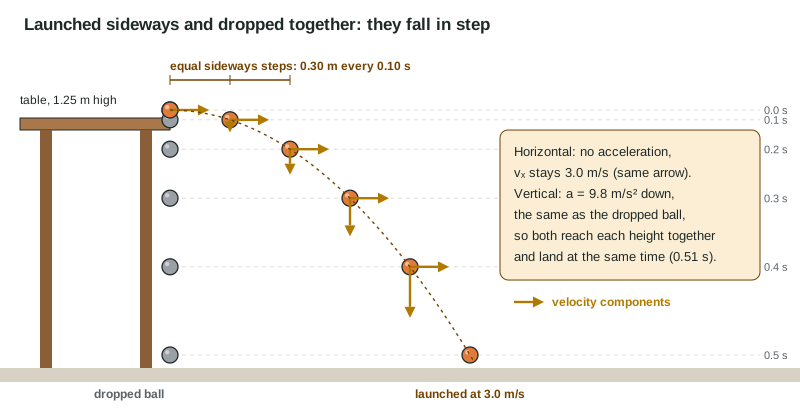
See it first
Part 5 · Step by step
How it works, step by step
- A velocity points at an angleit splits into a horizontal component v cos θ and a vertical component v sin θ
- Gravity acts only downward and air resistance is negligiblethe horizontal acceleration is zero and the vertical acceleration is g downward
- The two directions are independentyou solve each as a one-dimensional problem, linked only by the shared time
- The vertical motion sets how long the object is in the airthe range is the constant horizontal velocity times that time of flight
Part 6 · Key ideas
Key ideas
- Treat two-dimensional motion as two one-dimensional motions at right angles. They share only the time.
- A projectile: aₓ = 0, so vₓ is constant; a_y = g downward, so the vertical motion is free fall.
- Split the launch velocity: vₓ = v cos θ, vy = v sin θ (θ, the launch angle, measured from the horizontal).
- The time of flight comes from the vertical motion only. The horizontal range = vₓ × time of flight.
- At the top, vy = 0 but vₓ is unchanged and the acceleration is still g downward.
Part 7 · Misconception
A common mistake
The wrong idea: A ball launched sideways off a table takes longer to land than a ball dropped from the same height, because it travels farther.
What actually happens: Both start with zero vertical velocity and have the same downward acceleration, so they fall the same height in the same time. The sideways motion is independent and only decides where the ball lands.
Part 8 · Check yourself
Check yourself
Exam-style questions. Anything you miss goes into your review queue.
Diagram
A ball rolls off a table
A ball rolls off the edge of a level table 0.80 m high at 2.4 m/s, moving horizontally. Air resistance is negligible. Use g = 9.8 m/s².
Key: gold arrow, the ball's velocity as it leaves the table; dashed curve, its path.
1. How long is the ball in the air?
Type a number in s.
Show the answer
Vertically the ball starts with vy = 0 and falls 0.80 m: Δy = ½gt², so t = √(2Δy/g) = √(2 × 0.80 m ÷ 9.8 m/s²) = 0.40 s. The horizontal speed does not matter.
- Answer: 0.40 s
2. How far from the base of the table does the ball land (the distance d)?
Type a number in m.
Show the answer
Horizontally there is no acceleration, so d = vₓt = (2.4 m/s)(0.404 s) = 0.97 m.
- Answer: 0.97 m
3. The ball leaves the same table at 4.8 m/s instead. How does its time in the air compare?
- It is twice as long
- It is half as long
- It is √2 times as long
- It is the same, 0.40 s
Show the answer
Horizontal and vertical motions are independent. Same height, same vertical start, same fall time; only d doubles.
- It is twice as long: A faster horizontal speed carries the ball farther, but it does not change how long it takes to fall 0.80 m.
- It is half as long: The vertical motion starts from vy = 0 in both cases, so the ball falls the same way.
- It is √2 times as long: Square roots come from changing the height; here only the horizontal speed changed.
- Correct: It is the same, 0.40 s: Right: the fall time depends only on the vertical motion (height and g), and the vertical motion has not changed.
4. Which statement about the ball's velocity while it is in the air is correct?
- Its horizontal component slows down as the ball falls
- Its horizontal part is steady; its vertical part grows
- Both components grow at the same rate
- Its vertical component stays zero until it lands
Show the answer
A projectile: aₓ = 0, so vₓ is constant; a_y = −g, so vy grows downward steadily.
- Its horizontal component slows down as the ball falls: Nothing pushes the ball sideways once it leaves the table, so vₓ does not change.
- Correct: Its horizontal part is steady; its vertical part grows: Right: no horizontal acceleration; a constant downward acceleration g changes vy by 9.8 m/s each second.
- Both components grow at the same rate: Only the vertical component changes; the horizontal acceleration is zero.
- Its vertical component stays zero until it lands: Gravity gives the ball a downward velocity from the moment it leaves the table.
5. At the highest point of a ball's flight after being thrown at an angle, which is true? Air resistance is negligible.
- Its velocity and acceleration are both zero
- Its velocity is zero and its acceleration is g downward
- Its velocity is horizontal and its acceleration is zero
- Its velocity is horizontal; its acceleration is g down
Show the answer
At the top vy = 0 but vₓ is unchanged, and a = g downward at every point of a projectile's flight.
- Its velocity and acceleration are both zero: vₓ is not zero, and the acceleration stays g downward at the top.
- Its velocity is zero and its acceleration is g downward: Only the vertical part of the velocity is zero at the top; vₓ remains.
- Its velocity is horizontal and its acceleration is zero: The vertical velocity is changing from up to down at the top, so the acceleration is not zero.
- Correct: Its velocity is horizontal; its acceleration is g down: Right: vy = 0 at the top, so the velocity is just vₓ; the acceleration is g down throughout.
Part 9 · Summary
Summary
Part 10 · Up next
What comes next
Part 11 · Connections