Systems and Center of Mass
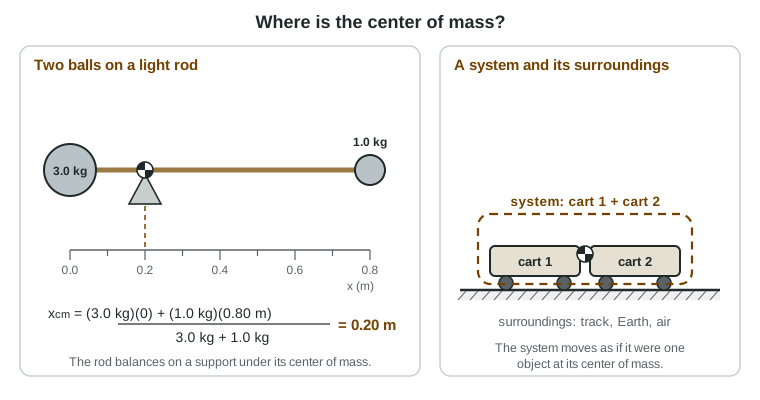
Choose a system and its boundary; when its insides do not matter, model it as one point at its center of mass, the mass-weighted average position x_cm = Σm·x ÷ Σm, which lies nearer the heavier parts and on any line of symmetry.
Part 1 · Hook
Why this matters
Part 2 · Before you start
What this builds on
Part 3 · Prerequisite check
Quick check before you start
1. In the object model, an object is treated as
- a single point with a position
- a point with a size and shape
- a set of separate moving parts
- a point that cannot move
Show the answer
The object model keeps only a position: no size, shape or inner parts.
- Correct: a single point with a position:
- a point with a size and shape:
- a set of separate moving parts:
- a point that cannot move:
2. A projectile's path, with air ignored, is
- a parabola
- a straight line
- a circle
- a zigzag
Show the answer
Constant velocity sideways plus constant acceleration downward gives a parabola.
- Correct: a parabola:
- a straight line:
- a circle:
- a zigzag:
Part 4 · See it
See it first
Part 5 · Step by step
How it works, step by step
- You draw a boundary around the objects you care aboutthey form the system, and everything else is the surroundings
- The parts of the system are not what the question is aboutyou can model the whole system as one point object
- The system's mass is not spread evenlythat point, the center of mass, sits nearer the heavier parts: x_cm = Σm·x ÷ Σm
- The system moves, tumbles or turnsits center of mass still moves like a single point object, so you can track one point instead of every part
Part 6 · Key ideas
Key ideas
- A system is the object or objects you choose to study; everything outside the boundary is the surroundings.
- Mass is a scalar measure of how much matter there is, in kilograms; masses add.
- The center of mass is the mass-weighted average position: x_cm = (m₁x₁ + m₂x₂ + …) ÷ (m₁ + m₂ + …). Do x and y separately.
- For a uniform, symmetric object the center of mass is on every line of symmetry. It can be in empty space (a ring).
Part 7 · Misconception
A common mistake
The wrong idea: The center of mass is halfway between the objects, or at the middle of the object.
What actually happens: Only for equal masses or a uniform object. Otherwise weight each position by its mass: the center of mass is closer to the heavier part.
Part 8 · Check yourself
Check yourself
Exam-style questions. Anything you miss goes into your review queue.
Diagram
A wrench sliding across ice
A wrench is given a spin and a shove across smooth, level ice. A camera above records it every 0.20 s. Most of its mass is in the steel head; the black dot marks the light end of the handle.
1. Which statement describes the motion of the wrench's center of mass across the ice?
- It moves along a straight line, covering equal distances in equal times
- It moves along a wavy path that follows the swinging handle
- It curves toward the heavy head a little more in each picture
- It speeds up each time the wrench completes half a turn
Show the answer
The pictures show the quartered center-of-mass symbol on one straight dashed line, equally spaced every 0.20 s. Nothing outside the wrench pushes it sideways along the slippery ice, so its center of mass keeps a constant velocity even while the wrench turns.
- Correct: It moves along a straight line, covering equal distances in equal times: Right: the center of mass moves like a single point object that nothing pushes or pulls along the ice.
- It moves along a wavy path that follows the swinging handle: The handle end follows a wavy path because it swings around the center of mass; the center of mass itself stays on the dashed line.
- It curves toward the heavy head a little more in each picture: The dashed line through the five positions is straight; the head turning around the center of mass does not bend that path.
- It speeds up each time the wrench completes half a turn: The spacing between positions is the same every 0.20 s, so the center of mass is not speeding up.
2. Between 0.00 s and 0.80 s the wrench's center of mass moves 2.4 m along the dashed line. What is its average speed, in m/s?
Type a number in m/s.
Show the answer
Average speed = distance ÷ time = 2.4 m ÷ 0.80 s = 3.0 m/s.
- Answer: 3.0 m/s
Data table
Three clamps on a meterstick
A student clamps three small masses to a meterstick of negligible mass. Each clamp is small enough to treat as a point object at the position shown, measured from the 0 end of the stick.
| Clamp | Mass (kg) | Position (m) |
|---|---|---|
| 1 | 0.20 | 0.10 |
| 2 | 0.30 | 0.50 |
| 3 | 0.70 | 0.90 |
3. Where is the center of mass of the three clamps, measured from the 0 end of the stick, in meters?
Type a number in m.
Show the answer
x_cm = Σm·x ÷ Σm = [(0.20)(0.10) + (0.30)(0.50) + (0.70)(0.90)] kg·m ÷ 1.20 kg = 0.80 kg·m ÷ 1.20 kg = 0.67 m.
- Answer: 0.67 m
4. Clamp 3 (0.70 kg) is moved from the 0.90 m mark to the 0.30 m mark. Where is the center of mass now?
- At about 0.32 m, closer to the 0 end
- At about 0.07 m, closer to the 0 end
- Still at 0.67 m, since the total mass is unchanged
- At about 0.50 m, the middle of the stick
Show the answer
The new Σm·x is (0.20)(0.10) + (0.30)(0.50) + (0.70)(0.30) = 0.38 kg·m, so x_cm = 0.38 kg·m ÷ 1.20 kg = 0.32 m. The center of mass moves (0.70/1.20) × 0.60 m = 0.35 m toward the 0 end.
- Correct: At about 0.32 m, closer to the 0 end: Right: recompute the weighted average with the new position.
- At about 0.07 m, closer to the 0 end: This moves the center of mass by the full 0.60 m that clamp 3 moved. One clamp carries only 0.70 of the 1.20 kg, so the center of mass moves 0.70/1.20 of that distance.
- Still at 0.67 m, since the total mass is unchanged: The total mass is the same, but the center of mass depends on where the mass is, not only on how much there is.
- At about 0.50 m, the middle of the stick: The middle of the stick is the center of mass of the stick itself, which is negligible here; the clamps set the center of mass.
5. A 2.0 kg ball sits at x = 0 and a 6.0 kg ball at x = 0.40 m, joined by a rod of negligible mass. Where is the center of mass, in meters?
Type a number in m.
Show the answer
x_cm = (2.0 kg × 0 + 6.0 kg × 0.40 m) ÷ 8.0 kg = 2.4 kg·m ÷ 8.0 kg = 0.30 m, closer to the heavier ball.
- Answer: 0.30 m
6. Where is the center of mass of a thin, uniform metal ring?
- At the center of the ring, where there is no metal
- Somewhere on the metal, where the mass is
- At the top of the ring, above its middle
- Nowhere, since the middle of the ring is empty
Show the answer
The ring is symmetric about every line through its center, so its center of mass is at the center, even though no material is there. A center of mass is a position, not a piece of the object.
- Correct: At the center of the ring, where there is no metal: Right: it lies on every line of symmetry, and they all cross at the center.
- Somewhere on the metal, where the mass is: The center of mass is an average position; it need not be inside the material.
- At the top of the ring, above its middle: Up and down do not matter to a uniform ring: the top has no more mass than the bottom.
- Nowhere, since the middle of the ring is empty: Every object has a center of mass; for a ring it is a point in empty space.
Part 9 · Summary
Summary
Part 10 · Up next
What comes next
Part 11 · Connections