Forces and Free-Body Diagrams
A force is an interaction between two objects.
Part 1 · Hook
Why this matters
Part 2 · Before you start
What this builds on
Part 3 · Prerequisite check
Quick check before you start
1. Which quantity is a vector?
- Force
- Mass
- Distance
- Time
Show the answer
A force has a size and a direction, so it is a vector. Mass, distance and time are sizes only.
- Correct: Force:
- Mass:
- Distance:
- Time:
2. On a line, a 30 m/s velocity to the right and a 10 m/s velocity to the left are written as
- +30 m/s and −10 m/s
- +30 m/s and +10 m/s
- −30 m/s and +10 m/s
- 30 m/s and 10 m/s, with no sign
Show the answer
Pick right as positive; then left is negative.
- Correct: +30 m/s and −10 m/s:
- +30 m/s and +10 m/s:
- −30 m/s and +10 m/s:
- 30 m/s and 10 m/s, with no sign:
3. The center of mass of a system is
- its mass-weighted average position
- its geometric middle in every case
- the heaviest part of it
- the point where it touches the ground
Show the answer
x_cm = Σm·x ÷ Σm weights each position by its mass.
- Correct: its mass-weighted average position:
- its geometric middle in every case:
- the heaviest part of it:
- the point where it touches the ground:
Part 4 · See it
See it first
Part 5 · Step by step
How it works, step by step
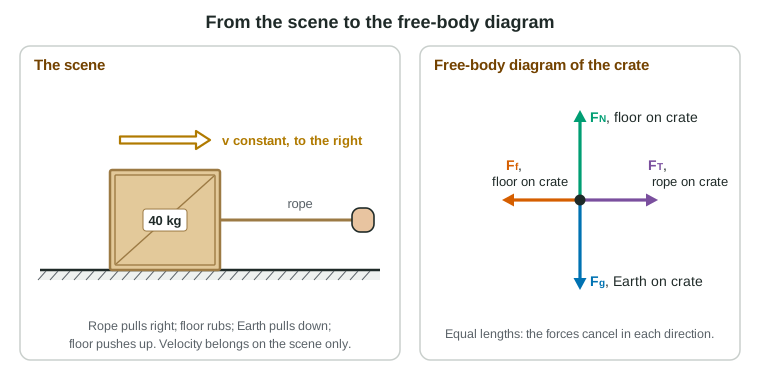
- Two objects interact (they touch, or one is Earth)each exerts a force on the other: a push or pull with a size and a direction
- You choose one object and list everything that touches it, plus Earthyou have every force on it, each with an agent
- You draw each force as an arrow starting on a dot at the center of massyou get a free-body diagram: whole forces, labeled with type and agent, lengths in proportion
- You add the forces as vectors, with signs on each axisyou get the net force, which is a result of the diagram, not one of its arrows
Part 6 · Key ideas
Key ideas
- A force is a push or pull between two objects, measured in newtons (1 N = 1 kg·m/s²). It is a vector.
- Contact forces (normal force, tension, friction) need touching. Weight, F_g = mg, is Earth's pull at a distance; near Earth g = 9.8 m/s² (10 m/s² is accepted).
- A free-body diagram: a dot for the object, one arrow per force starting on the dot, labeled type and agent ("F_N, floor on box"), no components, no velocity, no net force arrow.
- The net force is the vector sum of all the forces. Find it from the diagram; never draw it on the diagram.
Part 7 · Misconception
A common mistake
The wrong idea: A moving object has a "force of motion" pushing it along, and the free-body diagram should show it.
What actually happens: Every force needs an agent touching the object (or Earth). Once a thrown ball leaves the hand, only Earth (and air) act on it. Motion does not need a forward force.
Part 8 · Check yourself
Check yourself
Exam-style questions. Anything you miss goes into your review queue.
Diagram
A loaded sled slowing down
A sled loaded with firewood moves to the right across level snow. A person ahead of it pulls a horizontal rope, but the sled is slowing down. The snow rubs on the sled's runners. Air resistance is negligible.
1. How many forces act on the loaded sled?
- Four
- Three
- Five
- Two
Show the answer
Four objects interact with the sled: the rope pulls it right, the snow rubs on it to the left (friction), the snow pushes up on it (the normal force), and Earth pulls it down (the weight).
- Correct: Four: Right: rope, friction from the snow, normal force from the snow, and weight.
- Three: Three leaves one out, usually the normal force: the snow both rubs on the runners and pushes up on them, and those are two separate forces.
- Five: A fifth "force of motion" has no agent. Moving does not need its own force; every force on the sled comes from an object touching it or from Earth.
- Two: Two forces would leave out the vertical pair: Earth pulls the sled down and the snow pushes it up.
2. Which label correctly describes the friction arrow on the sled's free-body diagram?
- F_f, snow on sled
- F_f, sled on snow
- F_f, rope on sled
- F_f, Earth on sled
Show the answer
A free-body diagram shows forces exerted ON the sled, each labeled with its type and the object that exerts it (the agent). The snow exerts the friction on the sled.
- Correct: F_f, snow on sled: Right: type (friction), agent (snow), object (sled).
- F_f, sled on snow: The sled does push on the snow, but that force acts on the snow, so it belongs on the snow's diagram, not the sled's.
- F_f, rope on sled: The rope exerts a tension force on the sled, not friction.
- F_f, Earth on sled: Earth exerts the weight on the sled; friction comes from the surface the sled slides on.
3. A student's free-body diagram of the sled shows five arrows: F_T (rope on sled), F_f (snow on sled), F_N (snow on sled), F_g (Earth on sled) and an arrow to the right labeled v. What should she change?
- Remove the arrow labeled v
- Remove the friction arrow, since the sled moves
- Add an arrow for the force of motion
- Remove F_N, since F_g already covers the snow
Show the answer
Velocity is not a force: no object exerts it. It describes the motion, so it can go beside the scene, but never on the free-body diagram.
- Correct: Remove the arrow labeled v: Right: only forces, each with an agent, go on the diagram.
- Remove the friction arrow, since the sled moves: Friction acts precisely because the runners slide on the snow; it stays.
- Add an arrow for the force of motion: There is no force of motion. A moving object needs no force to keep moving (this unit explains why).
- Remove F_N, since F_g already covers the snow: F_N and F_g come from different agents (the snow and Earth) and are different forces; both belong.
4. The rope pulls the sled with a force of 55 N, and the net force on the sled is 30 N to the left. The vertical forces cancel. How large is the friction on the sled, in newtons?
Type a number in N.
Show the answer
Take right as positive. The net force is the sum of the horizontal forces: +55 N + F = −30 N, so F = −85 N. Friction is 85 N to the left.
- Answer: 85 N
5. A block rests on a ramp tilted 30° above the horizontal. In which direction does the normal force on the block point?
- Perpendicular to the ramp's surface, away from it
- Straight up, opposite the weight
- Up the ramp, along its surface
- Straight down, into the ramp
Show the answer
A surface pushes perpendicular to itself and away from itself. On a tilted ramp, perpendicular to the surface is tilted 30° from vertical.
- Correct: Perpendicular to the ramp's surface, away from it: Right: "normal" means perpendicular to the surface.
- Straight up, opposite the weight: The normal force is straight up only when the surface is level.
- Up the ramp, along its surface: A push along the surface would be friction, not the normal force.
- Straight down, into the ramp: A surface can only push an object away from itself; it does not pull it in.
6. A hockey puck slides across level ice after leaving the stick. Friction and air resistance are negligible. Which arrows belong on its free-body diagram? Select all that apply.
- F_g, Earth on puck, down
- F_N, ice on puck, up
- The force of the stick, forward
- The force of motion, forward
Show the answer
Only objects touching the puck now, plus Earth, exert forces on it. The stick stopped touching it when it was hit.
- Correct: F_g, Earth on puck, down: Right: Earth pulls the puck down.
- Correct: F_N, ice on puck, up: Right: the ice pushes up on the puck.
- The force of the stick, forward: The stick no longer touches the puck, so it exerts no force on it now.
- The force of motion, forward: There is no force of motion: the puck keeps sliding with no forward force at all.
Part 9 · Summary
Summary
Part 10 · Up next
What comes next
Part 11 · Connections