Newton's Third Law
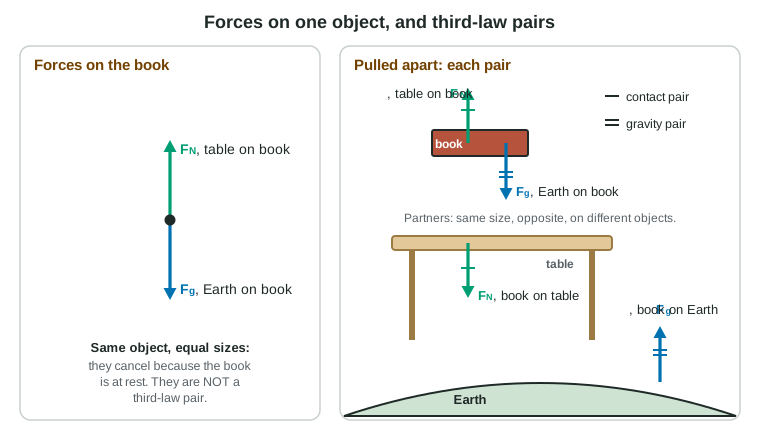
Forces come in third-law pairs: equal in size, opposite in direction, same type, acting on two different objects, so they never cancel each other.
Part 1 · Hook
Why this matters
Part 2 · Before you start
What this builds on
Part 3 · Prerequisite check
Quick check before you start
1. Every force on a free-body diagram has
- an agent that exerts it
- the same size as the weight
- a direction along the motion
- a partner on the same diagram
Show the answer
A force is an interaction, so some object exerts it.
- Correct: an agent that exerts it:
- the same size as the weight:
- a direction along the motion:
- a partner on the same diagram:
2. A system is
- the objects you choose to study, inside a boundary
- always a single object
- everything except Earth
- the object with the largest mass
Show the answer
You choose the system; the rest is the surroundings.
- Correct: the objects you choose to study, inside a boundary:
- always a single object:
- everything except Earth:
- the object with the largest mass:
Part 4 · See it
See it first
Part 5 · Step by step
How it works, step by step
- Object A exerts a force on object BB exerts a force on A of the same size, the opposite direction and the same type
- The two partner forces act on different objectsthey appear on different free-body diagrams and never cancel each other
- Both objects are inside the system you chosethe pair are internal forces and add to zero for the system
- Only external forces are left in the sum for the systemonly external forces can change how the system's center of mass moves
Part 6 · Key ideas
Key ideas
- Newton's third law: if A pushes on B, B pushes on A with a force equal in size, opposite in direction, of the same type. Partners act on different objects.
- To name a partner, swap the two objects and flip the direction: "road on tire, forward" ↔ "tire on road, backward".
- Internal forces act between parts of the system and cancel in pairs; external forces come from the surroundings.
- An ideal string is massless and does not stretch: one tension all along it. An ideal pulley is massless and frictionless: it turns the string without changing the tension.
Part 7 · Misconception
A common mistake
The wrong idea: The normal force and the weight of a book on a table are a third-law pair, because they are equal and opposite.
What actually happens: Both act on the book, so they cannot be partners. The weight's partner is the book pulling up on Earth; the normal force's partner is the book pushing down on the table.
Part 8 · Check yourself
Check yourself
Exam-style questions. Anything you miss goes into your review queue.
Diagram
Two blocks pushed together
A student pushes a 6.0 kg block to the right with a 24 N horizontal force. The 6.0 kg block pushes a 2.0 kg block that sits against it. The floor is frictionless, and both blocks speed up together.
1. The 6.0 kg block pushes on the 2.0 kg block with a force of 6.0 N to the right. What force does the 2.0 kg block exert on the 6.0 kg block?
- 6.0 N to the left
- 6.0 N to the right
- 2.0 N to the left
- 18 N to the left
Show the answer
The two blocks interact by touching, so the forces they exert on each other are a third-law pair: equal in size and opposite in direction, acting on different objects.
- Correct: 6.0 N to the left: Right: same size, opposite direction.
- 6.0 N to the right: The partner force points the opposite way: the small block pushes back on the large one.
- 2.0 N to the left: Third-law partners are equal in size whatever the masses; the smaller block does not push with a smaller force.
- 18 N to the left: 18 N is what is left of the student's 24 N after the 6.0 N, the net force on the 6.0 kg block, not the partner force.
2. Choose the two blocks together as the system. Which forces are internal to that system? Select all that apply.
- The 6.0 kg block on the 2.0 kg block
- The 2.0 kg block on the 6.0 kg block
- The student's hand on the 6.0 kg block
- Earth on the 2.0 kg block
Show the answer
An internal force is exerted by one part of the system on another part. Both partners of the push between the blocks are internal; the hand and Earth are outside the system, so their forces are external.
- Correct: The 6.0 kg block on the 2.0 kg block: Right: both blocks are inside the system.
- Correct: The 2.0 kg block on the 6.0 kg block: Right: the partner force is also between two parts of the system.
- The student's hand on the 6.0 kg block: The hand is not part of the system, so its push is external.
- Earth on the 2.0 kg block: Earth is not part of the system, so its pull is external.
Diagram
A truck towing a car
A truck tows a car along a level road with a light tow rope. The truck and the car speed up together to the right. Treat the rope as an ideal string.
3. While the truck and car speed up, how does the force of the rope on the car compare with the force of the rope on the truck?
- They are equal in size and opposite in direction
- The force on the car is larger, since the car is pulled
- The force on the truck is larger, since the truck leads
- They are equal in size and point the same way
Show the answer
An ideal rope (massless, does not stretch) has one tension along its whole length. It pulls the car forward and pulls the truck backward with the same size of force.
- Correct: They are equal in size and opposite in direction: Right: an ideal rope pulls with the same tension at both ends, each end toward the rope.
- The force on the car is larger, since the car is pulled: Being pulled does not make one end's tension larger; for an ideal rope the two ends match.
- The force on the truck is larger, since the truck leads: Leading does not change the tension; the rope pulls the truck back as hard as it pulls the car forward.
- They are equal in size and point the same way: A rope pulls each object toward the rope: forward on the car, backward on the truck.
4. A student says: "The truck pulls the car forward, so the car must pull the truck backward with a smaller force, or they would not speed up." Which response is correct?
- The pulls are equal; the road pushes the truck forward harder than the rope pulls it back
- The student is right: the car pulls back less hard than the truck pulls forward
- The two pulls are equal, so they cancel and the truck and car stay at one speed
- The car exerts no force on the truck, since it is the car that is being towed
Show the answer
Third-law partners act on different objects, so they never cancel each other. Whether the truck speeds up depends on all the forces on the truck, including the forward push of the road on its tires, which is larger than the rope's backward pull.
- Correct: The pulls are equal; the road pushes the truck forward harder than the rope pulls it back: Right: equal pulls, and the motion depends on the other forces on each object.
- The student is right: the car pulls back less hard than the truck pulls forward: The third law holds whether objects speed up or not; the pulls are equal.
- The two pulls are equal, so they cancel and the truck and car stay at one speed: Equal partner forces act on different objects, so they do not cancel; each object can still speed up.
- The car exerts no force on the truck, since it is the car that is being towed: The car pulls back on the rope and the rope pulls back on the truck; towing is an interaction.
5. A book rests on a table. A student says the normal force on the book and the book's weight are a third-law pair because they are equal and opposite. What is wrong with this claim?
- Both act on the book, so they are not partners
- The two forces are not equal in size
- The two forces point in the same direction
- Nothing: the two forces are a third-law pair
Show the answer
Third-law partners act on different objects. The normal force (table on book) and the weight (Earth on book) both act on the book; they are equal here only because the book is at rest. The weight's partner is the book pulling up on Earth.
- Correct: Both act on the book, so they are not partners: Right: partners never act on the same object.
- The two forces are not equal in size: They are equal in size here, but that does not make them partners.
- The two forces point in the same direction: One points up and one down; the trouble is which object they act on.
- Nothing: the two forces are a third-law pair: Equal and opposite is not enough; partners must also act on different objects and be the same type.
6. A horse pulls a cart. A student argues: "The cart pulls back on the horse as hard as the horse pulls the cart, so they cancel and the cart can never move." What is the best response?
- The pulls act on different objects, so they do not cancel
- The horse pulls a little harder than the cart pulls back
- The two pulls do cancel, and the ground moves the cart instead
- The cart pulls back on the horse after it starts moving
Show the answer
Forces cancel only when they act on the same object. The horse's pull acts on the cart and the cart's pull acts on the horse. The cart moves forward if the horse's pull on it is larger than the friction on the cart.
- Correct: The pulls act on different objects, so they do not cancel: Right: partners are on different objects, so they never cancel each other.
- The horse pulls a little harder than the cart pulls back: Third-law partners are always equal; the horse does not win the pair.
- The two pulls do cancel, and the ground moves the cart instead: They do not cancel; each acts on a different object.
- The cart pulls back on the horse after it starts moving: The cart pulls back on the horse from the moment the horse pulls, even while the cart is at rest.
Part 9 · Summary
Summary
Part 10 · Up next
What comes next
Part 11 · Connections