Newton's First Law
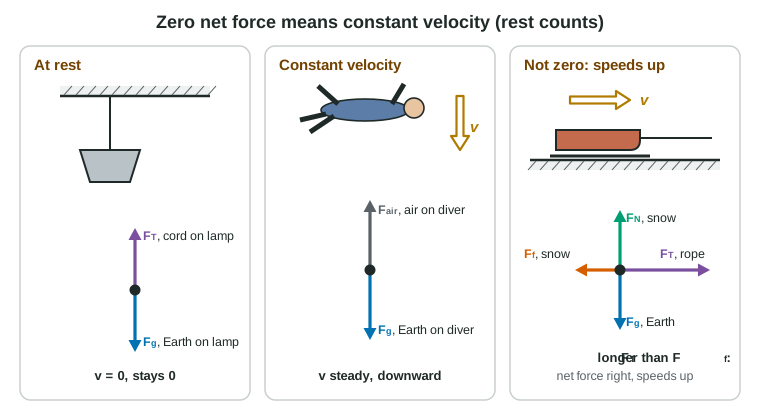
Newton's first law: zero net force means constant velocity, including rest.
Part 1 · Hook
Why this matters
Part 2 · Before you start
What this builds on
Part 3 · Prerequisite check
Quick check before you start
1. The net force on an object is
- the vector sum of all forces on it
- the largest force on it
- a force drawn on its diagram
- the force that moves it forward
Show the answer
Add the forces with their signs; the result is the net force.
- Correct: the vector sum of all forces on it:
- the largest force on it:
- a force drawn on its diagram:
- the force that moves it forward:
2. Constant velocity means
- the same speed in the same direction
- the same speed, any direction
- speeding up at a steady rate
- being at rest
Show the answer
Velocity is a vector; constant means neither size nor direction changes.
- Correct: the same speed in the same direction:
- the same speed, any direction:
- speeding up at a steady rate:
- being at rest:
3. A reference frame is
- the viewpoint from which motion is measured
- the outline of a free-body diagram
- the path an object follows
- the system you choose
Show the answer
Velocities are measured relative to an observer's frame.
- Correct: the viewpoint from which motion is measured:
- the outline of a free-body diagram:
- the path an object follows:
- the system you choose:
Part 4 · See it
See it first
Part 5 · Step by step
How it works, step by step
- The forces on an object add to zero in every directionthe object is in translational equilibrium
- The object is in translational equilibriumits velocity stays constant: at rest stays at rest, moving keeps the same speed and direction
- A moving object slows down on Earthsome net force (friction, air) acts on it; with that force removed it would keep going
- You view the motion from an accelerating vehicleobjects seem to lurch with no force, because that frame is not inertial; use the ground's frame
Part 6 · Key ideas
Key ideas
- Newton's first law: if the net force on an object is zero, its velocity does not change. Rest is just a velocity of zero.
- Translational equilibrium: ΣF = 0. Check each direction separately: ΣFx = 0 and ΣFy = 0. Forces can balance in one direction and not the other.
- Inertia is an object's tendency to keep its velocity; mass measures it. Inertia is not a force.
- An inertial reference frame is one in which the first law holds: the ground, or a vehicle at constant velocity.
Part 7 · Misconception
A common mistake
The wrong idea: A moving object needs a forward force on it to keep moving, so a box sliding at constant speed has a larger push than friction.
What actually happens: Constant velocity means zero net force: the push equals the friction. A larger push would make the box speed up.
Part 8 · Check yourself
Check yourself
Exam-style questions. Anything you miss goes into your review queue.
Data table
A crate pushed across a warehouse floor
A worker pushes a 40 kg crate across a level floor with a horizontal force. A motion detector records the crate's velocity, and a force sensor between the worker's hands and the crate records the push. The friction from the floor is 120 N throughout. At 2.0 s the worker starts pushing harder.
| Time (s) | Push (N) | Velocity (m/s) |
|---|---|---|
| 0.0 | 120 | 0.80 |
| 1.0 | 120 | 0.80 |
| 2.0 | 120 | 0.80 |
| 3.0 | 150 | 1.55 |
| 4.0 | 150 | 2.30 |
1. Between 0.0 s and 2.0 s, what is the net force on the crate?
- Zero
- 120 N forward
- 240 N forward
- 120 N backward
Show the answer
The push (120 N forward) and the friction (120 N backward) balance, so the net force is zero. The table agrees: the velocity stays 0.80 m/s, constant.
- Correct: Zero: Right: balanced forces, constant velocity.
- 120 N forward: 120 N is the push alone; the friction pulls back just as hard.
- 240 N forward: This adds the sizes of two forces that point in opposite directions.
- 120 N backward: 120 N is the friction alone; the push cancels it.
2. A student claims: "Between 0.0 s and 2.0 s the worker must push harder than the friction, or the crate would stop." Which evidence from the table best refutes this?
- Push equals friction while v stays 0.80 m/s
- The push rises to 150 N after 2.0 s
- No velocity in the table is zero
- The crate's mass stays 40 kg
Show the answer
The first law says zero net force keeps the velocity constant, and the data show exactly that: with push = friction = 120 N, the crate keeps moving at 0.80 m/s. A moving object needs no net force to keep moving.
- Correct: Push equals friction while v stays 0.80 m/s: Right: balanced forces, steady motion, in the same rows of data.
- The push rises to 150 N after 2.0 s: The change at 3.0 s shows what an unbalanced force does, but it does not test the claim about 0.0 s to 2.0 s.
- No velocity in the table is zero: The crate never stopping is consistent with the claim and with the first law alike, so it does not decide between them.
- The crate's mass stays 40 kg: The mass tells you how hard it is to change the velocity, not whether a net force is needed to keep it.
3. What happens to the crate's velocity after 2.0 s, and why?
- It increases, because the push now exceeds the friction
- It stays constant, because the crate is already moving
- It increases, because any push makes a crate speed up
- It decreases, because the friction now exceeds the push
Show the answer
At 150 N the push is larger than the 120 N friction, so the net force is 30 N forward and the velocity grows: 0.80 → 1.55 → 2.30 m/s.
- Correct: It increases, because the push now exceeds the friction: Right: an unbalanced forward force speeds the crate up.
- It stays constant, because the crate is already moving: Constant velocity needs zero net force; now the forces are unbalanced.
- It increases, because any push makes a crate speed up: The 120 N push before 2.0 s did not speed the crate up; only a net force does.
- It decreases, because the friction now exceeds the push: The friction stays at 120 N, less than the 150 N push.
4. The worker pushes with 150 N for the rest of the trip, then lets go at 6.0 s. Immediately after letting go, what is the net force on the crate, in newtons? Give its size.
Type a number in N.
Show the answer
Once the hands leave the crate the push is gone. The only horizontal force left is the 120 N friction, backward, so the net force is 120 N backward and the crate slows down.
- Answer: 120 N
5. Which objects are in translational equilibrium? Select all that apply.
- A book resting on a desk
- A car pulling away from a stop sign
- A ball at the top of its flight, momentarily at rest
- A car rounding a curve at a steady 20 m/s
Show the answer
Translational equilibrium means zero net force, so a constant velocity: same speed and same direction.
- Correct: A book resting on a desk: Right: at rest and staying at rest.
- A car pulling away from a stop sign: Its speed is increasing, so the forces on it do not balance.
- A ball at the top of its flight, momentarily at rest: For an instant its velocity is zero, but gravity is still the only force, so its velocity keeps changing.
- A car rounding a curve at a steady 20 m/s: Its direction changes on the curve, so its velocity changes; the net force is not zero.
6. A bus brakes hard, and a ball on the floor rolls toward the front. A rider says a force pushed the ball forward. What is the better explanation?
- The ball kept its velocity while the bus slowed under it
- The bus's floor pushed the ball forward during braking
- The air inside the bus pushed the ball forward
- The ball's inertia is a forward force acting on it
Show the answer
A braking bus is accelerating, so it is not an inertial frame. Seen from the road, the ball simply keeps its velocity (first law) while the bus slows down beneath it. No forward force acts on the ball.
- Correct: The ball kept its velocity while the bus slowed under it: Right: the ball keeps its velocity; the bus is the one that changes.
- The bus's floor pushed the ball forward during braking: The floor is nearly frictionless for a rolling ball and cannot push it forward while braking.
- The air inside the bus pushed the ball forward: Air in a closed bus does not push the ball forward.
- The ball's inertia is a forward force acting on it: Inertia is a property of the ball (its mass resisting a change in velocity), not a force on it.
Part 9 · Summary
Summary
Part 10 · Up next
What comes next
Part 11 · Connections