Newton's Second Law
Newton's second law: the acceleration of a system's center of mass equals the net external force divided by its mass, a = ΣF/m, and points along the net force.
Part 1 · Hook
Why this matters
Part 2 · Before you start
What this builds on
Part 3 · Prerequisite check
Quick check before you start
1. An object with zero net force
- keeps a constant velocity
- slows down
- stops at once
- speeds up slowly
Show the answer
Newton's first law: zero net force, no change in velocity.
- Correct: keeps a constant velocity:
- slows down:
- stops at once:
- speeds up slowly:
2. For the two-block system pushed by a hand, the forces between the blocks are
- internal and add to zero
- external and add to the push
- larger than the push
- not third-law partners
Show the answer
Both blocks are in the system, so their pushes on each other are an internal third-law pair.
- Correct: internal and add to zero:
- external and add to the push:
- larger than the push:
- not third-law partners:
3. Acceleration is
- the change in velocity divided by the time
- the change in position divided by the time
- speed in a direction
- distance over time squared
Show the answer
a = Δv/Δt.
- Correct: the change in velocity divided by the time:
- the change in position divided by the time:
- speed in a direction:
- distance over time squared:
Part 4 · See it
See it first
Part 5 · Step by step
How it works, step by step
- The forces on a system do not balancethere is a nonzero net external force ΣF
- There is a net external forcethe center of mass accelerates in the direction of the net force
- The net force is larger, or the mass smallerthe acceleration is larger: a = ΣF / m
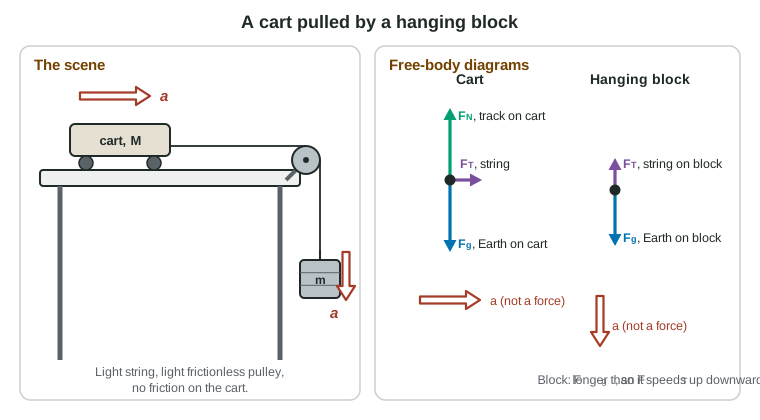
- You choose the whole connected systeminternal forces (tension, contact pushes) drop out, and one equation gives the shared acceleration
Part 6 · Key ideas
Key ideas
- Newton's second law: a = ΣF / m, or ΣF = ma. The acceleration points along the net force, not necessarily along the velocity.
- Apply it one axis at a time: ΣFx = max, ΣFy = may. Pick the axis along the acceleration.
- For a system, use only external forces and the total mass: asys = ΣFext / msys.
- For connected objects (cart and hanging block, Atwood machine), find the shared acceleration from the whole system, then the tension from one object.
Part 7 · Misconception
A common mistake
The wrong idea: The tension in the string equals the weight of the hanging block, even while it falls.
What actually happens: The block speeds up downward, so the net force on it points down and the tension is less than its weight. Tension equals the weight only if the block is at rest or at constant velocity.
Part 8 · Check yourself
Check yourself
Exam-style questions. Anything you miss goes into your review queue.
Diagram
A cart pulled by a hanging block
A 0.80 kg cart on a level track is tied to a light string that runs over a light, frictionless pulley to a hanging 0.20 kg block. Friction on the cart is negligible. The block is released from rest. Use g = 9.8 m/s².
1. Choose the cart, string and block as the system. What is the size of the acceleration of the cart, in m/s²?
Type a number in m/s^2.
Show the answer
For the whole system, the only external force along the string's path that is not balanced is the block's weight, mg = 0.20 kg × 9.8 m/s² = 1.96 N (the cart's weight is balanced by the track; the tension is internal). a = F_net ÷ m_total = 1.96 N ÷ 1.00 kg = 2.0 m/s².
- Answer: 2.0 m/s^2
2. What is the tension in the string while the block falls, in newtons?
Type a number in N.
Show the answer
Apply the second law to the cart alone: the only horizontal force on it is the tension, so F_T = Ma = 0.80 kg × 1.96 m/s² = 1.6 N (1.57 N rounded).
- Answer: 1.6 N
3. How does the tension in the string compare with the weight of the hanging block while the block falls?
- Less than the weight, so the block speeds up downward
- Equal to the weight, since the string holds the block
- Greater than the weight, since it also pulls the cart
- Zero, since the block is falling
Show the answer
The block accelerates downward, so the net force on it points down: its weight must be larger than the string's upward pull. F_T = 1.6 N while mg = 1.96 N.
- Correct: Less than the weight, so the block speeds up downward: Right: a downward net force on the block means F_g > F_T.
- Equal to the weight, since the string holds the block: Tension equals the weight only if the block hangs at rest or moves at constant velocity.
- Greater than the weight, since it also pulls the cart: Pulling the cart does not make the tension exceed the weight; the block's own motion caps it below mg.
- Zero, since the block is falling: The string stays tight and pulls on the block the whole time; otherwise the cart would not speed up.
4. The hanging block is replaced by one with twice the mass, 0.40 kg. How does the acceleration change?
- It rises by less than a factor of 2
- It doubles exactly
- It stays the same as before
- It increases by more than a factor of 2
Show the answer
a = mg ÷ (M + m). Doubling m doubles the top (the pulling weight) but also increases the bottom, from 1.00 kg to 1.20 kg: a = 3.92 N ÷ 1.20 kg = 3.3 m/s², up by a factor of 1.67.
- Correct: It rises by less than a factor of 2: Right: the extra mass both pulls harder and has to be accelerated.
- It doubles exactly: It would double only if the total mass stayed the same; the heavier block adds mass to the system.
- It stays the same as before: A larger pulling weight with the same cart gives a larger acceleration.
- It increases by more than a factor of 2: The total mass grows too, so the gain is less than the gain in the pull.
5. A net force of 12 N acts on a 3.0 kg box. What is the size of the box's acceleration? Give the value and its unit.
Type a number and its unit.
Show the answer
a = F_net ÷ m = 12 N ÷ 3.0 kg = 4.0 m/s² (a newton is a kg·m/s², so N/kg = m/s²).
- Answer: 4.0 m/s^2
6. An elevator moves upward and slows down as it nears the top floor. Which is true of the forces on it?
- The cable's pull is less than the elevator's weight
- The cable's pull is greater than the elevator's weight
- The cable's pull equals the elevator's weight
- The cable's pull points down to slow it
Show the answer
Moving up and slowing down means the acceleration points down, so the net force points down: Earth's pull is larger than the cable's.
- Correct: The cable's pull is less than the elevator's weight: Right: acceleration down, net force down.
- The cable's pull is greater than the elevator's weight: A larger pull would speed the elevator up while it rises.
- The cable's pull equals the elevator's weight: Equal forces would keep the velocity constant.
- The cable's pull points down to slow it: A cable can only pull up on the elevator; it slows because its pull is less than the weight.
Part 9 · Summary
Summary
Part 10 · Up next
What comes next
Part 11 · Connections