The first law says what happens when the forces balance: nothing changes. The second law says what happens when they do not. It is the most used equation in this course, and it ties together everything in this unit: forces from free-body diagrams on one side, motion from Unit 1 on the other.
Net force causes acceleration
Push an empty shopping cart, then push it twice as hard: it speeds up twice as fast. Push a cart loaded to twice the mass with the first push: it speeds up half as fast. Experiments like these give Newton's second law:
a = ΣF ÷ m, usually written ΣF = ma
Read it as cause and effect. The net force is the cause; the acceleration is the effect; the mass sets how big the effect is. The acceleration is proportional to the net force (double ΣF, double a) and inversely proportional to the mass (double m, half a). The units fit: 1 N = 1 kg·m/s², so newtons divided by kilograms give m/s².
Two points cause most mistakes:
- The acceleration points along the net force, not along the velocity. A cart rolling left with a net force to the right is slowing down. An elevator moving up while slowing has a net force downward.
- ma is not a force. It is what the forces add up to. Never draw "ma" on a free-body diagram.
A recipe that always works
- Choose the object or system and draw its free-body diagram.
- Choose axes, one along the acceleration if you know it. Choose positive.
- For each axis, add the forces with signs and set the sum equal to ma along that axis. On an axis with no acceleration the sum is zero.
- Solve in symbols first, then substitute numbers with units.
Worked example 1. A 3.0 kg box is pulled across a floor by a horizontal 20 N force. Friction on it is 8.0 N. Find its acceleration.
Principle: Newton's second law along the floor. Take the direction of the pull as positive.
ΣFx = Fpull − Ff = ma, so a = (Fpull − Ff) ÷ m
a = (20 N − 8.0 N) ÷ 3.0 kg = 12 N ÷ 3.0 kg = 4.0 m/s² in the direction of the pull.
Vertically, FN − mg = 0, since the box does not leave the floor.
Systems and the center of mass
The second law holds for a whole system too, with two changes: use the total mass, and use only the external forces. The internal forces cancel in third-law pairs. The result tells you how the system's center of mass accelerates:
asys = ΣFext ÷ msys (equations sheet: asys = ΣF/msys)
A system's center of mass speeds up, slows down or turns only when a net external force acts on it. That is why a tumbling wrench's center of mass follows a simple path.
Connected objects
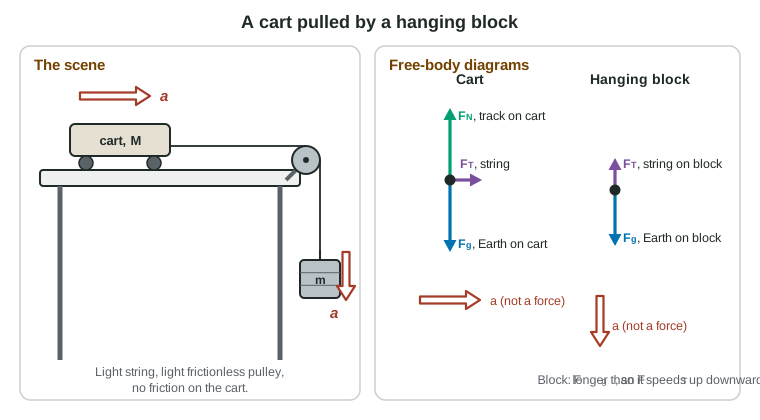
When objects are tied together by an ideal string, they share one acceleration. The fastest route is two steps: the whole system for the acceleration, then one object for the tension.
Worked example 2. A 0.70 kg cart on a frictionless level track is tied by a light string over a light, frictionless pulley to a hanging 0.30 kg block. Find the acceleration and the tension. Use g = 9.8 m/s².
Step 1: the whole system (cart, string, block), measured along the string. The cart's weight and the normal force cancel. The tension is internal. The one unbalanced external force is the block's weight, mg.
a = mg ÷ (M + m) = (0.30 kg)(9.8 m/s²) ÷ (0.70 kg + 0.30 kg) = 2.94 N ÷ 1.00 kg = 2.94 m/s² ≈ 2.9 m/s²
Step 2: the cart alone. Its only horizontal force is the tension: FT = Ma = (0.70 kg)(2.94 m/s²) = 2.1 N.
Check with the block alone: mg − FT = ma gives 2.94 N − 2.06 N = 0.88 N = (0.30 kg)(2.94 m/s²). It agrees.
Notice that the tension, 2.1 N, is less than the block's 2.94 N weight. If the tension equaled the weight, the block would not speed up. This is the most common error on connected-object problems.
The same method handles an Atwood machine: two masses hanging on either side of one pulley. The heavier side's weight minus the lighter side's weight is the net external force along the string, and the total mass is m₁ + m₂. With m₂ the heavier mass, a = (m₂ − m₁)g ÷ (m₁ + m₂).
Functional dependence
The exam often asks what happens to a quantity when another changes. Read the factor straight from the equation. If Fnet = ma, giving a mass of 3m an acceleration of 2a needs (3m)(2a) = 6F. In the cart-and-block system, doubling the hanging mass does not double the acceleration, because the hanging mass also appears in the denominator: a = 2mg ÷ (M + 2m), which here rises by a factor of only about 1.5.
| Change | Effect on a (other things fixed) |
|---|---|
| Net force × 2 | a × 2 |
| Mass × 2 | a ÷ 2 |
| Net force × 2 and mass × 2 | a unchanged |
| Object already moving fast | no effect: a depends on ΣF and m only |
Common slips
Dividing by one object's mass when the force accelerates the whole system. Setting tension equal to the hanging weight. Using the velocity, not the acceleration, in ΣF = ma. Putting the weight into a horizontal equation. Forgetting that slowing down is an acceleration opposite the velocity.