Angular Momentum and Angular Impulse
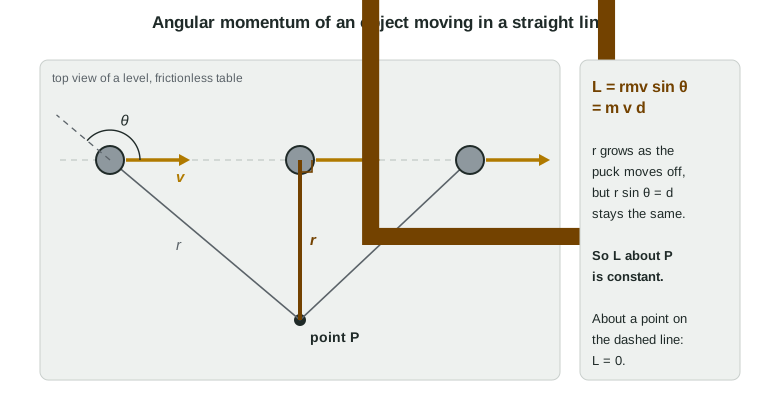
Angular momentum is L = Iω for a rigid object turning about a fixed axis, and L = rmv sin θ for a point object about a chosen point.
Part 1 · Hook
Why this matters
Part 2 · Before you start
What this builds on
Part 3 · Prerequisite check
Quick check before you start
1. A 2.0 kg cart moves at 3.0 m/s. Its momentum is
- 6.0 kg·m/s
- 9.0 kg·m/s
- 1.5 kg·m/s
- 18 kg·m/s
Show the answer
p = mv.
- Correct: 6.0 kg·m/s:
- 9.0 kg·m/s:
- 1.5 kg·m/s:
- 18 kg·m/s:
2. The area under a force-time graph equals
- the impulse, the change in momentum
- the work done
- the change in kinetic energy
- the average force
Show the answer
J = FΔt = Δp.
- Correct: the impulse, the change in momentum:
- the work done:
- the change in kinetic energy:
- the average force:
Part 4 · See it
See it first
Part 5 · Step by step
How it works, step by step
- A rigid object turns at ω and has rotational inertia Iit has angular momentum L = Iω
- A point object moves with momentum mv past a chosen pointit has angular momentum L = rmv sin θ = mv × (perpendicular distance) about that point
- A net torque acts for a time Δtit delivers an angular impulse τΔt
- An angular impulse is deliveredthe angular momentum changes by exactly that much: ΔL = τΔt
- The net torque is zeroL stays the same, and the L-t graph is flat
Part 6 · Key ideas
Key ideas
- L = Iω for a rigid object about a fixed axis; unit kg·m²/s.
- A point object has L = rmv sin θ about a chosen point: momentum × perpendicular distance from the point to its line of motion. Change the point, change L.
- A puck in straight-line motion keeps the same L about any fixed point, and has L = 0 about points on its path.
- Angular impulse τΔt = ΔL; it is the area under a τ-t graph.
- Net torque = slope of the L-t graph (and = Iα when I is constant).
Part 7 · Misconception
A common mistake
The wrong idea: Only spinning objects have angular momentum; a puck moving in a straight line has none.
What actually happens: About any point not on its line of motion, a moving point object has L = mv × (perpendicular distance). Whether something has angular momentum depends on the point you measure it about.
Part 8 · Check yourself
Check yourself
Exam-style questions. Anything you miss goes into your review queue.
Diagram
A puck sliding past two points
1. What is the size of the puck’s angular momentum about point P? Give the value and its unit.
Type a number and its unit.
Show the answer
L = rmv sin θ = mv(r sin θ) = mvd = (0.20 kg)(3.0 m/s)(0.40 m) = 0.24 kg·m²/s.
- Answer: 0.24 kg·m^2/s
2. As the puck slides on past P, its distance r from P grows. Its angular momentum about P
- stays the same, because r sin θ stays 0.40 m
- grows, because r grows
- shrinks, because the puck moves away from P
- is zero, because the puck is not turning
Show the answer
L = rmv sin θ, and r sin θ is the perpendicular distance from P to the line of motion, 0.40 m at every position. With m and v constant, L about P stays 0.24 kg·m²/s.
- Correct: stays the same, because r sin θ stays 0.40 m: Right: the perpendicular distance from P to the path never changes.
- grows, because r grows: r grows, but sin θ shrinks so that r sin θ stays 0.40 m.
- shrinks, because the puck moves away from P: Moving away along a straight line keeps the lever arm, and so L, the same.
- is zero, because the puck is not turning: A point object moving past a point has angular momentum about it, turning or not.
3. What is the puck’s angular momentum about point Q, which lies on its path?
- Zero
- 0.24 kg·m²/s
- 0.60 kg·m²/s
- It depends on how far the puck is from Q
Show the answer
The puck’s velocity points along the line through Q, so the perpendicular distance from Q to its line of motion is zero: L = mv(0) = 0. Angular momentum depends on the point you choose.
- Correct: Zero: Right: the puck moves straight along a line through Q, so θ = 0 or 180°.
- 0.24 kg·m²/s: That is the value about P. About Q the lever arm is zero.
- 0.60 kg·m²/s: That is the linear momentum, mv, in kg·m/s.
- It depends on how far the puck is from Q: Along a line through Q, r sin θ = 0 at every distance.
4. A second puck of the same mass slides at 6.0 m/s along a parallel line 0.20 m from P. Compared with the first puck, its angular momentum about P is
- the same
- twice as large
- half as large
- four times as large
Show the answer
L = mvd: (0.20)(6.0)(0.20) = 0.24 kg·m²/s, the same as (0.20)(3.0)(0.40).
- Correct: the same: Right: twice the speed × half the lever arm.
- twice as large: The speed doubles, but the lever arm halves.
- half as large: The lever arm halves, but the speed doubles.
- four times as large: L = mvd is the product; the two factors cancel.
5. For a rigid object turning about a fixed axis, angular momentum is
- L = Iω, in kg·m²/s
- L = ½Iω², in joules
- L = Iα, in N·m
- L = mv, in kg·m/s
Show the answer
L = Iω pairs I with m and ω with v, as p = mv does. Its unit is kg·m²/s (the same as N·m·s and J·s).
- Correct: L = Iω, in kg·m²/s: Right: the rotational partner of p = mv.
- L = ½Iω², in joules: That is rotational kinetic energy.
- L = Iα, in N·m: Iα is the net torque.
- L = mv, in kg·m/s: That is linear momentum.
6. A torque of 0.60 N·m acts on a spinning top for 0.50 s in the direction it spins. By how much does its angular momentum change?
Type a number in kg·m^2/s.
Show the answer
ΔL = τΔt = (0.60 N·m)(0.50 s) = 0.30 kg·m²/s.
- Answer: 0.30 kg·m^2/s
7. A graph of a wheel’s angular momentum against time is a horizontal line. What does that tell you?
- The net torque on the wheel is zero
- The wheel is not turning
- The wheel’s angular acceleration is constant and nonzero
- A constant torque is acting on the wheel
Show the answer
τ_net = ΔL/Δt, the slope of the L-t graph. A horizontal line has zero slope, so the net torque is zero and ω is constant.
- Correct: The net torque on the wheel is zero: Right: the slope of L-t is the net torque.
- The wheel is not turning: A horizontal line at a nonzero L means steady turning.
- The wheel’s angular acceleration is constant and nonzero: Constant nonzero α would make L change steadily, a sloped line.
- A constant torque is acting on the wheel: A constant nonzero torque gives a sloped straight line.
Part 9 · Summary
Summary
Part 10 · Up next
What comes next
Part 11 · Connections