To change an object's momentum, something must push on it for some time. A big push for a short time and a small push for a long time can change the momentum by the same amount. The quantity that measures this is the impulse. It explains how airbags, helmets and bent knees protect you, and it links Newton's second law to momentum.
Impulse
When a force acts on an object for a time interval Δt, the impulse it delivers is
J = F_avg Δt
Impulse is a vector in the direction of the force. Its unit is the newton-second, N·s, which is the same as kg·m/s: (kg·m/s²)(s) = kg·m/s. That shared unit is a clue to what impulse does.
Real collision forces are not constant: they rise as objects squash together and fall as they separate. For any force, the impulse is the area under the force-time graph, the same way displacement is the area under a velocity-time graph.
The impulse-momentum theorem
Newton's second law says F_net = ma = m Δv/Δt for constant mass. Multiply both sides by Δt:
F_net Δt = m Δv, so J_net = Δp = m v_f − m v_i
The net impulse on an object equals its change in momentum. Read backward, the net force is the rate of change of momentum, F_net = Δp/Δt, the slope of a momentum-time graph. Newton actually stated his second law this way.
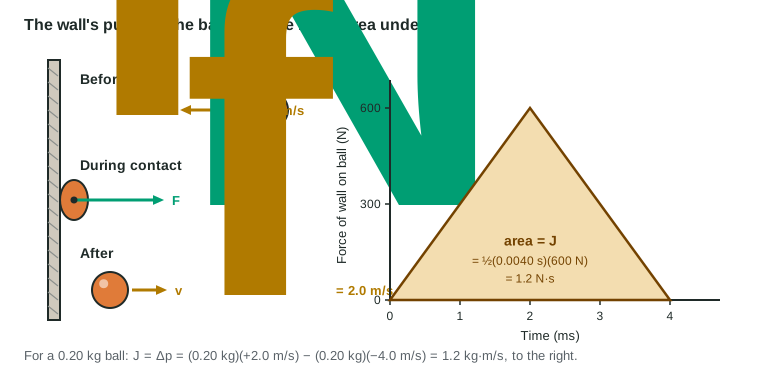
Worked example 1. A 0.10 kg ball moves left at 4.0 m/s, hits a wall and leaves right at 6.0 m/s. The wall's force rises linearly to 400 N in 2.5 ms and falls to zero at 5.0 ms. Find the impulse, the change in momentum and the average force (right positive).
Impulse = area of the triangle = ½(0.0050 s)(400 N) = 1.0 N·s, to the right.
Δp = m v_f − m v_i = (0.10)(+6.0) − (0.10)(−4.0) = +1.0 kg·m/s. They match, as the theorem says.
F_avg = J/Δt = 1.0 N·s / 0.0050 s = 2.0 × 10² N, half the peak.
Watch the signs. The ball's speed went from 4.0 to 6.0 m/s, but its velocity went from −4.0 to +6.0 m/s, a change of 10. m/s. Subtracting speeds (6.0 − 4.0) gives a wrong and much smaller answer. A bounce always takes more impulse than a stop: a clay ball of the same mass that sticks to the wall changes its momentum by only 0.40 kg·m/s.
Longer time, smaller force
If an object must go from a given speed to rest, its Δp is fixed, so the impulse is fixed. But J = F_avg Δt, so stretching the time shrinks the average force. That is the whole idea behind:
- airbags and crumple zones, which make a car's occupants stop over a longer time;
- bending your knees when you land, or rolling with a fall;
- catching an egg with a soft hand that moves back with it.
Doubling the stopping time halves the average force. This inverse dependence, F_avg ∝ 1/Δt at fixed Δp, is a common functional-dependence question.
Reading momentum-time graphs
Worked example 2. A 0.80 kg cart's momentum rises steadily from 0 to 2.0 kg·m/s between 0 and 4.0 s, then stays at 2.0 kg·m/s. Find the net force in each interval and the final speed.
0 to 4.0 s: F_net = slope = 2.0 kg·m/s / 4.0 s = 0.50 N.
After 4.0 s: the graph is flat, so F_net = 0. The cart coasts.
Final speed: v = p/m = 2.0 / 0.80 = 2.5 m/s.
Summary of the two graphs: on a force-time graph, the area is the impulse (Δp). On a momentum-time graph, the slope is the net force.
Common slips
| Slip | Fix |
|---|---|
| Writing momentum as p = Ft | Ft is the impulse, the change in momentum; p = mv |
| Subtracting speeds in a bounce | Use signed velocities: Δv = v_f − v_i |
| Using the peak force as the average | F_avg = (area)/Δt |
| Forgetting milliseconds | 1 ms = 0.001 s before multiplying |