Every collision with no net external force conserves momentum. Not every collision conserves kinetic energy. Telling these apart, and starting from the right one, is where the most points are lost on the momentum questions of the exam. This page classifies collisions, works through the perfectly inelastic case step by step, and shows how momentum bar charts make the bookkeeping visible.
Momentum first
For two objects colliding on a level, low-friction surface (or any brief collision), the net external force on the two-object system is negligible, so:
m₁v₁ + m₂v₂ = m₁v₁′ + m₂v₂′
This holds whether the objects bounce, crumple or stick. It is always your starting equation.
Three kinds of collision
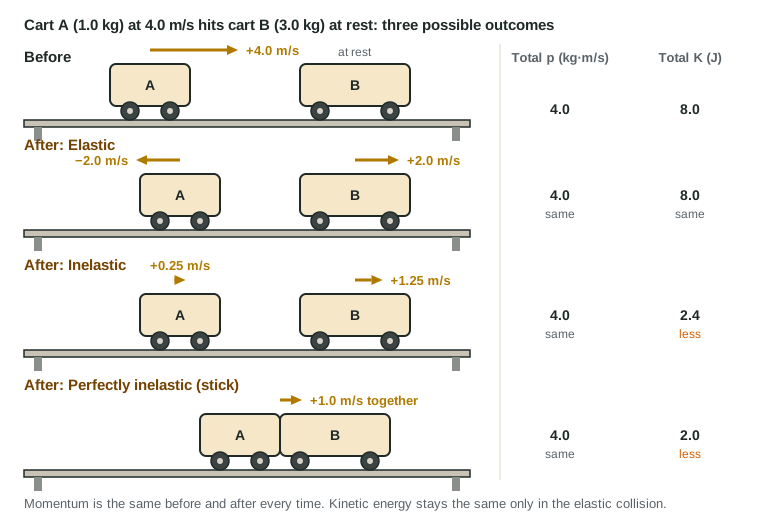
| Type | What happens | Momentum | Total kinetic energy |
|---|---|---|---|
| Elastic | objects bounce apart with no lasting deformation (magnets, hard steel balls) | conserved | unchanged |
| Inelastic | objects bounce apart, but some deformation, heating or sound | conserved | decreases |
| Perfectly inelastic | objects stick and move together | conserved | decreases the most |
"Elastic" is about the total kinetic energy. In an elastic collision, each object's kinetic energy can change a lot; in the figure, cart A goes from 8.0 J to 2.0 J while cart B gains 6.0 J.
The kinetic energy lost in an inelastic collision is not destroyed. The internal forces during the crunch are nonconservative: they deform the objects, warm them and make sound. Total energy is conserved; mechanical energy is not.
Perfectly inelastic collisions
When objects stick, there is one final velocity, so momentum alone solves the problem:
v_f = (m₁v₁ + m₂v₂)/(m₁ + m₂)
Worked example 1. Cart A (1.5 kg) moves right at 4.0 m/s; cart B (0.50 kg) moves left at 4.0 m/s. They stick. Find the final velocity and the kinetic energy lost.
System: both carts; the track is level and frictionless, so the net external force is zero and momentum is constant.
Momentum (right positive): (1.5)(+4.0) + (0.50)(−4.0) = 4.0 kg·m/s = (2.0 kg)v_f, so v_f = +2.0 m/s.
K before = ½(1.5)(4.0)² + ½(0.50)(4.0)² = 12 J + 4.0 J = 16 J (both positive; they add).
K after = ½(2.0)(2.0)² = 4.0 J. Lost: 16 J − 4.0 J = 12 J, to thermal energy and sound.
The classic mistake is setting K before equal to K after to find v_f. For a sticky collision that is always wrong: kinetic energy is exactly what is not conserved. Start from momentum; use energy only afterward (to find the loss, or for a later stage such as sliding up a ramp).
Elastic collisions on the exam
Fully solving an elastic collision for both unknown final velocities needs two equations at once (momentum and kinetic energy). That is outside the course. Instead you will be told one final velocity and asked for the other (momentum), then asked to check whether the collision was elastic (compare total K before and after).
Worked example 2. A 0.50 kg cart at +1.20 m/s hits a 0.70 kg cart at rest. Afterward the first cart moves at −0.20 m/s and the second at +1.00 m/s. Is the collision elastic?
Momentum check: before (0.50)(1.20) = 0.60; after (0.50)(−0.20) + (0.70)(1.00) = −0.10 + 0.70 = 0.60 kg·m/s. Conserved.
K before = ½(0.50)(1.20)² = 0.36 J. K after = ½(0.50)(0.20)² + ½(0.70)(1.00)² = 0.01 + 0.35 = 0.36 J. Unchanged: elastic.
Momentum bar charts
A momentum bar chart shows each object's momentum, with its sign, before and after, plus the system total. Bars above the zero line point right; bars below point left. With no external impulse, the total bar is the same height before and after. For example 1: before, A is +6.0, B is −2.0, total +4.0 kg·m/s; after, the stuck pair is +4.0 kg·m/s.
A momentum-time graph for the system is a flat horizontal line through the collision: no slope (no net external force) and no jump. For each cart, the graph changes during the collision, in equal and opposite amounts.
Bounce or stick: which pushes harder?
A ball that bounces back from a block reverses its momentum, a change of up to 2mv; a ball that sticks changes by only mv. The block receives the opposite impulse, so the bouncing ball gives the bigger push, even though the sticky ball "loses" more kinetic energy.
Common slips
- Using energy conservation to find the speed after a sticky collision. Use momentum.
- Thinking momentum is conserved only in elastic collisions. It is conserved in every collision with no net external force.
- Letting kinetic energies of objects moving in opposite directions cancel.
- Drawing the system's momentum-time graph with a drop at the collision. It is a flat line.