Conservation of Angular Momentum
A system’s total angular momentum stays constant when the net external torque on it is zero.
Part 1 · Hook
Why this matters
Part 2 · Before you start
What this builds on
Part 3 · Prerequisite check
Quick check before you start
1. A system’s total momentum stays constant when
- the net external force on it is zero
- its kinetic energy is constant
- no internal forces act
- it is at rest
Show the answer
Zero net external force means zero external impulse.
- Correct: the net external force on it is zero:
- its kinetic energy is constant:
- no internal forces act:
- it is at rest:
2. A wheel with I = 0.50 kg·m² turns at 6.0 rad/s. Its angular momentum is
- 3.0 kg·m²/s
- 9.0 kg·m²/s
- 12 kg·m²/s
- 0.083 kg·m²/s
Show the answer
L = Iω.
- Correct: 3.0 kg·m²/s:
- 9.0 kg·m²/s:
- 12 kg·m²/s:
- 0.083 kg·m²/s:
3. A puck slides in a straight line past point P. Its angular momentum about P
- stays the same
- grows as it moves away
- is zero
- shrinks as it moves away
Show the answer
mv × (perpendicular distance) does not change.
- Correct: stays the same:
- grows as it moves away:
- is zero:
- shrinks as it moves away:
Part 4 · See it
See it first
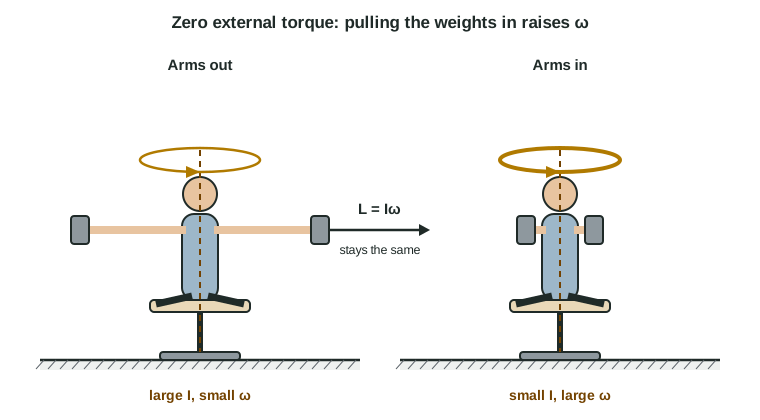
Part 5 · Step by step
How it works, step by step
- The net external torque on a system is zerono angular impulse comes from outside, so the total L stays the same
- Parts of the system push on each otherthey trade angular momentum, but the total is unchanged
- The system pulls mass in toward the axisI falls, so ω = L/I rises
- I falls with L fixedK = L²/(2I) rises; internal work (muscles) supplies it
- An object sticks to a pivoted bodyL about the pivot is conserved (the pivot force has no torque about it) even though linear momentum is not
Part 6 · Key ideas
Key ideas
- L is constant when the net external torque is zero. State the system and this condition every time.
- Choose the system so that the forces that change each part are internal.
- Shape change at constant L: I₁ω₁ = I₂ω₂. Pulling mass in speeds up the spin.
- Kinetic energy is not conserved in these changes: pulling in raises K; sticking collisions lower it.
- A pivot pushes during a collision, so linear momentum changes, but its torque about the pivot is zero, so L about the pivot is conserved.
Part 7 · Misconception
A common mistake
The wrong idea: When clay hits and sticks to a rod hanging from a pivot, linear momentum is conserved, so (m + M)v_after = mv.
What actually happens: The pivot pushes on the rod during the collision, an outside force, so linear momentum is not conserved. That force acts at the pivot and has no torque about it, so angular momentum about the pivot is conserved: mvd = I_total ω.
Part 8 · Check yourself
Check yourself
Exam-style questions. Anything you miss goes into your review queue.
Diagram
Pulling weights in on a rotating stool
1. What is the student’s angular velocity after pulling the weights in?
Type a number in rad/s.
Show the answer
The net torque about the axle from outside the student-stool system is negligible, so L is constant: (3.0 kg·m²)(2.0 rad/s) = (1.2 kg·m²)ω, ω = 5.0 rad/s.
- Answer: 5.0 rad/s
2. Why is the angular momentum of the student, weights and stool the same before and after?
- No net torque about the axle comes from outside the system
- Angular momentum is conserved whatever acts on a system
- The student pulls the weights in slowly
- The student’s arms exert no force on the weights
Show the answer
For the student-weights-stool system, the forces from the arms are internal. The external forces (gravity, the floor through the axle) have no lever arm about the vertical axle, and friction is negligible, so the net torque from outside is about zero and L stays constant.
- Correct: No net torque about the axle comes from outside the system: Right: the axle is nearly frictionless, and gravity and the floor act along the axis.
- Angular momentum is conserved whatever acts on a system: It is constant just when the net torque from outside the system is zero.
- The student pulls the weights in slowly: Speed of pulling does not matter; the condition is zero net torque from outside.
- The student’s arms exert no force on the weights: The arms do exert forces, but they are internal to the system.
3. By how much does the rotational kinetic energy of the system change?
Type a number in J.
Show the answer
Before: ½(3.0)(2.0)² = 6.0 J. After: ½(1.2)(5.0)² = 15 J. The change is +9 J.
- Answer: 9.0 J
4. Where does the extra rotational kinetic energy come from?
- Work done by her muscles pulling the weights in
- The floor, through the stool’s axle
- Nowhere: kinetic energy is conserved in a closed system
- The angular momentum, which turns into energy
Show the answer
L stays the same, but K = L²/(2I) rises as I falls. The student’s arms pull the weights inward through a distance, doing positive work from stored chemical energy.
- Correct: Work done by her muscles pulling the weights in: Right: the weights move inward against their tendency to keep moving in a straight line; the arms do positive work.
- The floor, through the stool’s axle: The axle exerts no torque about the axis and does no work on the turning.
- Nowhere: kinetic energy is conserved in a closed system: Mechanical energy is not conserved here; the student converts internal (chemical) energy.
- The angular momentum, which turns into energy: Angular momentum stays the same; it is not converted into anything.
Diagram
Clay hits a hanging rod
5. What is the clay’s angular momentum about the pivot just before it hits?
Type a number in kg·m^2/s.
Show the answer
The clay moves horizontally on a line 0.80 m below the pivot: L = mvd = (0.050 kg)(8.0 m/s)(0.80 m) = 0.32 kg·m²/s.
- Answer: 0.32 kg·m^2/s
6. What is the angular velocity of the rod and clay just after the collision?
Type a number in rad/s.
Show the answer
About the pivot, L is conserved: 0.32 kg·m²/s = (⅓ML² + mL²)ω = (0.256 + 0.032)ω, so ω = 0.32/0.288 = 1.11 rad/s, about 1.1 rad/s.
- Answer: 1.1 rad/s
7. For the clay-rod system during the collision, which quantity stays the same?
- Angular momentum about the pivot
- Linear momentum of the clay and rod
- Kinetic energy of the clay and rod
- Each of momentum, angular momentum and energy
Show the answer
The only outside forces during the brief collision are gravity (no lever arm while the rod hangs straight down, and negligible over so short a time) and the pivot force, which acts at the axis. So the net torque about the pivot is zero and L about the pivot is constant. The pivot force is not zero, so linear momentum is not constant.
- Correct: Angular momentum about the pivot: Right: the pivot’s force acts at the axis, so it exerts no torque about it.
- Linear momentum of the clay and rod: The pivot pushes on the rod during the collision, an outside force, so linear momentum changes.
- Kinetic energy of the clay and rod: The clay sticks; the collision is perfectly inelastic and kinetic energy is lost.
- Each of momentum, angular momentum and energy: Angular momentum about the pivot is the one quantity whose condition is met.
8. What fraction of the clay’s kinetic energy is left just after the collision?
- About 11%
- Nearly 100%
- About 4%
- About 50%
Show the answer
Before: ½(0.050)(8.0)² = 1.6 J. After: ½(0.288)(1.111)² = 0.18 J, about 11%. The rest became thermal energy and sound when the clay deformed.
- Correct: About 11%: Right: 0.18 J of 1.6 J.
- Nearly 100%: A sticky collision is not elastic; kinetic energy is lost.
- About 4%: This is the ratio of the clay’s mass to the total mass, which is not the energy ratio here.
- About 50%: Half is not a rule for sticky collisions; compute both energies.
Part 9 · Summary
Summary
Part 10 · Up next
What comes next
Part 11 · Connections