A rolling ball does two things at once. Its center moves along, and it spins about its center. Everything in this topic comes from connecting those two motions and adding up their energies. The payoff is one of the classic results of mechanics: in a race down a ramp, shape beats mass.
Rolling without slipping
Roll a wheel of radius R one full turn along the ground, and watch a paint mark on its rim. If the wheel does not skid, the rim unrolls onto the ground like tape: one full turn lays down one circumference, 2πR, and the center moves forward by exactly that much. So for rolling without slipping,
Δxcm = RΔθ and vcm = Rω
The point touching the ground is momentarily at rest: it is moving backward at Rω relative to the center, while the center moves forward at vcm = Rω. That is what "not slipping" means.
Two kinds of kinetic energy
A rolling object's kinetic energy is the energy of its center moving along plus the energy of spinning about its center:
K = ½Mvcm² + ½Iω²
Worked example 1. A 0.45 kg solid ball (I = ⅖MR², given) rolls without slipping at 3.0 m/s. Find its total kinetic energy.
Translational: ½(0.45 kg)(3.0 m/s)² = 2.03 J.
Rotational: with ω = v/R, ½(⅖MR²)(v/R)² = ⅖ × ½Mv² = 0.81 J. The radius cancels.
Total K = 2.8 J.
Friction that does no work
On a slope, a rolling object needs friction to make it spin faster as it speeds up. That friction is static: it acts at the contact point, which is not sliding. A force on a point that does not move through a distance does no work. So static friction makes the object spin without taking any mechanical energy away. Energy conservation holds: Mgh = ½Mv² + ½Iω².
(Rolling friction, the small loss from a tire or ball squashing slightly, is beyond the scope of this course.)
The rolling race
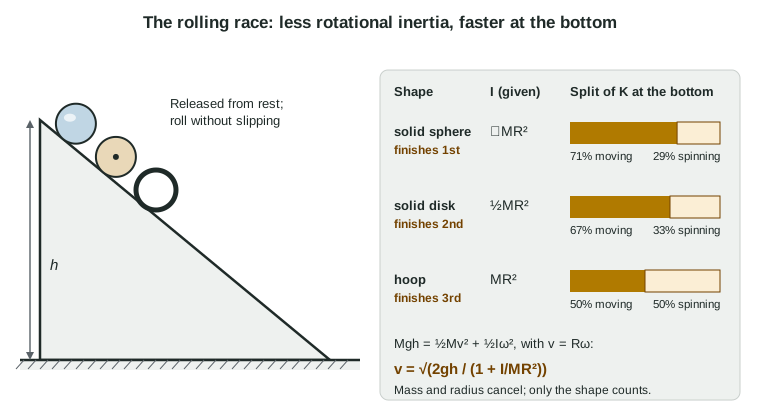
Release a solid sphere, a solid disk and a hoop, each of mass M and radius R, from rest at height h. Write each one's I as βMR² (sphere β = ⅖, disk β = ½, hoop β = 1, all given). Then, with ω = v/R,
Mgh = ½Mv² + ½(βMR²)(v/R)² = ½Mv²(1 + β), so v = √(2gh / (1 + β))
Three things follow. Mass cancels. Radius cancels. Only β, the shape, remains. The smaller β, the more of the energy goes into moving along, so the faster the object. Sphere first, disk second, hoop last. A frictionless block that slides without spinning (β = 0) beats them all, at √(2gh).
Worked example 2. A solid sphere rolls from rest down a ramp 1.5 m high. Find its speed at the bottom. Use g = 9.8 m/s².
β = ⅖: v = √(2gh/1.4) = √(10gh/7) = √(10 × 9.8 × 1.5/7) m/s = 4.6 m/s.
Check the energy split: ½Mv² is 5/7 of the total and ½Iω² is 2/7.
Rolling while slipping
Bowl a ball so it slides along the lane without spinning. Now vcm ≠ Rω, and the bottom of the ball rubs forward on the lane. Kinetic friction acts backward on the ball. That one force does two jobs: it slows the center (vcm falls), and because it acts at the bottom, a distance R from the center, its torque spins the ball up (ω rises). When vcm has fallen and Rω has risen until they are equal, the sliding stops and the ball rolls. During the skid, kinetic friction dissipates mechanical energy, so the total kinetic energy falls. The exam asks about this only in words: which way each quantity changes and why.
| Rolling without slipping | Rolling while slipping | |
|---|---|---|
| Link | vcm = Rω | no link: vcm ≠ Rω |
| Friction at the contact | static (or none on level ground) | kinetic |
| Mechanical energy | conserved (friction does no work) | decreases (dissipated as thermal energy) |
| Analysis on the exam | quantitative | qualitative only |