A cart moving at speed v has kinetic energy ½mv². A wheel spinning on a fixed axle does not go anywhere, yet stopping it takes work, and a heavy spinning wheel can drive a machine. So the spinning wheel must hold energy. This page finds how much, and the answer has a familiar shape.
Adding up the moving pieces
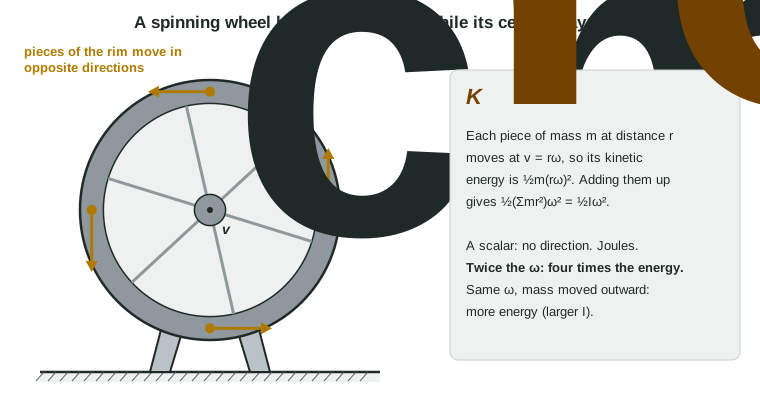
Think of the wheel as many small pieces. A piece of mass m at distance r from the axle moves in a circle at speed v = rω. Its kinetic energy is ½mv² = ½m(rω)² = ½mr²ω².
Every piece shares the same ω, so adding them up gives
K = ½(m₁r₁² + m₂r₂² + …)ω² = ½(Σmr²)ω²
The bracket is the rotational inertia I. So a turning object has rotational kinetic energy
Krot = ½Iω²
Compare it with ½mv²: rotational inertia stands in for mass and angular velocity for velocity, exactly the pairing from Unit 5.
Energy without going anywhere
The wheel's center of mass stays put, so its total momentum is zero: pieces on opposite sides move in opposite directions, and their momenta cancel. Kinetic energy does not cancel. It is a scalar, never negative, so each piece adds to the total no matter which way it moves. A spinning wheel with its center at rest still has kinetic energy.
The direction of turning does not matter either. Squaring ω removes its sign, so a wheel turning clockwise at 10 rad/s has the same K as one turning counterclockwise at 10 rad/s. The unit is the joule: kg·m² × (rad/s)² = kg·m²/s² = J.
Worked example 1. A potter's wheel is a solid disk of mass 5.0 kg and radius 0.25 m (I = ½MR², given) with a 0.40 kg lump of clay 0.10 m from the axis. It turns at 4.0 rad/s. What is its rotational kinetic energy?
Rotational inertia of the system: I = ½MR² + mr² = ½(5.0 kg)(0.25 m)² + (0.40 kg)(0.10 m)² = 0.156 + 0.0040 = 0.160 kg·m².
K = ½Iω² = ½(0.160 kg·m²)(4.0 rad/s)² = 1.3 J.
How K scales
Two factors set the energy, and they behave differently.
- ω is squared. Double the angular velocity and K becomes 4 times as large. Triple it: 9 times.
- I enters directly. At the same ω, twice the rotational inertia means twice the energy. A hoop spinning at the same rate as a disk of the same mass and radius has twice the disk's energy, because its I is MR² instead of ½MR².
That is why flywheels for storing energy put most of their mass in a heavy rim: at a given ω, mass far from the axle stores far more energy.
Worked example 2. A flywheel with I = 0.60 kg·m² has 48 J of rotational kinetic energy. How fast is it turning?
Rearrange K = ½Iω²: ω = √(2K/I) = √(2 × 48 J / 0.60 kg·m²) = √160 rad/s = 13 rad/s.
Two slips to avoid: leaving out the ½ (which gives 8.9 rad/s) and forgetting the square root (160 rad/s).
Reading data
If you measure K at several angular velocities, plotting K against ω gives a curve that bends upward. Plotting K against ω² gives a straight line through the origin, because K = (½I)ω². The slope is ½I, so the rotational inertia is twice the slope.
| Moving along a line | Turning about an axis | |
|---|---|---|
| Inertia | mass m | rotational inertia I |
| Rate of motion | v (m/s) | ω (rad/s) |
| Kinetic energy | ½mv² | ½Iω² |
Some objects do both at once: a rolling ball moves along and spins. Its kinetic energy is the sum of the two, a topic of its own later in this unit.