Rotational Kinetic Energy
An object turning about an axis has rotational kinetic energy K = ½Iω², the sum of ½mv² over all its pieces.
Part 1 · Hook
Why this matters
Part 2 · Before you start
What this builds on
Part 3 · Prerequisite check
Quick check before you start
1. A 4.0 kg cart moves at 3.0 m/s. Its kinetic energy is
- 18 J
- 6.0 J
- 36 J
- 12 J
Show the answer
K = ½mv² = ½(4.0)(3.0)² = 18 J.
- Correct: 18 J:
- 6.0 J:
- 36 J:
- 12 J:
2. A point 0.50 m from an axis turns at 4.0 rad/s. Its speed is
- 2.0 m/s
- 8.0 m/s
- 0.13 m/s
- 4.0 m/s
Show the answer
v = rω = (0.50)(4.0).
- Correct: 2.0 m/s:
- 8.0 m/s:
- 0.13 m/s:
- 4.0 m/s:
3. A hoop and a disk have the same mass and radius. Which has the larger rotational inertia about its center?
- The hoop
- The disk
- Neither
- It depends on how fast they spin
Show the answer
All of the hoop’s mass is at the rim: MR² > ½MR².
- Correct: The hoop:
- The disk:
- Neither:
- It depends on how fast they spin:
Part 4 · See it
See it first
Part 5 · Step by step
How it works, step by step
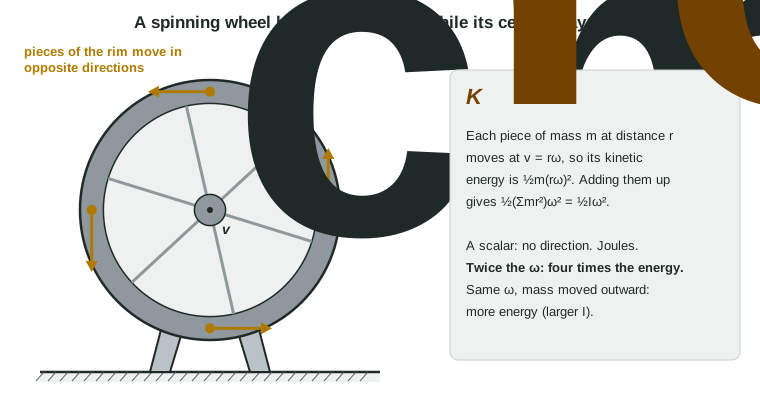
- A wheel turns at ω about a fixed axleeach piece of mass m at distance r moves at v = rω
- Each piece has kinetic energy ½mv² = ½m r²ω²adding the pieces gives ½(Σmr²)ω²
- Σmr² is the rotational inertia Ithe wheel’s kinetic energy is K = ½Iω²
- ω doublesK becomes 4 times as large
- The same mass sits farther from the axleI and so K are larger at the same ω
Part 6 · Key ideas
Key ideas
- A turning object has rotational kinetic energy K = ½Iω², even if its center of mass is at rest.
- It is the sum of ½mv² over every piece, with v = rω.
- A scalar in joules; the direction of turning does not matter, because ω is squared.
- K ∝ ω² at fixed I (doubling ω gives 4K) and K ∝ I at fixed ω.
- K against ω² is a straight line with slope ½I.
Part 7 · Misconception
A common mistake
The wrong idea: A wheel spinning in place has no kinetic energy, because it is not going anywhere.
What actually happens: Every piece of the wheel is moving, so the wheel has kinetic energy ½Iω². Its momentum adds to zero because opposite sides move opposite ways, but kinetic energy is a scalar and does not cancel.
Part 8 · Check yourself
Check yourself
Exam-style questions. Anything you miss goes into your review queue.
Diagram
A turntable with a lump of clay
1. What is the rotational inertia of the turntable and clay together about the axle?
Type a number in kg·m^2.
Show the answer
I = ½MR² + mr² = ½(3.0 kg)(0.20 m)² + (0.10 kg)(0.15 m)² = 0.0600 + 0.00225 = 0.06225 kg·m², about 0.062 kg·m² (the data have two significant figures).
- Answer: 0.062 kg·m^2
2. What is the rotational kinetic energy of the turntable and clay? Give the value and its unit.
Type a number and its unit.
Show the answer
K = ½Iω² = ½(0.06225 kg·m²)(6.0 rad/s)² = 1.12 J, about 1.1 J.
- Answer: 1.1 J
3. The turntable’s center does not move. Which statement about its kinetic energy is correct?
- It has kinetic energy, because every piece of it is moving
- It has no kinetic energy, because its center of mass is at rest
- It has no kinetic energy, because opposite sides cancel out
- Its kinetic energy is at the rim, where the speed is largest
Show the answer
Each piece of mass moves at v = rω and has ½mv². Kinetic energy is a scalar, so these add up (to ½Iω²) even though the velocities point in different directions and the center does not move.
- Correct: It has kinetic energy, because every piece of it is moving: Right: K = ½Iω² counts the motion of every piece around the axle.
- It has no kinetic energy, because its center of mass is at rest: A body can have rotational kinetic energy while its center of mass stays put.
- It has no kinetic energy, because opposite sides cancel out: Velocities cancel in the total momentum, but kinetic energy is a scalar; it never cancels.
- Its kinetic energy is at the rim, where the speed is largest: Every piece moves (v = rω) and contributes ½mv²; the rim pieces just contribute most.
4. The turntable is sped up to 12 rad/s. Its rotational kinetic energy becomes
- 4 times as large
- 2 times as large
- the same
- 8 times as large
Show the answer
K = ½Iω² with I fixed, so doubling ω multiplies K by 4 (to about 4.5 J).
- Correct: 4 times as large: Right: K ∝ ω², and (2)² = 4.
- 2 times as large: K depends on ω², not ω.
- the same: A faster spin has more kinetic energy.
- 8 times as large: There is no cube: K = ½Iω².
Data table
Energy stored in a flywheel
An engineer measures the energy stored in a flywheel (from the work needed to spin it up from rest on a frictionless bearing) at four angular velocities.
| Angular velocity (rad/s) | Energy stored (J) |
|---|---|
| 10 | 40 |
| 20 | 160 |
| 30 | 360 |
| 40 | 640 |
5. Which graph of these data gives a straight line through the origin?
- K against ω²
- K against ω
- K against 1/ω
- √K against ω²
Show the answer
K = ½Iω², so K against ω² is a straight line through the origin with slope ½I.
- Correct: K against ω²: Right: K = (½I)ω² is proportional to ω².
- K against ω: K rises faster than ω; the points curve upward.
- K against 1/ω: K increases with ω, so it falls along a curve against 1/ω.
- √K against ω²: √K is proportional to ω, not ω².
6. Use the data to find the flywheel’s rotational inertia.
Type a number in kg·m^2.
Show the answer
From any row, I = 2K/ω²: for example 2(640 J)/(40 rad/s)² = 0.80 kg·m². The slope of K against ω² is ½I = 0.40 kg·m².
- Answer: 0.80 kg·m^2
7. A wheel with rotational inertia 0.40 kg·m² has 25 J of rotational kinetic energy. How fast is it turning?
Type a number in rad/s.
Show the answer
ω = √(2K/I) = √(2 × 25 J / 0.40 kg·m²) = √125 = 11.2 rad/s, about 11 rad/s.
- Answer: 11 rad/s
Part 9 · Summary
Summary
Part 10 · Up next
What comes next
Part 11 · Connections