Torque and Work
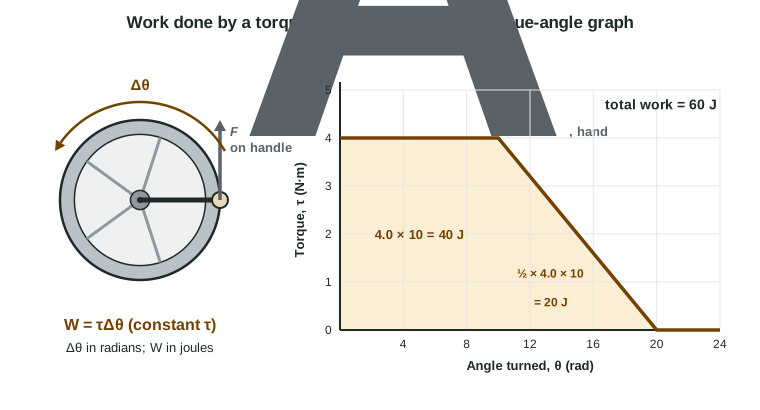
A torque that turns an object through an angle does work W = τΔθ (angle in radians), or the area under a torque-angle graph when the torque varies.
Part 1 · Hook
Why this matters
Part 2 · Before you start
What this builds on
Part 3 · Prerequisite check
Quick check before you start
1. A 20 N force pushes a box 3.0 m in the direction of the force. The work done is
- 60 J
- 6.7 J
- 23 J
- 0.15 J
Show the answer
W = Fd = (20 N)(3.0 m).
- Correct: 60 J:
- 6.7 J:
- 23 J:
- 0.15 J:
2. On a force-position graph, the area under the line is
- the work done
- the power
- the impulse
- the acceleration
Show the answer
Area = force × distance = work.
- Correct: the work done:
- the power:
- the impulse:
- the acceleration:
3. A wheel with I = 0.50 kg·m² turns at 4.0 rad/s. Its rotational kinetic energy is
- 4.0 J
- 1.0 J
- 8.0 J
- 2.0 J
Show the answer
K = ½Iω² = ½(0.50)(16) = 4.0 J.
- Correct: 4.0 J:
- 1.0 J:
- 8.0 J:
- 2.0 J:
Part 4 · See it
See it first
Part 5 · Step by step
How it works, step by step
- A force at the rim pushes the wheel through a distance s along the rimit does work Fs on the wheel
- s = rθ and the torque is rFthe work is Fs = (rF)θ = τΔθ
- The torque changes with anglethe work is the area under the torque-angle graph
- The net torque does positive work on a wheelits rotational kinetic energy increases by that amount
- A torque opposes the turningit does negative work and takes kinetic energy out
Part 6 · Key ideas
Key ideas
- W = τΔθ for a constant torque, with Δθ in radians: the partner of W = Fd.
- For a changing torque, W is the area under the τ-θ graph.
- Positive when the torque turns the object the way it is going; negative when it opposes.
- The net work done on a turning object equals its change in rotational kinetic energy.
- Convert revolutions to radians first: 1 rev = 2π rad.
Part 7 · Misconception
A common mistake
The wrong idea: Work done by a torque is τ times the number of revolutions (or degrees).
What actually happens: W = τΔθ only works with the angle in radians, because it comes from W = Fs with s = rθ. Four revolutions is 8π rad, about 25 rad.
Part 8 · Check yourself
Check yourself
Exam-style questions. Anything you miss goes into your review queue.
Diagram
Winding up a bucket
1. What torque does the rope exert on the drum while the bucket rises at constant speed?
Type a number in N·m.
Show the answer
At constant speed the rope’s tension equals the bucket’s weight, (6.00 kg)(9.8 m/s²) = 58.8 N. The rope pulls tangent to the drum, so τ = rF = (0.0800 m)(58.8 N) = 4.70 N·m.
- Answer: 4.70 N·m
2. How much work does the crank do on the drum while it turns through 25.0 rad? Give the value and its unit.
Type a number and its unit.
Show the answer
W = τΔθ = (4.704 N·m)(25.0 rad) = 117.6 J, about 118 J. (No friction and constant speed, so the crank’s torque equals the rope’s.)
- Answer: 118 J
3. How far does the bucket rise?
Type a number in m.
Show the answer
The rope winds onto the drum without slipping: s = rθ = (0.0800 m)(25.0 rad) = 2.00 m.
- Answer: 2.00 m
4. How does the work done by the torque on the drum compare with the increase in the bucket’s gravitational potential energy?
- They are equal: nothing speeds up and there is no friction
- The work is larger, because some goes into spinning the drum
- The work is smaller, because the drum’s radius is small
- The work is a rotational quantity, so it is not an energy
Show the answer
For the drum-rope-bucket system, the crank’s work all goes into gravitational potential energy: τΔθ = (r · mg)(θ) = mg(rθ) = mgΔy = 117.6 J. Nothing speeds up and there is no friction.
- Correct: They are equal: nothing speeds up and there is no friction: Right: τΔθ = (rmg)θ = mg(rθ) = mgΔy.
- The work is larger, because some goes into spinning the drum: The drum turns at a steady rate, so its kinetic energy does not change.
- The work is smaller, because the drum’s radius is small: A small radius means a small torque but a large angle; the product is the same.
- The work is a rotational quantity, so it is not an energy: Both are energies in joules; τΔθ = mgΔy here.
Graph
A motor spinning up a wheel
A motor exerts a torque on a wheel (I = 0.50 kg·m²) on a frictionless axle. The graph shows the torque against the angle the wheel has turned since it started from rest.
Data table
| Angle turned (rad) | τ |
|---|---|
| 0 | 6 |
| 8 | 6 |
| 14 | 0 |
| 16 | 0 |
5. How much work does the motor do on the wheel from 0 to 8.0 rad?
Type a number in J.
Show the answer
Constant torque: W = τΔθ = (6.0 N·m)(8.0 rad) = 48 J, the rectangle under the graph.
- Answer: 48 J
6. How much work does the motor do on the wheel from 0 to 14.0 rad?
Type a number in J.
Show the answer
Area under the graph: (6.0 N·m)(8.0 rad) + ½(6.0 N·m)(6.0 rad) = 48 + 18 = 66 J.
- Answer: 66 J
7. The wheel (I = 0.50 kg·m²) starts from rest on a frictionless axle. How fast is it turning at 14.0 rad?
Type a number in rad/s.
Show the answer
The net work equals the change in rotational kinetic energy: 66 J = ½(0.50 kg·m²)ω², so ω = √(2 × 66/0.50) = √264 = 16.2 rad/s, about 16 rad/s.
- Answer: 16 rad/s
Part 9 · Summary
Summary
Part 10 · Up next
What comes next
Part 11 · Connections