In Unit 3, a force that pushes an object through a distance does work on it, and that work changes its energy. Turning has the same story. A torque that turns an object through an angle does work on it. This page finds the formula, shows what to do when the torque changes, and connects the work to rotational kinetic energy.
From force times distance to torque times angle
Push on the rim of a wheel, always along the rim, with a force F. The wheel turns through an angle Δθ, and the point you push on moves a distance s = rΔθ along the rim. The work you do is
W = Fs = F(rΔθ) = (rF)Δθ
But rF is the torque you exert, τ. So the work done by a torque is
W = τΔθ (constant torque, Δθ in radians)
The angle must be in radians, because the step s = rΔθ only works in radians. Turn revolutions into radians first: three revolutions is 3 × 2π = 18.8 rad.
Worked example 1. An electric drill applies a constant torque of 2.5 N·m while it turns a bit through 6 revolutions. How much work does it do?
Δθ = 6 × 2π rad = 37.7 rad.
W = τΔθ = (2.5 N·m)(37.7 rad) = 94 J. A newton-meter times a radian is a joule.
The sign of the work
As with force, work by a torque can be positive or negative.
- A torque in the direction the object turns does positive work: it adds kinetic energy (a motor spinning up a wheel).
- A torque opposite to the turning does negative work: it removes kinetic energy (a brake).
- A torque on an object that does not turn does no work.
When the torque changes: the area under τ-θ
If the torque changes as the object turns, slice the turning into small angles, each with a nearly constant torque, and add up τΔθ. That sum is the area under a graph of torque against angle, just as work by a changing force is the area under F-x.
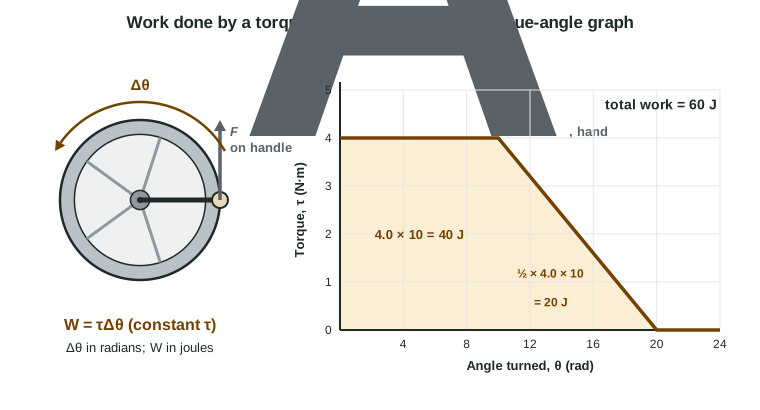
Worked example 2. A motor's torque on a wheel is 8.0 N·m for the first 5.0 rad, then falls steadily to zero at 12.0 rad. The wheel (I = 0.80 kg·m²) starts from rest on a frictionless axle. How fast is it turning at 12.0 rad?
Work = area: rectangle (8.0 N·m)(5.0 rad) = 40. J, plus triangle ½(8.0 N·m)(7.0 rad) = 28 J, total 68 J.
Principle: the net work on the wheel equals its change in rotational kinetic energy. From rest, 68 J = ½(0.80 kg·m²)ω².
ω = √(2 × 68 J / 0.80 kg·m²) = √170 rad/s = 13 rad/s.
Work and rotational kinetic energy
The work-energy idea carries over: the net work done on a rigid object by all the torques on it equals its change in rotational kinetic energy, Wnet = ΔKrot = ½Iω² − ½Iω₀².
A brake problem uses it backward. A wheel with I = 1.5 kg·m² spinning at 20. rad/s has ½(1.5)(20.)² = 300 J. A brake that stops it in 50. rad must do −300 J of work, so its torque has size 300 J ÷ 50. rad = 6.0 N·m.
Sometimes the work goes into a different kind of energy. A hand crank winds a 5.00 kg sack up to a loft on a drum of radius 0.0500 m at constant speed. The rope's tension equals the sack's weight, 49.0 N, so the torque on the drum is (0.0500 m)(49.0 N) = 2.45 N·m. Turning the drum 30.0 rad takes W = (2.45 N·m)(30.0 rad) = 73.5 J, and the sack rises rΔθ = 1.50 m, gaining mgΔy = (5.00)(9.8)(1.50) = 73.5 J of gravitational potential energy. The drum turns at a steady rate, so none of the work stays as its kinetic energy.
| Linear | Rotational |
|---|---|
| W = Fd (force along the motion) | W = τΔθ (torque along the turning) |
| area under F-x | area under τ-θ |
| Wnet = ΔK = Δ(½mv²) | Wnet = ΔKrot = Δ(½Iω²) |
Keep the angle in view: work is torque times angle, and it changes the kinetic energy. The next topic multiplies torque by time instead, and that product changes a different quantity.