In Unit 2 you found the speed of a satellite in a circular orbit by letting gravity supply the centripetal force. This topic adds the two conservation laws you now have, energy and angular momentum, and with them handles orbits that are not circles: comets that swing in fast and crawl back out, and the speed needed to leave a planet for good.
The model
A satellite of mass m orbits a body of mass M that is much larger, so the central body stays put. Gravity is the only force. We use the gravitational potential energy from Unit 3,
UG = −GMm/r
with r measured between centers and UG = 0 when the two are infinitely far apart. Closer in, UG is more negative.
Two conservation laws, two reasons
For the satellite-planet system:
- Energy. Gravity is a conservative force acting inside the system, and nothing else acts, so the total mechanical energy E = K + UG stays constant.
- Angular momentum. The planet's pull on the satellite always points at the planet's center. About that point it has zero lever arm, so zero torque. The satellite's angular momentum about the planet's center, L = rmv sin θ, stays constant.
Circular orbits
In a circular orbit r is constant, so UG is constant. Gravity is perpendicular to the velocity, so it does no work and the speed is constant too. Every quantity, E, U, K and L, stays the same all the way around. Gravity provides the centripetal force:
GMm/r² = mv²/r, so v = √(GM/r) and K = GMm/(2r)
Comparing K with UG = −GMm/r gives U = −2K, and so
E = K + U = −K = −GMm/(2r)
The total energy is negative. That is what a bound orbit means: the satellite does not have enough energy to reach infinite separation, where E would be at least zero. Higher circular orbits are slower (v ∝ 1/√r), yet their total energy is higher, closer to zero. Raising an orbit takes energy from a rocket even though the satellite ends up slower.
Worked example 1. A 500. kg satellite orbits a planet of mass 3.0 × 10²⁴ kg in a circle of radius 8.0 × 10⁶ m. Find its speed and the total energy.
v = √(GM/r) = √((6.67 × 10⁻¹¹)(3.0 × 10²⁴)/(8.0 × 10⁶)) m/s = 5.0 × 10³ m/s.
K = ½mv² = 6.25 × 10⁹ J, U = −GMm/r = −1.25 × 10¹⁰ J, so E = −6.3 × 10⁹ J, equal to −K.
Elliptical orbits
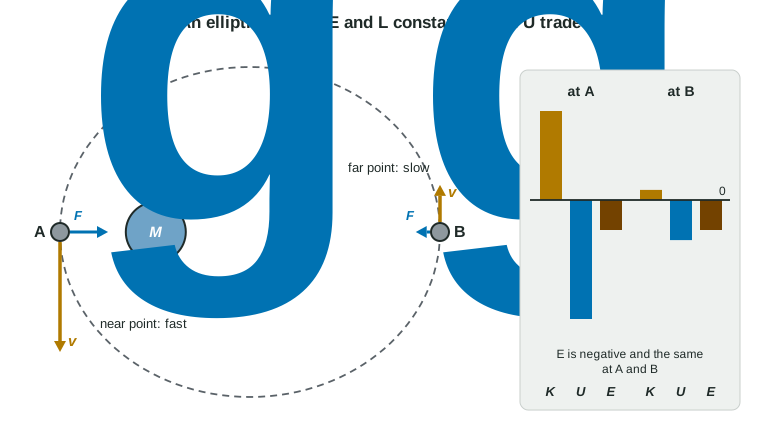
On an elliptical orbit the distance changes, so U changes, and so does K: E and L stay constant while K and U trade. Falling inward, U becomes more negative and K grows: the satellite is fastest at its closest point and slowest at its farthest.
Angular momentum gives the speeds directly. At the closest and farthest points the velocity is perpendicular to r, so sin θ = 1 and
rAvA = rBvB
Worked example 2. A satellite's closest point to Earth's center is 8.0 × 10⁶ m, where it moves at 7.5 × 10³ m/s. Its farthest point is 2.4 × 10⁷ m. How fast is it there?
No torque about Earth's center, so L is constant: vB = rAvA/rB = (8.0 × 10⁶)(7.5 × 10³)/(2.4 × 10⁷) m/s = 2.5 × 10³ m/s.
Three times as far, one third as fast. Using the circular-orbit formula here is the classic slip: it does not apply on an ellipse.
Escape speed
To leave for good, an object must be able to reach infinite separation, where U = 0, with K ≥ 0. So its total energy must be at least zero. Setting E = 0 at distance r gives the escape speed:
½mv² − GMm/r = 0, so vesc = √(2GM/r)
It is √2 times the circular orbital speed at the same distance, and it does not depend on the escaping object's mass. From the Moon's surface (M = 7.35 × 10²² kg, R = 1.74 × 10⁶ m), with no air to worry about, vesc ≈ 2.4 × 10³ m/s, about 2.4 km/s. Escape speed is not on the equations sheet; you derive it from E = 0 as here.
| Circular orbit | Elliptical orbit | |
|---|---|---|
| Total energy E | constant, = −GMm/(2r) | constant, negative |
| Angular momentum L | constant | constant |
| K and U | both constant | trade: K largest where U is most negative |
| Speed | constant, √(GM/r) | fastest at the closest point |