Linear momentum stays constant when nothing outside a system pushes on it. Angular momentum follows the same rule with torque in place of force. This page states the rule with its condition, shows the famous spinning-skater effect, and works through a collision with a pivot, where angular momentum survives even though linear momentum does not.
The rule and its condition
From the last topic, only an angular impulse changes angular momentum: τΔt = ΔL. Inside a system, parts push on each other, but by Newton's third law those pushes come in equal and opposite pairs, and their torques cancel in the total. So only torques from outside the system can change its total angular momentum. That gives the rule:
If the net external torque on a system is zero, its total angular momentum stays constant.
On the exam, always state both: which system, and why the net external torque on it is zero. "Angular momentum is conserved because of conservation of angular momentum" earns nothing.
Changing shape
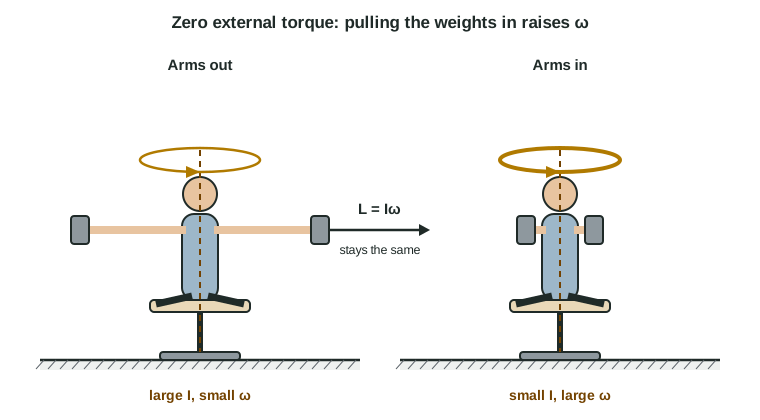
A student sits on a stool that turns on a nearly frictionless vertical axle, holding weights at arm's length, turning slowly. She pulls the weights in. Take the system to be the student, the weights and the stool. Her arms' pulls on the weights are internal. Gravity and the floor's push act along the axle and have no lever arm about it, and the axle's friction is tiny. So the net external torque is about zero, and L = Iω stays constant.
Pulling the weights in reduces I, so ω must rise:
I₁ω₁ = I₂ω₂
Worked example 1. With arms out the system has I = 4.0 kg·m² and turns at 1.5 rad/s. With arms in, I = 1.5 kg·m². Find the new angular velocity and the change in kinetic energy.
L is constant: (4.0 kg·m²)(1.5 rad/s) = (1.5 kg·m²)ω, so ω = 4.0 rad/s.
K before = ½(4.0)(1.5)² = 4.5 J. K after = ½(1.5)(4.0)² = 12 J. K increased by 7.5 J.
The kinetic energy went up because the student's muscles did work pulling the weights inward. This is the key contrast: angular momentum is conserved, kinetic energy is not. Written as K = L²/(2I), the energy grows as I shrinks at fixed L. Divers, skaters and gymnasts all use this: tuck to spin fast, open out to slow down.
Collisions around a pivot
A uniform rod (mass 0.90 kg, length 1.00 m, I about its top = ⅓ML², given) hangs at rest from a frictionless pivot. A 0.050 kg lump of clay moving horizontally at 9.0 m/s hits the bottom end and sticks. How fast does the rod swing just after?
Which quantity is conserved? The pivot pushes on the rod during the collision, so the clay-rod system feels an outside force and its linear momentum changes. But the pivot force acts at the pivot, so it has no torque about the pivot. Gravity acts at the rod's center, straight below the pivot, and has no lever arm about the pivot while the rod hangs straight down. So the net external torque about the pivot is zero, and angular momentum about the pivot is constant during the collision.
Worked example 2. Before: the clay's angular momentum about the pivot is mvd = (0.050 kg)(9.0 m/s)(1.00 m) = 0.45 kg·m²/s.
After: Itotal = ⅓(0.90 kg)(1.00 m)² + (0.050 kg)(1.00 m)² = 0.30 + 0.050 = 0.35 kg·m².
0.45 = 0.35 ω, so ω = 1.3 rad/s.
Kinetic energy: ½(0.050)(9.0)² = 2.0 J before, ½(0.35)(1.29)² = 0.29 J after. The clay sticks, so most of the energy becomes thermal energy.
The same reasoning applies to a child jumping onto a merry-go-round. For the child and merry-go-round together, their pushes on each other are internal and the axle has no torque about itself, so (child's mvr) before = (Itotal)ω after.
Choosing the system
| Situation | System | Why the net external torque is zero |
|---|---|---|
| Skater pulls in her arms | the skater | ice friction negligible; gravity and the normal force act along her axis |
| Clay sticks to a pivoted rod | clay + rod | the pivot force acts at the axis; gravity has no lever arm during the brief hit |
| Disk dropped onto a spinning disk | both disks | their friction on each other is internal; the axle is frictionless |
| Satellite on an orbit | the satellite, about the planet's center | gravity points at the center, so it has no lever arm |
Scaling questions follow from ω = L/I. If a spinning star collapses to one thirtieth of its radius with the same mass and shape, I ∝ R² drops by a factor of 900, so its spin rate rises 900-fold.