Bridges, shelves, ladders and seesaws all sit still. That stillness is information. If an object is not starting to move and not starting to turn, the forces on it must balance and the torques on it must balance. Those two facts are often enough to find every unknown force, including ones you could never measure directly.
Two separate conditions
From Unit 2: if the net force on an object is zero, its center of mass does not accelerate. That is translational equilibrium.
The rotational partner: if the net torque on an object is zero, its angular velocity does not change. This is Newton's first law in rotational form. A wheel at rest stays at rest; a wheel spinning at 5 rad/s on a frictionless axle keeps spinning at 5 rad/s. An object with zero net torque is in rotational equilibrium.
The two conditions are independent. Push up on one side of a steering wheel and pull down equally hard on the other: the net force is zero, so the wheel's center stays put, but both forces turn it the same way, so the net torque is not zero and it starts to turn. An object sitting still needs both:
ΣF = 0 and Στ = 0
A balanced seesaw
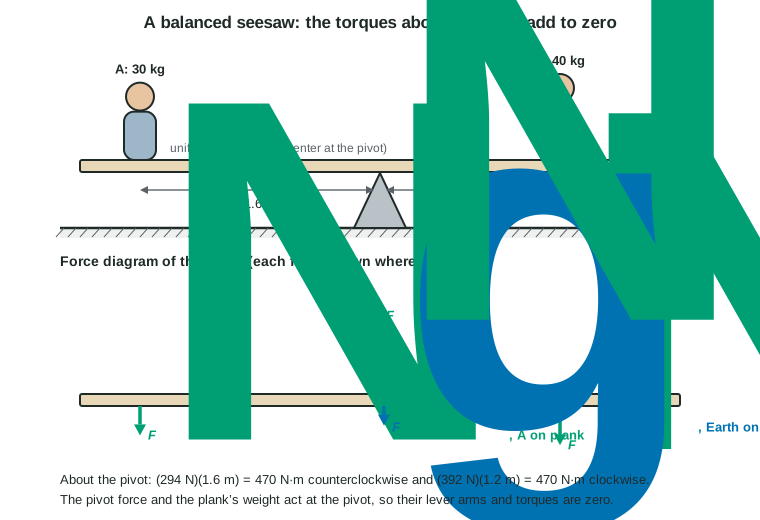
A 30 kg child sits 1.6 m left of a seesaw's pivot and a 40 kg child sits 1.2 m right of it. About the pivot, the left child's push gives (30 kg)(9.8 m/s²)(1.6 m) = 470 N·m counterclockwise; the right child's gives (40 kg)(9.8 m/s²)(1.2 m) = 470 N·m clockwise. They cancel, so the seesaw balances. The heavier child sits closer.
The pivot pushes up on the plank with a force equal to the total weight, so the net force is zero too. That force acts at the axis, so it has no torque about it.
Choosing where to take torques
In equilibrium the net torque is zero about every point, not just the real pivot. So you may choose the axis. Choose it at the point where an unknown force acts: that force then has zero lever arm and drops out of the torque equation.
Worked example 1. A uniform meterstick of mass 0.120 kg balances on a pivot at the 35 cm mark with a block hanging from the 15 cm mark. Find the block's mass.
Force diagram: pivot force up at 35 cm; the stick's weight down at its center, 50 cm; the string's pull down at 15 cm.
Torques about the pivot (the pivot force drops out): the block, 0.20 m left, turns the stick counterclockwise; the stick's weight, 0.15 m right, turns it clockwise.
m g (0.20 m) = (0.120 kg) g (0.15 m), so m = 0.090 kg. g cancels.
Leaving out the stick's own weight would give the absurd answer m = 0. Its center is not at the pivot, so its weight has a torque.
Hinges
A hinge or pivot can push on an object in whatever direction is needed. It is a contact force with no fixed direction, and it often has both a horizontal part and a vertical part. Do not assume it points straight up. Instead, let it be unknown, take torques about the hinge so it disappears, then use ΣF = 0 to find it.
Worked example 2. A uniform 3.00 m beam of mass 15.0 kg sticks out horizontally from a wall on a hinge. A cable from its far end to the wall makes 40.0° with the beam, and a 10.0 kg sign hangs from the far end. Find the cable's tension and the hinge force. Use g = 9.8 m/s².
Torques about the hinge. Only the part of the tension perpendicular to the beam, FT sin 40.0°, has a lever arm (3.00 m). The beam's weight acts at 1.50 m, the sign's pull at 3.00 m.
FT (sin 40.0°)(3.00 m) = (15.0)(9.8)(1.50) + (10.0)(9.8)(3.00) = 220.5 + 294 = 514.5 N·m, so FT = 514.5 ÷ (0.643 × 3.00) N = 267 N.
Forces. Horizontally, the cable pulls toward the wall with FT cos 40.0° = 204 N, so the hinge pushes away from the wall with 204 N. Vertically, Fhinge,y + FT sin 40.0° = 245 N (the total weight), and FT sin 40.0° = 171.5 N, so Fhinge,y = 245 − 171.5 = 73.5 N ≈ 74 N upward. The hinge pushes away from the wall and slightly upward.
A recipe
- Draw a force diagram: the object, each force from its point of application, labeled with type and agent.
- Choose an axis where an unknown force acts. Choose a positive direction of turning.
- Write Στ = 0 with signs. Solve for one unknown.
- Write ΣF = 0 in each direction for the rest.
When equilibrium is broken, the reasoning tells you which way things go. Slide the block on the meterstick toward the pivot and its torque shrinks while the stick's stays the same: the net torque is no longer zero and the stick tips. Walk toward one support of a plank and that support pushes harder while the other pushes less; their sum still equals the total weight.