Every point of a turning wheel shares one angle, one angular velocity and one angular acceleration. Yet a fly on the rim of a fan blade gets a much wilder ride than a fly near the hub. This page explains why, with three short equations that turn rotational quantities into the distances, speeds and accelerations of individual points.
Distance along the circle: s = rθ
Take a point a distance r from the axis. As the object turns through an angle θ, the point travels along a circle of radius r. How far? The definition of the radian answers it directly. θ = s/r, so
s = rθ (θ in radians)
s is the arc length, the distance along the circle. A point twice as far from the axis travels twice as far for the same turn. This only works with θ in radians. In degrees you would need an extra factor of π/180, which is why physics keeps to radians.
Speed: v = rω
Divide both sides of s = rθ by the time it takes. Distance per time is the point's speed along its circle; angle per time is the angular velocity. So
v = rω
This is the tangential speed: the point's velocity points along the circle, at right angles to the radius. Every point shares ω, but v grows in proportion to r.
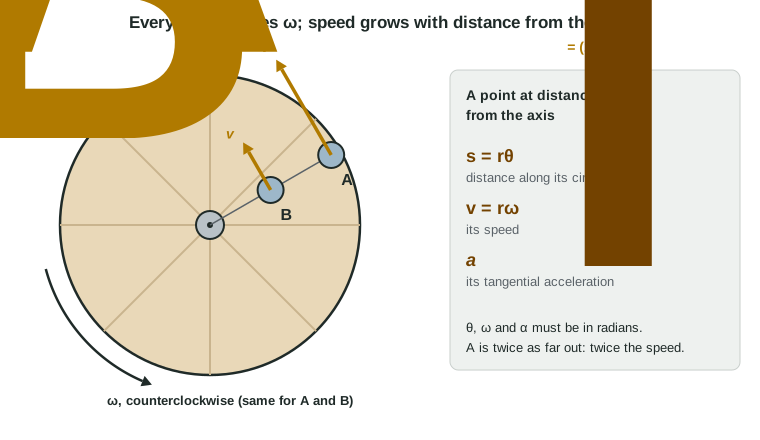
Worked example 1. A carousel horse is 4.0 m from the axis, and the carousel turns once every 12 s. How fast does the rider move?
ω = 2π rad / 12 s = 0.524 rad/s.
v = rω = (4.0 m)(0.524 rad/s) = 2.1 m/s. The rad drops out because it is a ratio of lengths: m × rad/s = m/s.
Tangential acceleration: aT = rα
Do it once more. If ω changes at a rate α, then v = rω changes at a rate
aT = rα
This tangential acceleration speeds the point up or slows it down along its circle. Do not confuse it with the centripetal acceleration from Unit 2, v²/r = rω², which points toward the center and changes the point's direction. A wheel spinning at a steady rate has α = 0 and so no tangential acceleration, but every point on it still has a centripetal acceleration.
| Quantity of the whole object | Matching quantity for a point at r |
|---|---|
| angle θ (rad) | arc length s = rθ (m) |
| angular velocity ω (rad/s) | tangential speed v = rω (m/s) |
| angular acceleration α (rad/s²) | tangential acceleration aT = rα (m/s²) |
Worked example 2. A lathe turning a wooden bowl at 40. rad/s slows steadily to rest in 10. s. A pencil mark on the bowl is 0.12 m from the axis. Find the mark's speed at the start, its tangential acceleration, and how far it travels while the lathe stops.
Speed: v = rω = (0.12 m)(40. rad/s) = 4.8 m/s.
α = Δω/Δt = (0 − 40. rad/s)/(10. s) = −4.0 rad/s², so aT = rα has size (0.12 m)(4.0 rad/s²) = 0.48 m/s².
Angle: the average ω is 20. rad/s, so Δθ = (20. rad/s)(10. s) = 200 rad. Distance: s = rθ = (0.12 m)(200 rad) = 24 m.
Strings, belts and no slipping
When a string unwinds from a spool without slipping, the string and the rim move together where they touch. So the length of string pulled off is rθ, its speed is rω, and its acceleration is rα, with r the spool's radius. The same link makes a hanging block and a pulley move together in later topics.
A belt joining two pulleys works the same way. The belt has one speed, and it equals the rim speed of each pulley: r₁ω₁ = r₂ω₂. The pulleys are not one rigid body, so their angular velocities differ. The smaller pulley turns faster.
Worked example 3. A belt joins a motor pulley of radius 0.050 m, turning at 24 rad/s, to a pulley of radius 0.20 m. How fast does the large pulley turn?
Belt speed = rim speed of the small pulley: (0.050 m)(24 rad/s) = 1.2 m/s.
Large pulley: ω = v/r = (1.2 m/s)/(0.20 m) = 6.0 rad/s. Four times the radius, one quarter the angular velocity.
Reading the factors
Because all three links are simple proportions, scaling questions are quick. At a fixed ω, a point three times as far out moves three times as fast. Doubling ω doubles every point's speed. Halving r halves s, v and aT, but leaves θ, ω and α alone, because those belong to the whole object.