Mass tells you how hard it is to change an object's motion along a line. Turning has its own version, and it holds a surprise: the same mass can be easy or hard to set spinning depending on where it sits. A tightrope walker's long pole is hard to rotate, which is exactly why it steadies her. This page defines that resistance, the rotational inertia.
Why distance matters
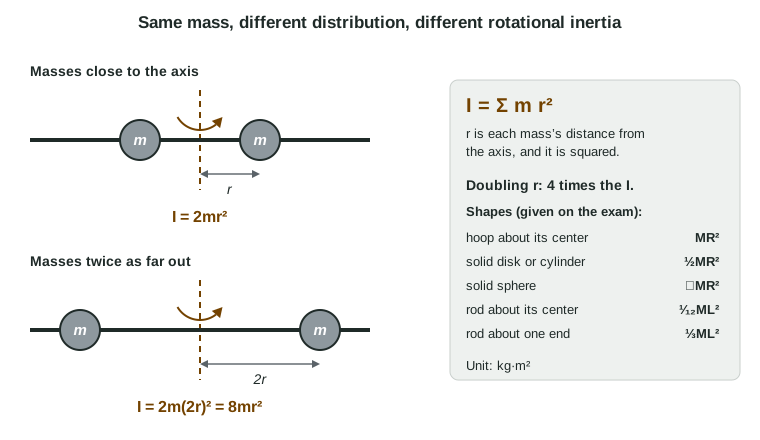
Imagine a light rod with two small masses, spun about its middle. Each mass moves on a circle. For a given angular velocity ω, a mass far from the axis moves faster (v = rω) than one close in. To spin the rod up, you have to give each mass its speed, and the far ones need more. So mass far from the axis resists a change in rotation more than mass close to it.
The careful result counts each piece of mass with the square of its distance from the axis. For a set of small masses (point objects),
I = Σ m r²
Here r is each mass's perpendicular distance from the axis, and the sum runs over all the masses. The unit is kg·m². The exam asks you to compute this for up to five objects.
Worked example 1. A light rod 0.60 m long carries a 0.30 kg ball at each end and a 0.10 kg ball at its middle. Find I about an axis through the middle, and about an axis through one end. Both axes are perpendicular to the rod.
Middle axis: the middle ball has r = 0. I = (0.30 kg)(0.30 m)² + 0 + (0.30 kg)(0.30 m)² = 0.054 kg·m².
End axis: r = 0, 0.30 m and 0.60 m. I = 0 + (0.10 kg)(0.30 m)² + (0.30 kg)(0.60 m)² = 0.009 + 0.108 = 0.12 kg·m².
Same mass, same rod, more than twice the rotational inertia, because the mass is farther from the second axis on average.
Mass and its distribution
So rotational inertia depends on two things: how much mass there is, and how that mass is spread around the axis, its mass distribution. Changing the axis changes I. Moving the same mass outward increases I, and because r is squared, doubling every distance makes I four times as large.
Shapes are given
For solid objects you would add up a huge number of tiny pieces. The results for common shapes are known, and the exam gives them to you when you need them. You never have to memorize them.
| Object (mass M) | Axis | I |
|---|---|---|
| Thin hoop or ring, radius R | through its center, perpendicular to it | MR² |
| Solid disk or cylinder, radius R | through its center, along its axis | ½MR² |
| Solid sphere, radius R | through its center | ⅖MR² |
| Thin rod, length L | through its center | ¹⁄₁₂ML² |
| Thin rod, length L | through one end | ⅓ML² |
Notice the pattern rather than the numbers. A hoop has all its mass at the rim, so its I is the full MR². A disk of the same mass and radius has much of its mass close to the center, so its I is only half as big. A sphere has even more mass near the center. The number in front tells you how far out the mass is, on average.
Shifting the axis: the parallel-axis theorem
If you know Icm, the rotational inertia about an axis through the center of mass, you can find it about any parallel axis a distance d away:
I = Icm + Md²
M is the total mass. Because Md² is never negative, an object's rotational inertia is smallest about an axis through its center of mass.
Worked example 2. A solid disk of mass 4.0 kg and radius 0.20 m (Icm = ½MR², given) turns about an axis through a point on its rim, parallel to its central axis. Find I.
Icm = ½(4.0 kg)(0.20 m)² = 0.080 kg·m². The axes are d = 0.20 m apart.
I = Icm + Md² = 0.080 + (4.0 kg)(0.20 m)² = 0.080 + 0.16 = 0.24 kg·m², three times Icm.
You can check the theorem on the rod above: the middle axis passes through its center of mass, the total mass is 0.70 kg and the end axis is 0.30 m away, so 0.054 + (0.70 kg)(0.30 m)² = 0.117 kg·m², the same as the direct sum.
Finding I from data
Lab questions often move masses and measure I. If two sliders of mass m each sit a distance r from the axis on a platform, I = Iplatform + 2mr². A graph of I against r is a curve, but a graph of I against r² is a straight line: its slope is 2m and its intercept is the platform's own inertia. Choosing what to plot so the graph is a line is a skill the exam rewards.